Editorial — Published 2026-07-18 — By Wangzian, Pet Lifestyle Curator
How Often Should You Clean a Cat Water Fountain? A Maintenance Schedule That Actually Works
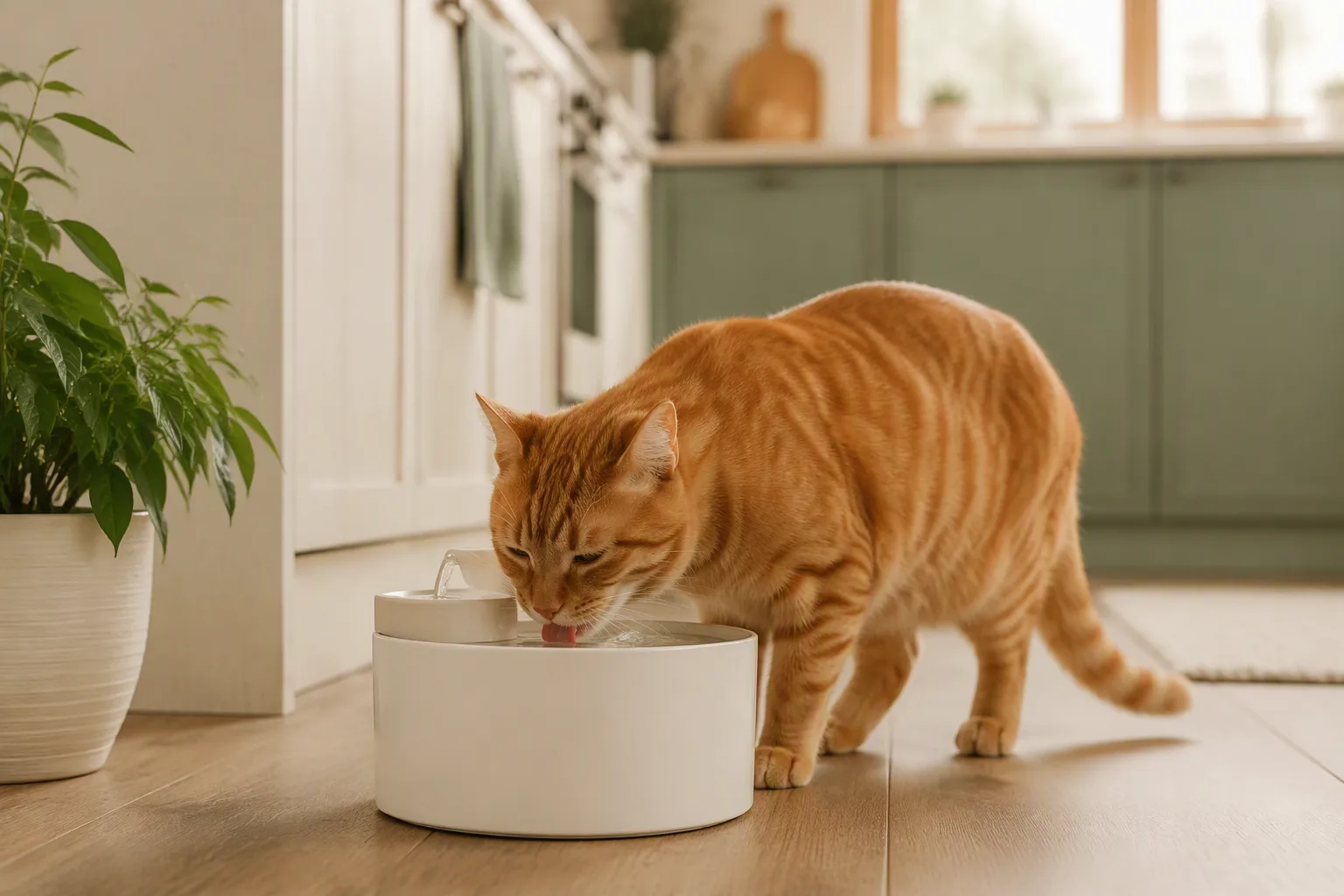
The first time I skipped fountain cleaning for three weeks, I found out exactly what biofilm feels like. Running a finger along the inside of the pump housing of our office's 3.2L cat water fountain, I hit a slippery, almost soapy layer — invisible in the water, but coating every submerged surface. Our tabby Zaza had been drinking over that film the whole time. Since then I've maintained six fountains across our office and test room on a fixed schedule, and the difference in water clarity, smell, and how willingly the cats drink is not subtle.
The short answer
If you want the one-line version: wipe and refill every 2–3 days, do a full teardown clean weekly, and replace the filter every 2–4 weeks. Below is why each interval exists, because once you understand what actually grows in a fountain, you stop treating cleaning as optional.
What's actually growing in there
A cat water fountain is a warm-room water feature with organic input. Every time your cat drinks, saliva backwashes trace protein into the water. Add dust, food particles carried on whiskers, and ambient bacteria, and you have a growth medium circulating 24 hours a day.
Three things build up on different clocks:
- Biofilm (the slime) — bacterial colonies that anchor to plastic and pump surfaces within 48–72 hours. You can't see it in the water; you can only feel it. This is the "soapy" layer I found. According to the Cornell Feline Health Center, standing water contaminated with organic matter is a common route for feline gastrointestinal upset.
- Mineral scale — if you run tap water, calcium deposits start showing as white crust on the pump impeller within about two weeks. Scale doesn't just look bad: it slows the impeller, makes the motor louder, and shortens pump life.
- Filter saturation — the activated carbon in most filters exhausts its adsorption capacity in roughly 2–4 weeks depending on water hardness and how much debris it catches. After that, the filter isn't cleaning anything; it's just a wet sponge in the flow path.
The schedule I actually run
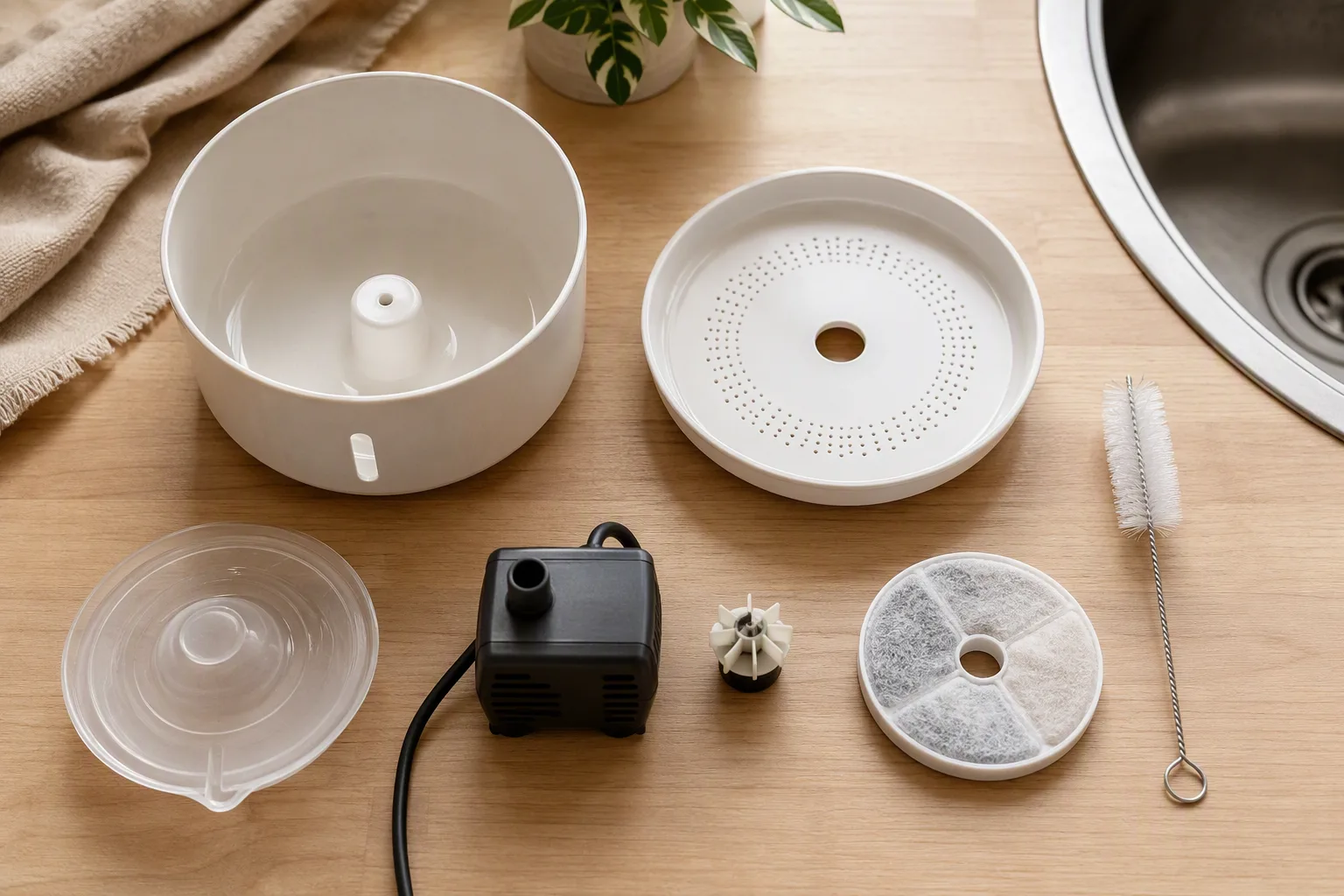
Here's the exact routine across our six units. Total weekly time cost per fountain: about 12 minutes.
| Task | Frequency | Time |
|---|---|---|
| Top up water to max line | Daily | 30 sec |
| Rinse bowl, wipe rim, full water change | Every 2–3 days | 3 min |
| Full teardown wash with dish soap | Weekly | 8 min |
| Pump impeller pulled and descaled | Every 2 weeks | 4 min |
| Filter replaced | Every 2–4 weeks | 1 min |
| Deep descale with 1:1 white vinegar soak | Monthly | 15 min (mostly soaking) |
Two notes from experience:
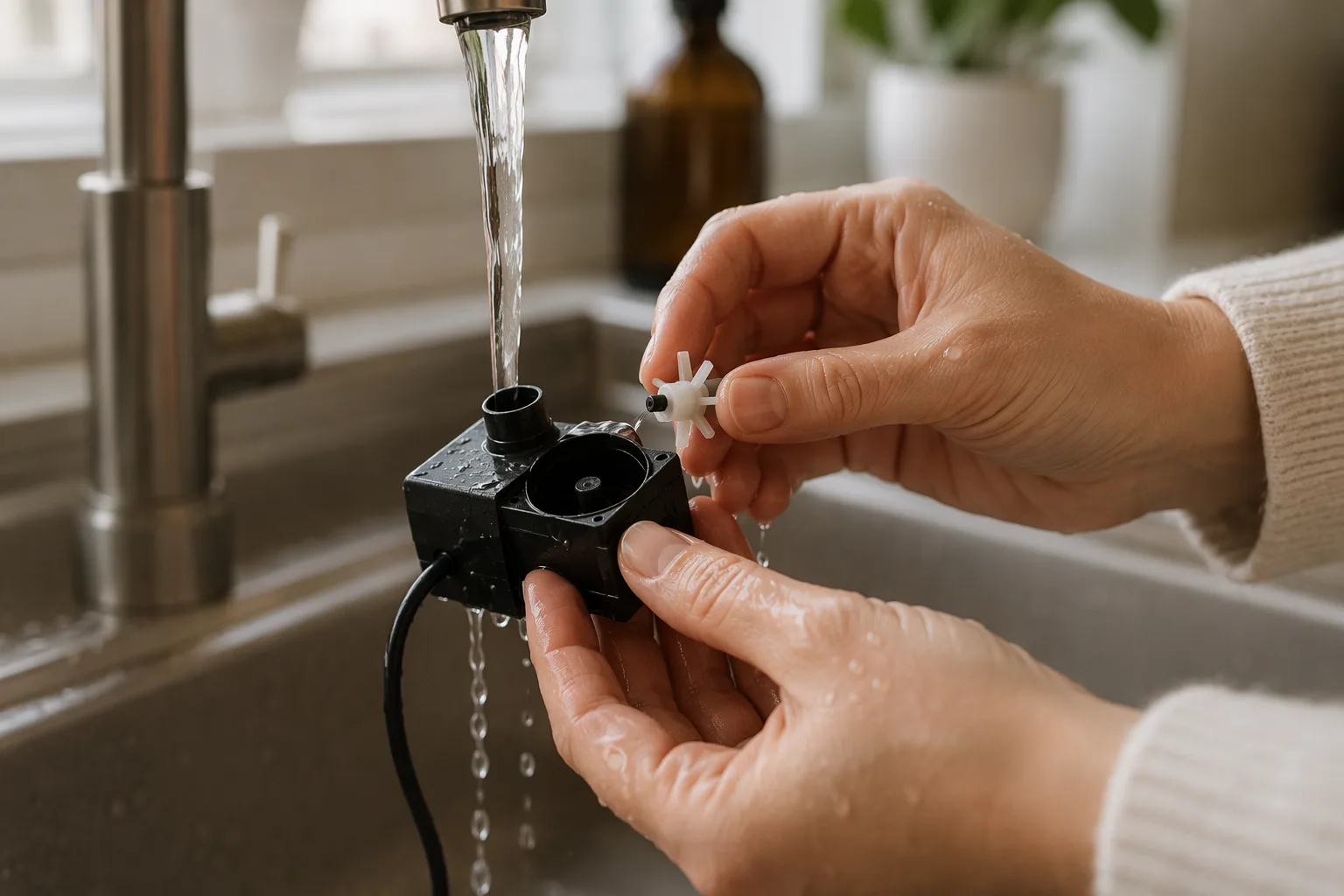
- The impeller is the part everyone forgets. It's a thumbnail-sized rotor hidden behind a small cover on the pump. Ours collect a ring of scale and hair exactly where the shaft spins. Pop the cover, pull the impeller, rub it clean between your fingers under running water. A fountain that has gotten noticeably louder is almost always telling you the impeller is dirty — of the six units I maintain, every "loud pump" complaint so far has been fixed by this one step.
- Soap residue drives cats away faster than dirt. Cats can smell detergent traces we can't. After the weekly soap wash, I rinse each part under running water for a slow count of ten. When we once cut that short, two of our test-room cats refused the fountain for a full day.
Multi-cat households: compress the schedule
Every interval above assumes one cat per fountain. With two or three cats sharing one unit, organic load scales roughly with the number of drinkers. For our twin-cat room, we run the 2–3 day wipe daily and replace filters every two weeks without waiting for visible debris. If you have more than three cats on one fountain, a second unit is cheaper than the vet visit you're gambling on.
Signs you've waited too long
- Water smells faintly sweet or musty when you lean in
- The flow has gone from a steady stream to a dribble (clogged filter or scaled impeller)
- Pump hum has become a rattle
- A slippery feel on any submerged plastic
- Your cat sniffs the fountain and walks away — the most reliable sensor in the house
Any one of these means: teardown clean today, new filter, vinegar soak if you see white crust.
Tap water, filtered water, or distilled?
We run filtered tap water in all six units. Straight tap water is fine for most municipal supplies, but hard water doubles your descaling work — that's a scale problem, not a safety problem. Fully distilled water keeps the fountain cleanest, but there is ongoing debate about long-term mineral-free drinking for cats, so we don't recommend it as the only water source. Filtered tap is the practical middle: fewer minerals than tap, none of the concerns of distilled.
The bottom line
A cat water fountain is not an appliance you install and forget; it's closer to a small aquarium. The good news is the maintenance math is light — about 12 minutes a week per fountain — and the payoff shows up where it matters: cats that drink more water have measurably lower urinary crystal risk, which is the main reason most of us bought a fountain in the first place. Set a weekly phone reminder, keep two spare filters in the drawer, and learn to pull the impeller. That's 90% of fountain ownership done right.
Sources referenced: Cornell Feline Health Center, Hydration — guidance on feline hydration and water contamination; manufacturer maintenance instructions from the units tested.