Editorial — Published 2026-08-13 — By Wangzian, Pet Lifestyle Curator
How Long Can a Cat Stay in a Carrier? The Numbers Everyone Quotes Have No Source
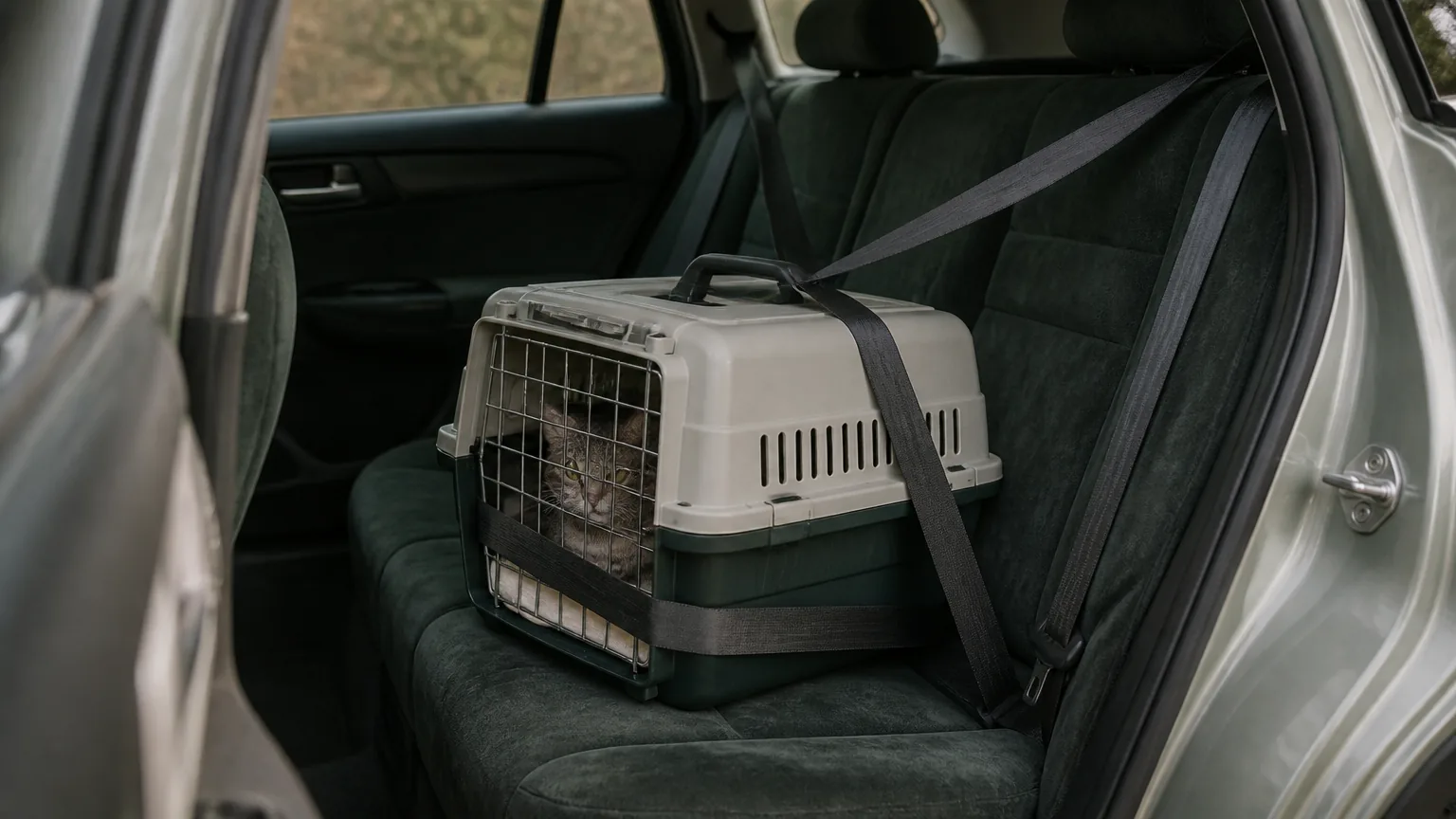
There is no researched maximum for how long a healthy adult cat can stay in a carrier. The written standards that do exist — from shelter veterinary transport guidelines — set check-in intervals of every 4 hours and a 12-hour ceiling on a day's transport, not a stopwatch limit on the carrier itself. What matters is what you do at those intervals, not the hour count.
Four different answers, zero citations
I searched the question and recorded what the first page actually says.
| Source type | Answer given | Source cited |
|---|---|---|
| Pet retail blog | 4–6 hours, breaks every 2–3 for seniors | none |
| Veterinary hospital page | under 6 hours is "just fine" | none |
| Carrier manufacturer blog | up to 6, "8 at the absolute maximum" | none |
| Q&A expert answer | no more than 3 hours | none |
| Large veterinary charity | "more than a couple of hours" → offer food and water | none |
Five sources, four incompatible numbers, spanning 3 to 8 hours. Not one explains where the figure came from. A cat does not become unsafe at hour four and fine again at hour six because a blog said so.
The honest position: nobody has run the trial. No study has confined healthy pet cats for escalating durations and measured where harm begins. That research does not exist, and any page giving you a precise hour is filling the gap with a guess.
What is actually written down
The closest thing to a real standard comes from a document not written for pet owners at all: the Association of Shelter Veterinarians' Guidelines for Standards of Care in Animal Shelters. Shelters move cats between facilities constantly, so the profession had to commit to intervals in writing.
From the transport section:
- Observation at least every 4 hours. The guidelines cite the USDA Animal Welfare Act requirement that a driver or attendant observe dogs and cats "as often as circumstances allow, but not less than once every 4 hours."
- Water at least every 4 hours if it is not continuously available — provided at "frequent (at least every 4 hours) observation stops."
- Rest every 4–6 hours. All dogs and cats "must be observed and allowed to rest every 4–6 hours."
- Food at least every 24 hours for adults, more often for animals under six months.
- A 12-hour ceiling. Maximum transport time to an intermediate or final destination "should be no more than 12 hours."
- Temperature between 15.5°C and 26.6°C (60–80°F), with a thermometer placed at the animals' level — not at the driver's.
Read that list again and notice what it is not. It is not a maximum time in the box. It is a schedule of interventions. The 12-hour figure is a ceiling on a travel day, and everything below it describes what has to happen along the way.
One detail I will not smooth over: the guidelines specify that adult dogs must be allowed to exercise and eliminate every 4–6 hours. Cats are covered by the observation and rest clauses, not that one. The document does not tell you to take your cat out of the carrier at a rest stop — and on a roadside, opening a carrier is how cats are lost.
Why the carrier is rarely the real problem
The carrier gets blamed for stress that mostly belongs to the journey. That distinction has been measured.
A 2018 blinded randomised trial at the University of Veterinary Medicine Vienna put 22 cats through mock veterinary visits, training half of them with 28 carrier sessions over six weeks. Training produced a significantly larger drop in stress score during the car ride — and no difference at all in the waiting room or exam room.
The relevant finding for trip length: across every cat in that study, trained or not, the average Cat Stress Score sat at 4.29 on a scale where 5.31 reads as "fearful, stiff." These were cats in a familiar carrier on a short trip, and they were still tense. Duration was never the variable that made them calm. I covered that study in full in what carrier training actually fixes, including the two sampling limits worth knowing before you copy its protocol.
So "how many hours" is the wrong question. The better one is whether the cat can rest, stay in a survivable temperature, and reach water.
What to do on a long drive
Practical reading of the standards, adapted for one cat in a private car:
Every 4 hours, stop and look. Not a glance in the mirror. Park, open the door, and check breathing rate, posture, and whether the bedding is soiled. Panting in a cat is not the mild sign it is in a dog.
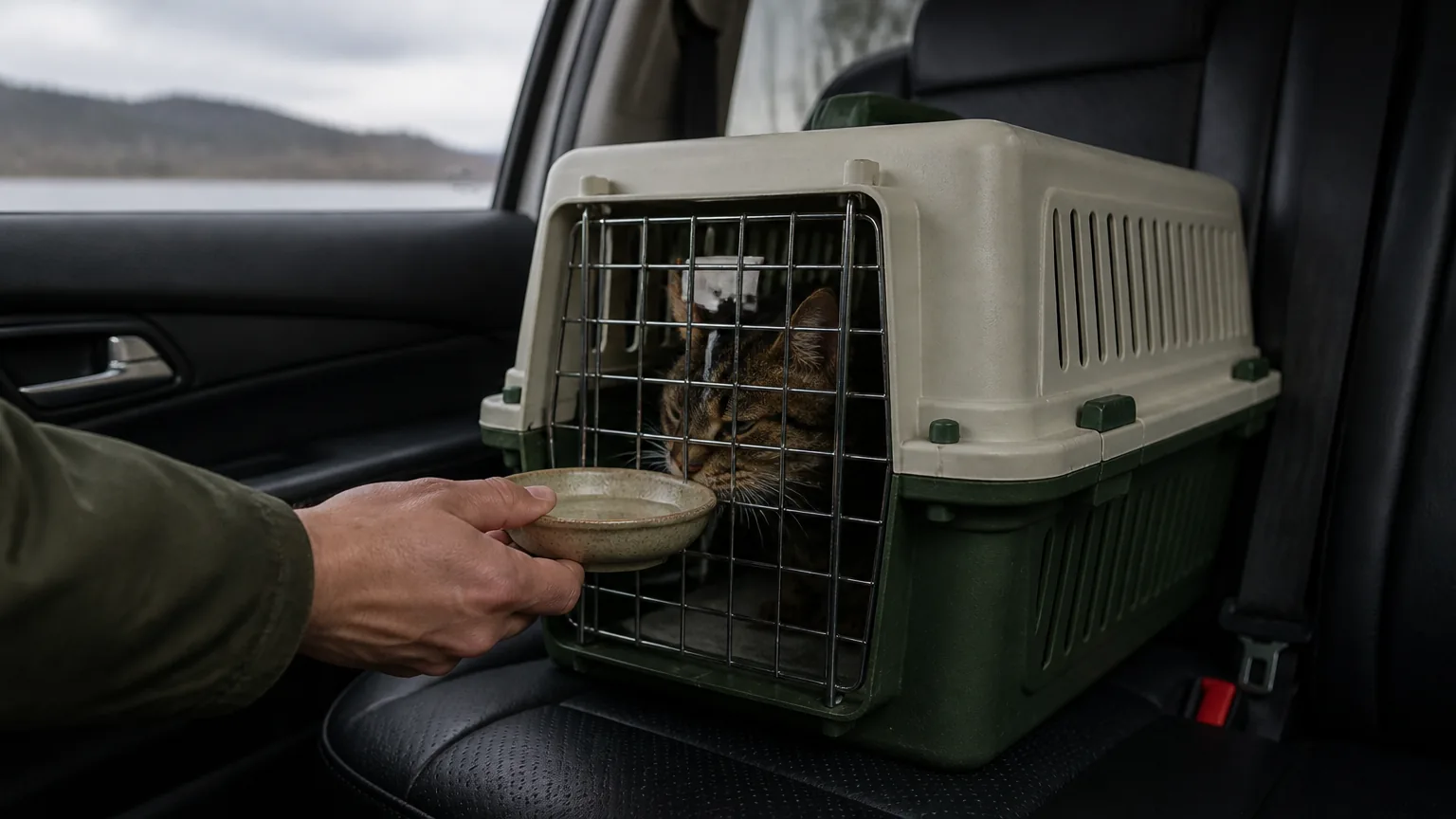
Offer water at each stop, in the carrier. A shallow dish held to the closed grille door, or a syringe if your cat accepts one. Most cats refuse to drink in a moving vehicle and many refuse at stops too — offering it and having it declined is a normal result, and it still tells you something about how the cat is doing.
Do not open the carrier outdoors. No harness is escape-proof on a frightened cat at a service station. If the trip runs long enough to need a litter break, that belongs in a closed room — a motel bathroom, not a verge.
Line it for the accident you are planning around. An absorbent pad under a familiar-smelling blanket. The shelter guidelines require enclosures be cleaned and litter replaced as often as needed to prevent soiling of the animal; a cat sitting in urine for hours is a welfare problem regardless of the clock.
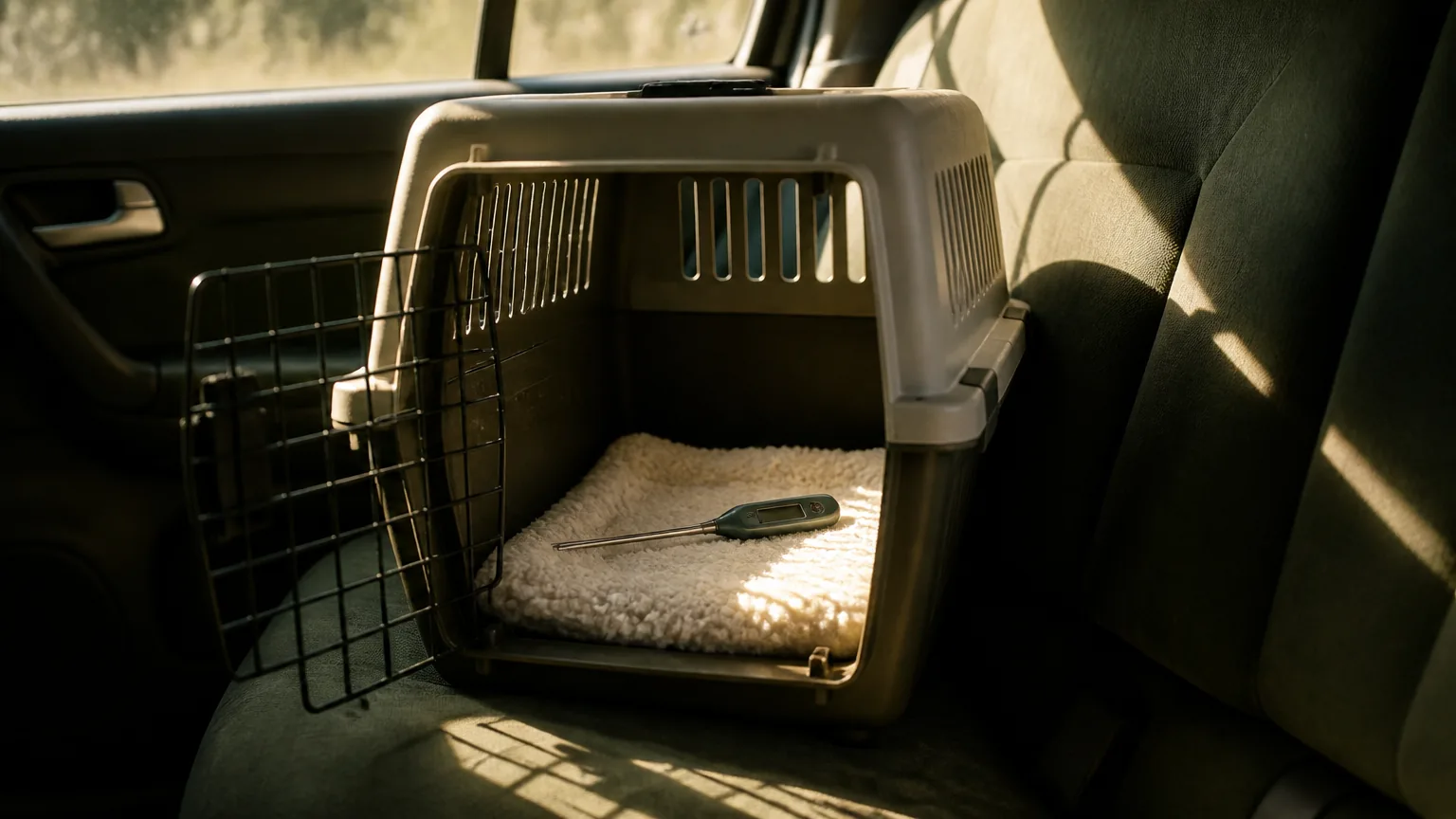
Watch the temperature at cat level, not yours. The guidelines put the thermometer where the animal is for a reason: a carrier in direct sun through a rear window is a different environment from the driver's seat. A vehicle parked in full sun "can rapidly exceed safe temperature levels" even when the outside air feels comfortable.
Size it so the cat can stand, turn, and lie down. That is the transport standard's minimum. A carrier the cat cannot turn around in fails it regardless of trip length. Our ventilated travel carrier is built to that geometry, with mesh on multiple faces so airflow does not depend on which way the box is facing — though for air travel you should always check your airline's own dimensions, because we make no boarding claims for it.
When the hour count genuinely matters
Some cats do not get the benefit of the doubt on duration:
- Kittens under six months — the guidelines require food more frequently than every 24 hours for them, and they dehydrate faster.
- Cats with kidney disease or diabetes, where water intake is medically managed.
- Brachycephalic cats (Persians, Exotics), whose airways make heat a sharper risk.
- Sedated cats — the shelter guidelines are direct here: animals should not be sedated for transport unless a veterinarian recommends it, because sedation increases vulnerability to hypothermia, dehydration and injury. Ask before you medicate for a long drive.
For these, the interval to plan around is your vet's advice, not a number from a blog.
So how long can a cat stay in a carrier?
A healthy adult cat can be in a carrier for a normal travel day, provided you check every 4 hours, offer water, keep the temperature in range, and stay under about 12 hours of transport in a day. There is no evidence a cat is fine at 5 hours 59 minutes and harmed at 6 hours 1 minute, and anyone printing that boundary is inventing it.
If your cat's problem is the carrier rather than the trip, the fix is not shorter journeys — it is changing what the carrier predicts. And if the trip is a vet visit that ends in a cone, the sizing guide for recovery collars covers the part most people get wrong on the way home.
Unsourced numbers are not unique to this question. Taking your cat to the vet works through the whole subject the same way — what carrier training, pheromone spray, medication and carrier design have each been measured to do, and which widely repeated figures turn out to have nothing behind them.
---
Sources
- The Association of Shelter Veterinarians (2010). Guidelines for Standards of Care in Animal Shelters, Animal Transport section, pp. 45–47. All transport intervals quoted above — 4-hour observation and water stops, 4–6 hour rest, 24-hour food, 12-hour daily ceiling, 15.5–26.6°C range, sedation caution — are taken from this document. It cites USDA/APHIS Section 3.90 (Care in transit) for the 4-hour observation requirement and National Federation of Humane Societies 2010 for the 12-hour ceiling. A second edition was published in December 2022 (DOI 10.56771/ASVguidelines.2022); its full text was not retrievable at the time of writing, so every figure here is attributed to the 2010 edition that was read directly.
- Pratsch L, Mohr N, Palme R, Rost J, Troxler J, Arhant C (2018). Carrier training cats reduces stress on transport to a veterinary practice. Applied Animal Behaviour Science 206:64–74. Blinded randomised controlled trial, 22 cats. Used here only for the finding that stress reduction was confined to the car journey and for the overall Cat Stress Score; the full protocol and its limits are covered in the linked article.
On the table of unsourced answers: those five figures were recorded from the first page of search results for this question on 13 August 2026. We have named the source types rather than linked them, because the point is the absence of citation, not the individual sites.
What we do not claim: we sell a travel carrier, and we have no data of our own on safe confinement duration. Nothing here is a veterinary opinion on your individual cat, and nothing here should be read as an airline compliance claim.
Related reading
- Cat Hides When the Carrier Comes Out? Here Is What Training Actually Fixes
- What Size Cone Does Your Dog Need? Measure These Two Things First
- XueQiu Pets ventilated travel carrier