Editorial — Published 2026-08-17 — By Wangzian, Pet Lifestyle Curator
Taking Your Cat to the Vet: What the Evidence Supports, and Where It Runs Out
Four things have been tested properly: carrier training, pheromone spray, pre-appointment medication, and the design of the carrier itself. Each works in a narrower band than its marketing suggests, and the single largest problem is not any of them — it is that three-quarters of owners were never told anything at all.
This is the summary page for everything we have written about getting a cat to the vet. Each section gives the finding, the size of it, and the point at which the evidence stops. Where we have covered something in depth, there is a link rather than a repetition.
The problem is bigger than one bad afternoon
In a 2022 survey of 277 cat owners published in the Journal of Feline Medicine and Surgery, 31.3% said watching their cat's distress had put them off going to the vet at all. Not "made it unpleasant" — put them off. The free-text answers describe boosters stretched to 13-month intervals, dental work postponed, and small complaints left to resolve themselves.
That reframes the entire subject. The goal is not a calmer cat for its own sake. It is a cat that gets examined.
And the most striking number in that survey is not about cats at all: 75.5% of owners had never been given any advice by their clinic on how to transport their cat. One in five had. Everything below exists to fill a gap that a thirty-second conversation at the end of an appointment would mostly close.
What carrier training does, and what it does not
A controlled trial at the University of Veterinary Medicine Vienna trained 11 of 22 cats over six weeks and compared them against an untrained group on a real trip to a clinic.
The trained cats were measurably better during the car journey. Their stress scores fell further, they settled faster, they spent longer sitting rather than pacing.
Inside the consulting room, the two groups were indistinguishable. Training did not make cats more willing to walk out of the carrier on their own either.
That is a narrower result than "train your cat and vet visits stop being a problem," which is roughly what the internet promises. It is still worth doing — the car journey is a real and long part of the ordeal — but it should be bought for what it delivers.
We covered this trial, its protocol, and its two significant limitations in cat hides when the carrier comes out.
How long before the appointment should you start?
Nobody knows, and that is not a figure of speech. Carrier training has been tested against no training. No published study has compared one training duration against another. Every specific number in circulation — three to five days, one to two weeks, several months — is an estimate presented as a finding.
There is a better way to think about it, which comes out of the survey data. Putting a cat into the carrier at home rated a median stress of 6 out of 10. Putting the same cat back into the same carrier at the clinic, later the same afternoon, rated 2.
If the box were inherently frightening, both numbers would be high. The cat has not learned that carriers are bad. It has learned that this carrier means the car. Which means the thing you are working against is a prediction, and predictions are broken by frequency rather than by the length of any individual session.
A carrier that lives in the living room permanently has no "before" to count backwards from. The full argument, including the six contradictory answers on the first page of Google, is in how long before a vet visit to start carrier training.
Pheromone spray: real effect, narrow band
This is the newest evidence we have looked at, and the most commonly misread.
A 2022 randomised, blinded, placebo-controlled trial of 150 cats tested a synthetic F3 facial pheromone spray against a placebo of plain 75% medical alcohol. Owners sprayed the carrier, waited 15 minutes, then travelled, and scored their cat 30 minutes into the journey.
Three behaviours were significantly lower in the treated group than the placebo group at the end:
| Behaviour | Treated | Placebo | P (between groups) |
|---|---|---|---|
| Curling | 41.3% → 13.3% | 38.7% → 28.0% | 0.0265 |
| Motionless | 37.3% → 10.7% | 28.0% → 33.3% | 0.0008 |
| Meowing | 62.7% → 36.0% | 64.0% → 54.7% | 0.0217 |
Hiding, trembling, flattened ears, dilated pupils and shortness of breath showed no significant difference between the groups.
Now the part that gets left out. In the regression, the main effect of the product was not statistically significant (P = 0.755). What was significant was the interaction with baseline stress (P = 0.004): the spray only separated from placebo once a cat's baseline score exceeded 2.94 cm on a 10 cm scale.
In plain terms: it helped cats that were already substantially stressed. For a mildly anxious cat, this trial does not show it beats spraying alcohol in the box.
One methodological detail from that study is worth borrowing whatever you are evaluating. Hiding dropped sharply in both arms — from 46.7% to 13.3% with the product, and from 30.7% to 8.0% with placebo, both highly significant within their own group. Had the study only measured before-and-after in treated cats, it would have reported a large effect on hiding. The control arm is what reveals there was none.
Funding, stated plainly: the trial was supported by Fiber Biotech (Shanghai), the company that makes the tested product, and the authors declared no conflicts of interest. Both of those things are true at once, and both are printed in the paper. The result is also entirely owner-assessed — the authors themselves call for future work with cortisol, temperature and respiration measurements.
Medication: the one intervention with a number attached
For cats with a genuine history of difficult visits, a randomised, blinded, crossover trial gave 20 such cats a single 100 mg dose of gabapentin 90 minutes before going into the carrier, against a placebo. Owner-rated stress during transport and examination, and vet-rated compliance, all improved significantly. Sedation was common; ataxia, hypersalivation and vomiting were also reported, all resolving within eight hours.
Note the asymmetry. The intervention everyone recommends — training — has no evidence-based timing. The one that does is the drug, at 90 minutes. That is prescription-only and requires an examination; it is a conversation with your vet, not a shopping list.
The carrier itself is the underrated variable
Of the four things on this page, this is the only one that takes effect immediately and asks nothing of the cat.
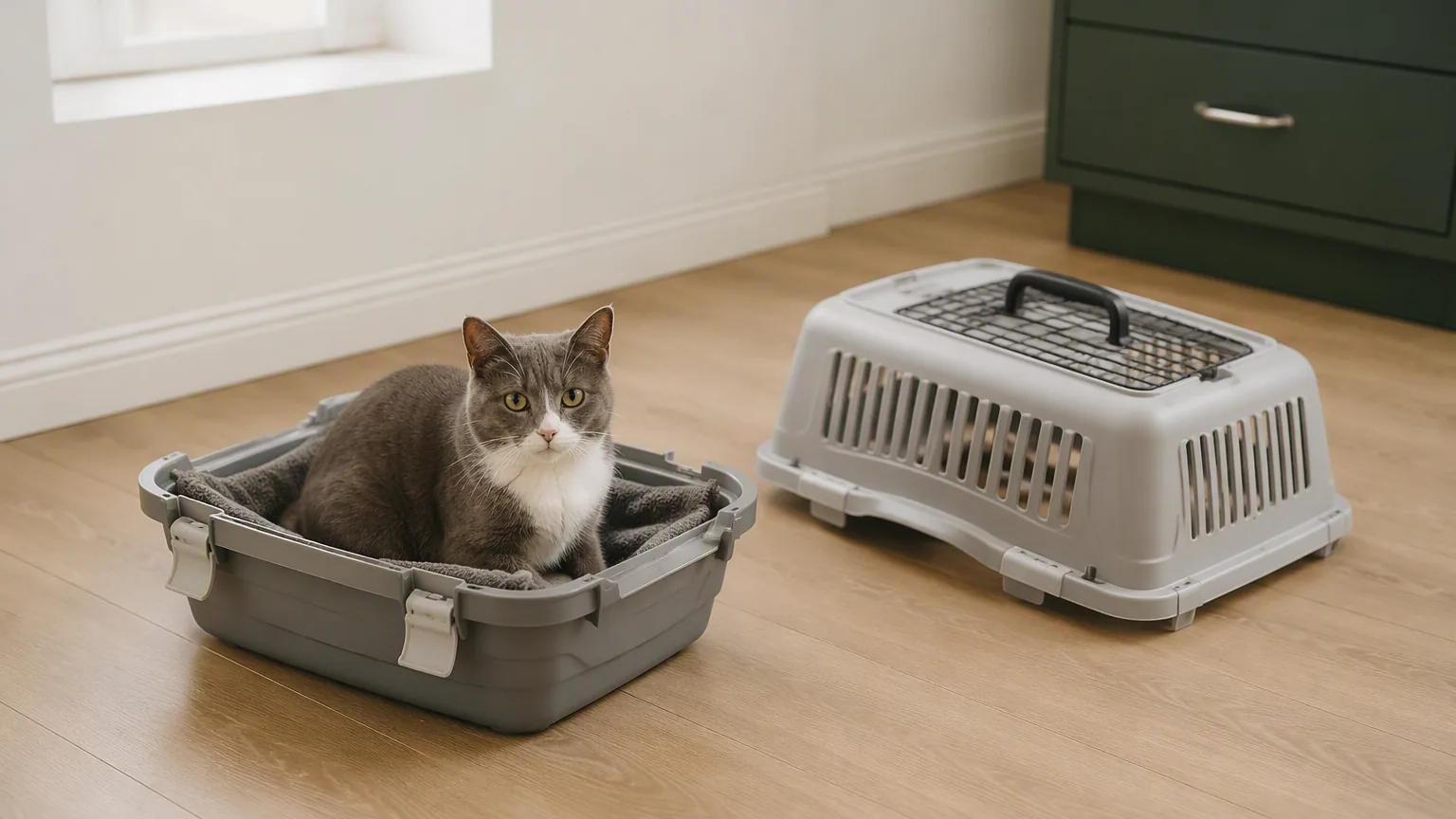
In the 2022 survey, coming out of the carrier at the clinic rated a median stress of 5 — worse than the journey home. But 10.6% of owners had their cat examined in the base of the carrier with the top removed, and only 3.0% saw their cat dragged out. A carrier whose shell unclips converts the second-worst-rated moment of the visit into a non-event.
No training period. No prescription. It is a purchasing decision.
How long can a cat stay in one?
A separate question with a similarly empty first page of results — the four numbers on offer are 3, 4-6, 6 and 8 hours, none of them sourced. The only written standard we could find is a shelter-transport guideline specifying observation at least every four hours and a 12-hour daily ceiling, which is an intervention interval, not a duration limit.
That distinction, and what the guideline does and does not cover for cats as opposed to dogs, is in how long can a cat stay in a carrier.
If you are doing this next week
Ordered by strength of evidence, not by how much effort each takes:
- Use a carrier that comes apart. Immediate, evidence-linked, no cooperation required from the cat.
- Leave the carrier out permanently. Attacks the prediction rather than the object. Costs nothing.
- Feed ordinary meals in or beside it. Removes the signal instead of drilling a behaviour.
- If your cat is genuinely fractious, ask about pre-appointment medication. The only intervention with a published timing.
- Pheromone spray if your cat is already very stressed. The evidence supports it in that band and does not support it below.
- Ask your clinic what they recommend. Three-quarters of owners never have. It is free.
What we sell, and what we do not
We make a ventilated travel carrier. Its listing states a 3-5kg suitable weight and cites no airline or IATA compliance testing, so we make no claim about cabin travel. Nothing on this page is a reason to buy it — and the feature with the best evidence behind it, a shell that unclips, is made by several manufacturers.
For another case where the popular explanation of a cat's behaviour did not survive the data, see why cats scratch furniture.
---
Sources
- Caney SMA, Robinson NJ, Gunn-Moore DA, Dean RS (2022). Happy cats: stress in cats and their carers associated with outpatient visits to the clinic. J Feline Med Surg 24(12):e551-e557. Open access, full text read. Stress medians, the 75.5% advice figure and the 31.3% avoidance figure are from Tables 1-3 and Results, n=277. Funded by MSD Animal Health; authors state independence.
- Shu H, Gu X (2022). Effect of a synthetic feline facial pheromone product on stress during transport in domestic cats: a randomised controlled pilot study. J Feline Med Surg 24(8):691-699. Open access, full text read. All percentages and P values above are from Tables 3-5. Funded by Fiber Biotech (Shanghai), the manufacturer of the tested product (grant 2020-ZX-06); the authors declared no conflicts of interest. Pilot study, owner-assessed outcomes only.
- van Haaften KA, Eichstadt Forsythe LR, Stelow EA, et al. (2017). Effects of a single preappointment dose of gabapentin on signs of stress in cats during transportation and veterinary examination. J Am Vet Med Assoc 251(10):1175-1181. Abstract read; full text not obtained — no effect sizes are quoted because the abstract does not report them.
- The carrier training trial (Pratsch et al., 2018) and the shelter transport guideline (Association of Shelter Veterinarians, 2010) are each covered in full in the linked articles and are not restated here.
What we do not claim: we hold no data of our own on any of this. None of it is veterinary advice, and medication in particular requires a prescription and an examination. A cat whose distress is new or worsening should be seen sooner, not later.
Related reading
- Cat Hides When the Carrier Comes Out? Here Is What Training Actually Fixes
- How Long Before a Vet Visit Should You Start Carrier Training? Nobody Has Measured It
- How Long Can a Cat Stay in a Carrier? The Four Numbers on Page One Have No Source