Editorial — Published 2026-08-03 — By Wangzian, Pet Lifestyle Curator
Why Do Cats Scratch Furniture (And What Actually Stops It)
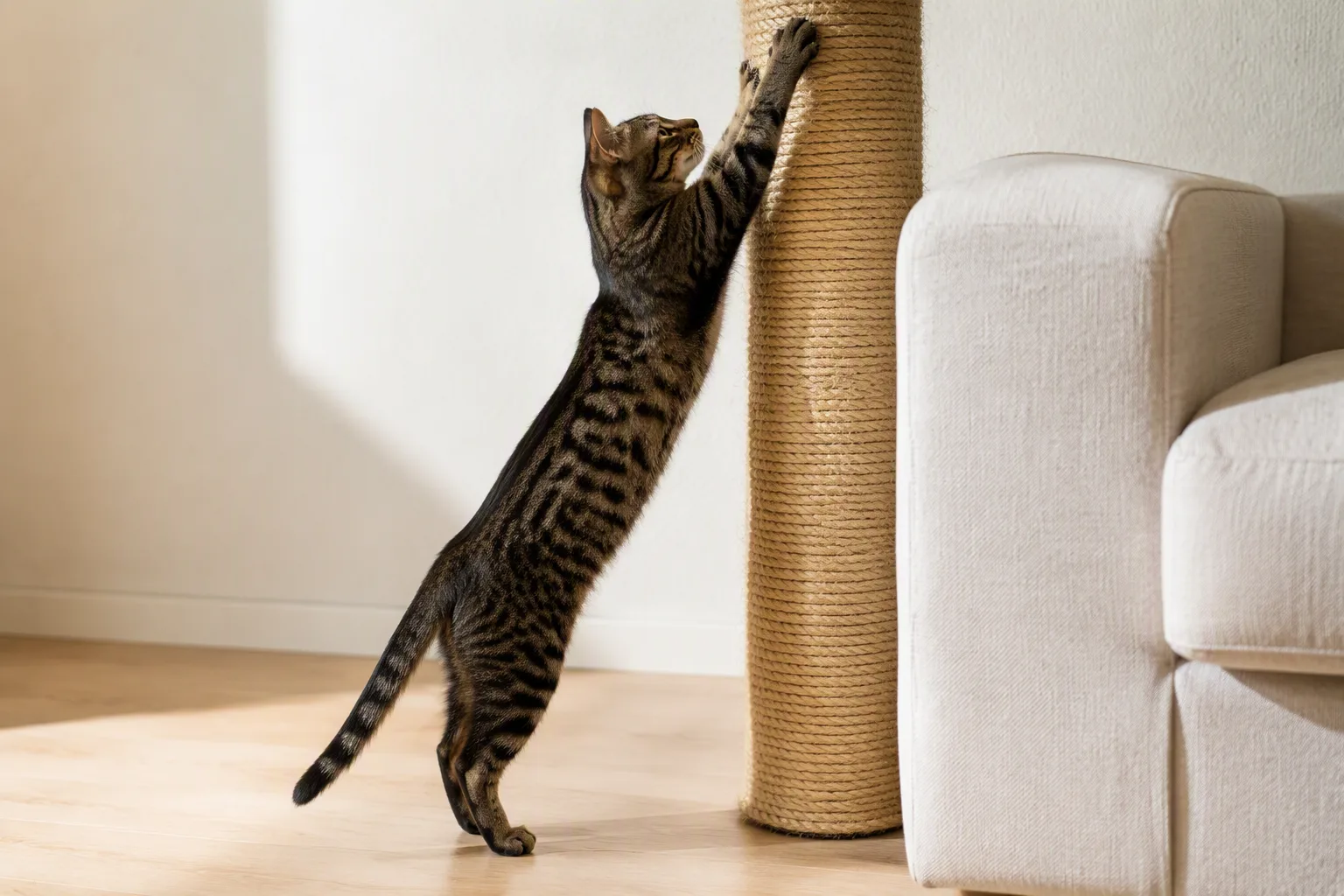
The short answer: cats scratch furniture because scratching is a normal behaviour they cannot switch off — it marks territory visually and chemically, sheds the outer nail sheath, and stretches the spine and forelimbs after rest. The sofa gets chosen because it is tall, stable, prominently placed, and often the only thing in the room that resists a good pull. Give the cat something that beats the sofa on those four counts and the behaviour moves. Punishing it does not work, and the research says it makes things worse.
Two large surveys sit behind almost everything below. Wilson and colleagues collected owner observations on 4,105 cats across 36 countries in 2016. Salgirli Demirbas and colleagues assessed 1,211 cats in France in 2024, scoring not just whether scratching happened but how often and how hard. Where the two agree, the finding is worth acting on. Where they diverge, I say so.
Scratching is not a behaviour problem
It is worth being precise about this, because the framing decides what you do next. Scratching serves at least four purposes at once: chemical marking from scent glands in the paw pads, visual marking through the shredded surface left behind, removal of the dead outer layer of the claw, and a full stretch of the claws and forelimbs — which is why cats so often scratch immediately after waking.
A cat that scratches your armchair is not defying you. It is doing something it is built to do, on the best available surface. That is also why the standard interventions aimed at stopping the behaviour outright tend to fail: the drive does not go away when the target is removed.
Scratching is the second most common behavioural complaint from cat owners, with around 60% describing it as a problem. In the Wilson survey, 86% of owners who had a cat declawed did so because of damage to the home. Declawing is an amputation, it is illegal in many jurisdictions, and it is not a treatment for a normal behaviour.
Which surface cats actually choose
This is the single most useful finding in the Wilson data, and it contains a mismatch worth knowing about. Carpet was the substrate owners offered most often. Rope — in practice, sisal — was the substrate cats used most often when it was available. Owners were buying one thing and cats were voting for another.
| Substrate | Preferred by cats aged 9 and under | Preferred by cats aged 10+ |
|---|---|---|
| Rope (sisal) | 32.5% | 22.9% |
| Carpet | 25.1% | 24.7% |
| Cardboard | 18.2% | 19.6% |
Read the right-hand column carefully. The preference inverts with age: cats over ten chose carpet first and rope second. If you have an older cat and a sisal post it ignores, that is not stubbornness — it is a documented shift. A softer surface is worth trying.
The substrate also tracked with damage elsewhere in the home. Owners whose cat preferred a rope post reported the least inappropriate scratching at 53.7%, followed by cardboard at 60.2%, carpet at 63.1% and wood at 64.4%. The gap between best and worst is about eleven percentage points — real, but not decisive on its own. Which brings us to the factor that matters more.
Both substrates that came out ahead are ones we produce: the oversized sisal scratch mat covers the rope preference, and the oval corrugated scratcher lounge covers cardboard — the cheaper way to test whether your cat has a horizontal preference before committing to a tall post.
Where the post stands beats what it is made of
The 2024 French study found that the location of the scratching post was a significant factor in redirecting the behaviour: posts placed in areas the cat actually frequents worked, posts placed out of the way did not.
The Wilson data shows why this is so easy to get wrong. Among owners still reporting damage, 69.3% already had a post in the same room as the damaged object, and 49.3% had one standing one to five feet away. The post was right there. It was simply not the better option at the moment the cat wanted to stretch.
The practical reading: put the post where the cat already scratches, not where it looks tidy. Beside the sofa arm. At the end of the hallway it patrols. Next to where it sleeps, because scratching follows waking.
Height, width and stability
Here the two measures in the Wilson survey point in different directions, and the distinction is worth keeping straight.
What cats used most
Narrower posts won clearly: 88.1% of cats used posts three feet wide or less, against 9.1% for wider ones. Shorter posts were also used more often, 60.2% against 36.3%.
What actually reduced damage
Taller posts did. Homes whose cat used a post over three feet high reported inappropriate scratching in 55.2% of cases, against 64.7% for shorter posts. Cats used the short ones more, but the tall ones were associated with less damage elsewhere.
The explanation is most likely the full stretch. A cat needs to extend to its full length; a post it cannot stretch against gets used casually and the real stretching happens on the sofa back. Choose a post the cat can reach right up on, and make sure it does not wobble — a post that tips once may not be tried again.
Wall-mounted and hanging scratchers performed worst on both counts: least used, and associated with the most damage elsewhere at 74.1%. They save floor space at the cost of the thing you bought them for.
More posts, less damage
This relationship is close to linear in the Wilson data. Homes with up to seven posts reported inappropriate scratching in about 60.2% of cases. Homes with more than ten reported it in 32.4% — roughly half.
Ten posts sounds absurd in a normal flat, and that is not quite what the number means. It is a proxy for variety and coverage: different substrates, different angles, different rooms. A cat that meets an acceptable surface wherever the urge strikes has less reason to improvise. Two or three well-placed and genuinely different options will get you most of the way; a single post in the corner will not.
Vertical or horizontal
Both, if you can. Cats aged nine and under favoured cat trees with two or more levels, then simple vertical posts, then horizontal ones lying flat on the floor. Cats over ten reversed the top two, preferring simple vertical posts first.
Horizontal scratchers were used less overall but were far from ignored — around half of younger cats used them. They also solve a problem vertical posts cannot: a cat that scratches the carpet or a rug is signalling a horizontal preference, and no amount of vertical post will address it.
What the 2024 study adds: stress and play
The French study looked past furniture at the cat itself, and several factors came out significant. Play duration, playfulness and night-time activity were all associated with higher scratching. So were aggressiveness and disruptiveness. The presence of a child in the home was associated with more scratching episodes.
The play finding is the counter-intuitive one, and it is easy to misread. More play was linked to more scratching, which does not mean play causes damage. The authors suggest what matters is how play is structured — short, well-paced sessions that end in a resolution rather than long ones that leave the cat wound up. A cat that is aroused and unresolved has to put that energy somewhere.
Marking behaviours, scratching included, also increase under stress: social tension with other cats, or changes in the household. If scratching suddenly intensifies without anything about the furniture changing, the furniture is probably not the variable.
Why punishment backfires
Both papers land on this. Positive punishment — shouting, spraying water, physically moving the cat mid-scratch — is associated with an increased level of scratching, not a decreased one.
The mechanism is straightforward once scratching is understood as marking. Punishment raises stress, stress raises marking behaviour, and the marking behaviour in question is the one you were trying to stop. Meanwhile the cat learns that you are unpredictable, which raises stress further.
Positive reinforcement of the acceptable target, and synthetic feline pheromones, are both reported to help. The general shape of the solution is redirection, not suppression.
A checklist that follows from the data
- Put a post exactly where the damage is happening, not where it looks neat.
- Offer sisal rope first for a cat under ten; try carpet for a cat over ten.
- Choose something tall enough for a full stretch, and narrow rather than wide.
- Check it does not wobble. One tip may end its career.
- Add a horizontal option if the cat scratches rugs or carpet.
- Build up to several genuinely different options rather than one showpiece.
- Reward use of the post; never punish use of the sofa.
- If scratching spikes suddenly, look for a stressor before blaming the post.
What the research does not tell you
Both studies are owner-reported surveys, not controlled experiments. They establish association, not cause. The Wilson respondents skew heavily towards the United States at 73.6%, and both samples are self-selected — people who answer a cat behaviour survey are not a random slice of cat owners.
Individual preference also remains large. The Wilson authors are explicit that their data is a starting point for a recommendation, not a prediction for any one animal. A third of cats chose rope; two thirds chose something else. If your cat contradicts the table above, your cat is not unusual.
Sources: Wilson C et al. (2016), Journal of Feline Medicine and Surgery 18(10):791-797, n = 4,105. Salgirli Demirbas Y et al. (2024), Frontiers in Veterinary Science 11:1403068, n = 1,211. Both are open to read in full; every figure quoted here appears in the published papers.
Related reading
- Why Does My Cat Ignore the Scratching Post?
- How Often Should You Clean a Cat Water Fountain?
- What Size Cone Does Your Dog Need? A Measuring Guide