Editorial — Published 2026-08-19 — By Wangzian, Pet Lifestyle Curator
Why Does My Cat Ignore the Scratching Post? Three Quarters of Damaged Homes Already Own One
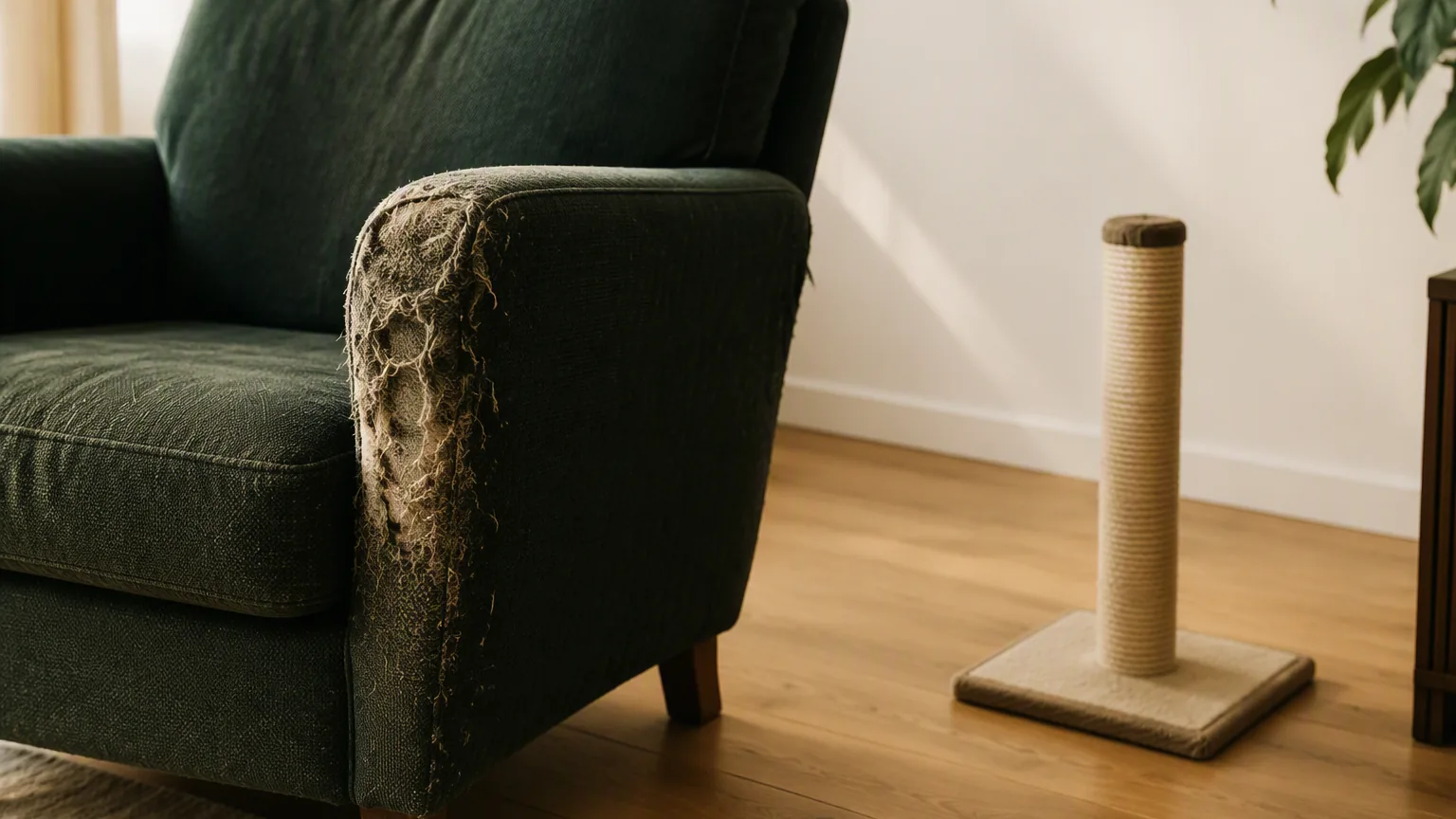
Because owning a post and stopping the damage are two different outcomes, and the research only supports the first. In a survey of 116 indoor cats, 83.9% scratched something they should not, and 76.1% of those households already had a scratcher sitting there.
This is the summary page for everything we have written about cat scratching. Each section gives the finding, its size, and the point where the evidence stops. Where we have covered something in depth there is a link rather than a repetition.
The contradiction at the centre of the advice
Two studies say things that sound incompatible.
A 2013 Italian questionnaire of 128 cats reported that when a scratching post is present in the cat's environment, the cat appears to use it, and that this coincides with less scratching of other surfaces.
A 2018 survey of 116 cats at a Georgia veterinary practice found that 83.9% scratched inappropriate items — and that 76.1% of those households already owned a designated scratcher.
Both can be true, and the resolution is the single most useful idea on this page. The Italian study measured whether the post gets used at all. The Georgia study measured whether the damage stops. A cat can do both: use the post daily and still shred the sofa arm every evening.
So when you ask why your cat ignores the scratching post, the honest reframing is that it probably does not ignore it. It uses it, and then also uses your furniture, because the two behaviours are answering different needs in different places.
Buying a second post does not address that. It adds another object to a house that already has one.
What actually predicts damage
The Georgia survey ranked what cats destroyed and how often, on a 0-5 scale:
| Surface | Mean frequency |
|---|---|
| Furniture and chairs | 3.4 |
| Carpet | 2.1 |
| Walls and door frames | 0.4 |
By material, fabric scored 3.1, carpet 2.3, wood 0.5. And by orientation, vertical surfaces 3.3 against horizontal 2.2 (P < 0.01).
The Italian study adds a different predictor that nobody sells a product for: whether the cat is neutered. Entire males with no post available were the profile most associated with scratching other surfaces. Neutered males, neutered females and entire females rarely chose furniture — and that held regardless of whether a post was available at all.
That is an association from a descriptive analysis, not a controlled comparison, so treat it as a lead rather than a finding. But it points somewhere the product-shaped advice never does.
The two interventions that backfire
Carrying the cat to the post makes things worse. Owners in the Georgia survey who picked their cat up and placed it beside the scratcher saw it used less often: mean frequency 3.8 against 4.6, P = 0.0135. The authors suggest scratching follows waking, stretching or social tension, and lifting the animal mid-sequence breaks the chain.
Punishment does nothing. In the same sample, 69.2% of owners yelled and 37.4% sprayed water. When the techniques were grouped and tested, none of the categories significantly changed how often cats scratched the wrong things. The Italian paper's discussion goes further, citing evidence that punishment can raise anxiety and simply relocate the scratching.
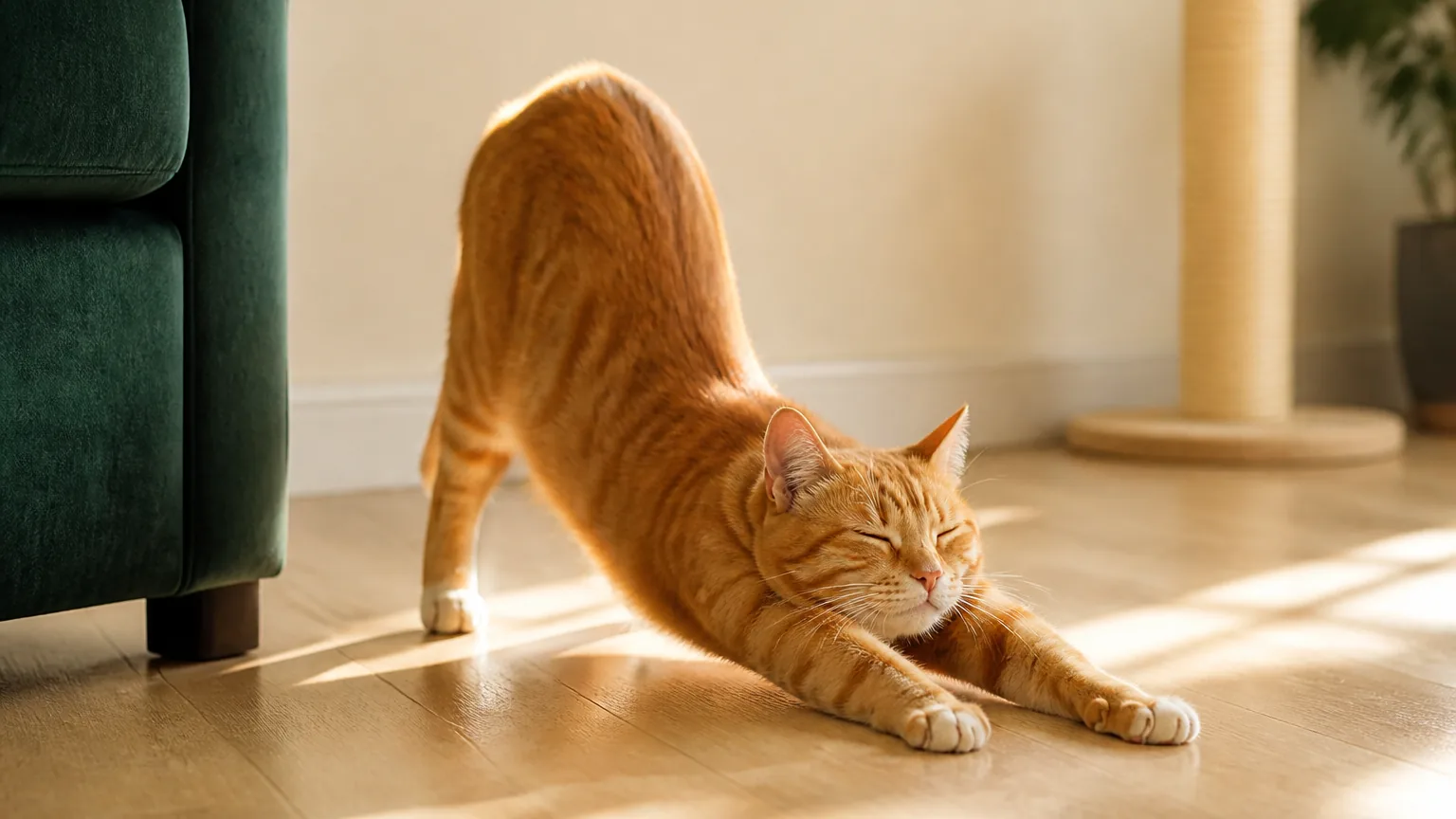
Orientation: the clearest disagreement in the field
Two studies point in opposite directions, and it is worth understanding why before you buy anything.
| Study | Subjects | Finding |
|---|---|---|
| Zhang 2019 | 40 kittens, 8 weeks, choice test | Horizontal preferred; a scratcher laid flat beat itself standing up, 21.67s to 10.50s |
| Moesta 2018 | 116 adult cats, owner report | Vertical surfaces damaged more, 3.3 against 2.2 |
| Moesta 2018 | same | Posts used more than pads, 4.1 against 3.6 |
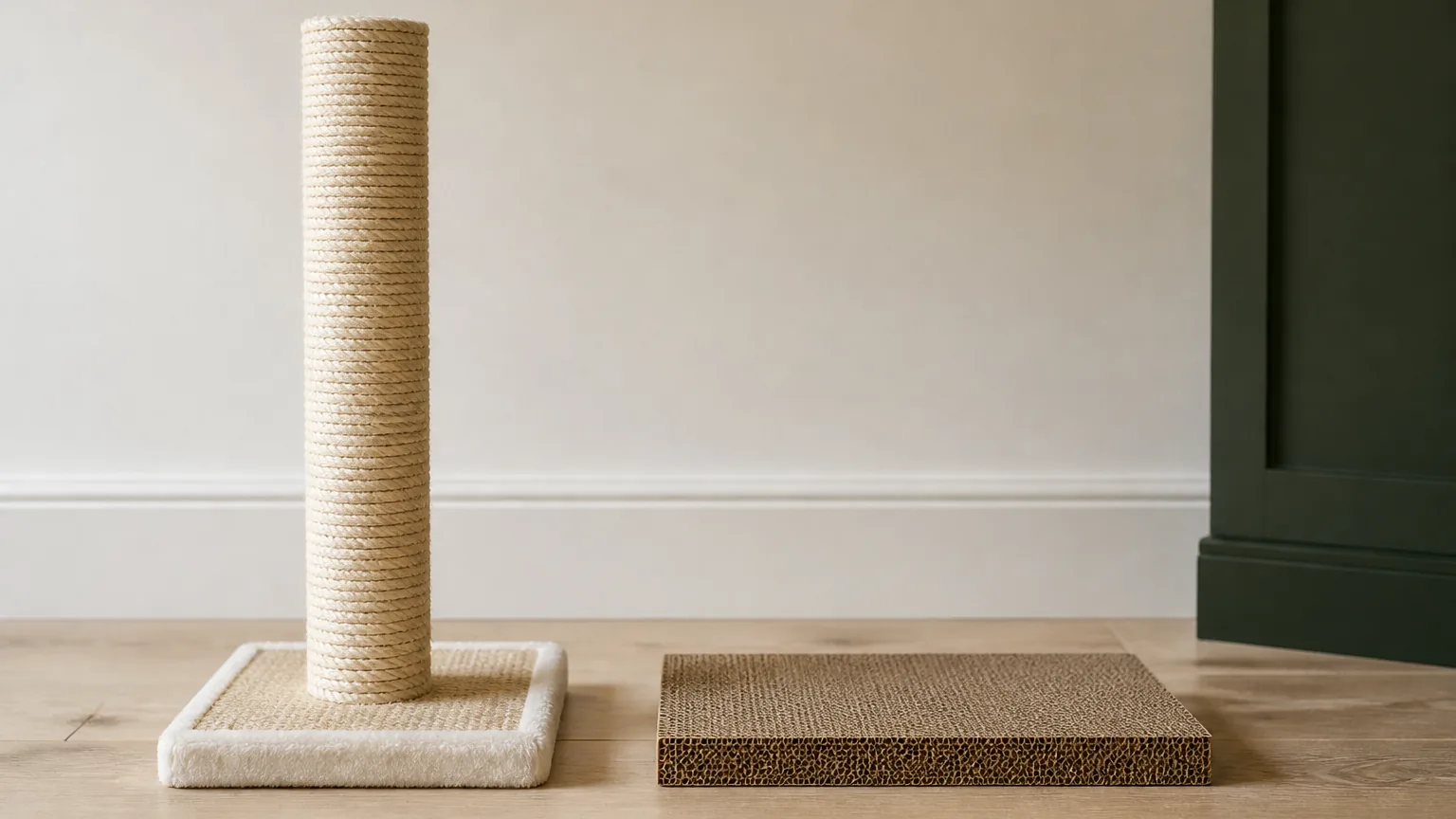
These are not really contradicting each other. One measures what kittens choose in a 20-minute test; the other measures what adult owners report finding shredded. Preference and damage are different variables, and age may matter too.
The practical read: if your cat is destroying something vertical, a pad on the floor is not competing for the same behaviour, and vice versa. Match what you provide to what is being damaged, rather than to a general rule.
We worked through the carpet case specifically — including why deep pile on the floor was the only surface a winning scratcher could not clearly beat — in how to stop a cat scratching the carpet.
What the material evidence supports
The largest survey in this field, 4,105 cats, found rope used most and upright posts of three feet or more preferred. A separate 1,211-cat survey found the same broad pattern for materials and heights.
Interestingly, the Georgia study did not reproduce this: it found no independent effect of material, angle or length on how much a scratcher got used. Three datasets, two agreeing and one not.
Both of the larger surveys, and what they mean when you are choosing between sisal and cardboard, are covered in why cats scratch furniture. We are not restating them here.
Does anything you spray on it help?
Catnip did nothing in kittens. Three additives tested against a plain scratcher: dried catnip P = 0.69, catnip oil spray P = 0.75, hair from other cats P = 0.63. The paper supplies the caveat itself — cats under three months barely respond to catnip because the relevant system is not developed. This is evidence about kittens, not about adult cats.
Feliscratch has three studies and they do not agree. The two that found it works both have a commercial tie to the manufacturer; the one with no commercial relationship returned P = 0.06 and did not reach significance. That is the whole picture in one sentence, and the detail — including a methodological limitation that weakens the negative result — is in does Feliscratch actually work.
If your cat is ignoring the post right now
Ordered by how well the evidence holds, not by effort:
- Check whether it is actually being ignored. The Italian data suggest posts do get used when present. If yours is used and the sofa is still being destroyed, you have a placement problem, not a product problem.
- Match orientation to the damage. Vertical damage needs something vertical; carpet damage needs something flat. This is the clearest actionable signal in the data.
- Stop carrying the cat to it. It measurably lowers use.
- Stop punishing. No technique in the survey changed anything, and the mechanism suggested is that it relocates rather than reduces.
- Do not raise a flat scratcher off the floor. In the kitten trial, lifting a carpet pad onto a 12cm base dropped its use to 5 seconds against 37.5 for a flat cardboard one.
- Buy a second one last, not first. Three quarters of damaged homes already had one.
Where all of this stops
One of the two core studies has no statistics. The Italian paper uses multiple correspondence analysis, which is descriptive. There are no P values in it, no effect sizes, no hypothesis tests. Every relationship above drawn from it is a proximity on a plot. It is also a preliminary study of 128 cats in one city, collected in 2009.
The Georgia survey is a single practice. Its authors say the sample is unlikely to represent cat owners generally, and that their broad definition of "inappropriate" probably inflates the 83.9% — earlier studies reported 15% to 52%.
The kitten trial is kittens. Eight weeks old, five or six per comparison, in a 20-minute test.
Nobody has run the experiment you actually want. There is no controlled trial that takes homes with existing damage, changes one variable, and measures whether the damage stops. Everything above is preference tests and owner surveys.
This is the same shape of gap we hit writing about vet visits, where the intervention everyone recommends has no measured timing and the one that does is a drug. Taking your cat to the vet sets out that version of the problem.
A note on who funded what
Both the Italian and the Georgia studies state they received no funding and declare no conflicts of interest. That is unusual in this field and worth saying.
One detail belongs alongside it: three authors of the Italian paper are at IRSEA, and one of them holds the US patent on Feliscratch — the product whose evidence base we examined separately. The declaration of no conflict is what the paper states. The affiliation is a fact you are entitled to weigh yourself.
What we sell, and what we do not
We make scratching products — a flat sisal mat and a corrugated lounger, both of which sit on the floor. Given that the adult damage data point towards vertical surfaces, that format is the right answer for carpet damage and the wrong answer for a shredded sofa arm. We have run no trials of our own, and none of the studies above tested our products.
---
Sources
- Mengoli M, Mariti C, Cozzi A, et al (2013). Scratching behaviour and its features: a questionnaire-based study in an Italian sample of domestic cats. J Feline Med Surg 15(10):886-892. Open access, full text read. 128 owners, Padua, 2009. Analysed by multiple correspondence analysis, a descriptive method: the paper contains no P values and no significance tests. No funding; authors declare no conflicts. Three authors are affiliated with IRSEA; one holds the US patent on Feliscratch.
- Moesta A, Keys D, Crowell-Davis S (2018). Survey of cat owners on features of, and preventative measures for, feline scratching of inappropriate objects: a pilot study. J Feline Med Surg 20(10):891-899. Open access, full text read. 116 of 140 questionnaires returned at one University of Georgia practice. No funding, no conflicts declared.
- Zhang L, Plummer R, McGlone J (2019). Preference of kittens for scratchers. J Feline Med Surg 21(8):691-699. Open access, full text read. 40 kittens, 5-6 per comparison. No funding, no conflicts declared.
- Wilson C et al (2016), n = 4,105; Salgirli Demirbas Y et al (2024), n = 1,211; and Zhang & McGlone (2020) on olfactory additives are each covered in full in the linked articles and are not restated here.
What we do not claim: we hold no data of our own on scratching, and nothing above tells you with certainty why your cat ignores the scratching post you bought — only which explanations survive contact with a control group and which do not. Nothing here is veterinary advice. A sudden change in scratching, especially alongside other behavioural changes, is worth raising with a vet rather than solving with furniture.
Related reading
- Why Do Cats Scratch Furniture (And What Actually Stops It)
- How to Stop a Cat Scratching the Carpet: The One Substrate That Held Its Own in Testing
- Does Feliscratch Actually Work? Three Studies, and Who Paid for Them