Editorial — Published 2026-09-08 — By Wangzian, Pet Lifestyle Curator
Do Cats Play Less in Winter?
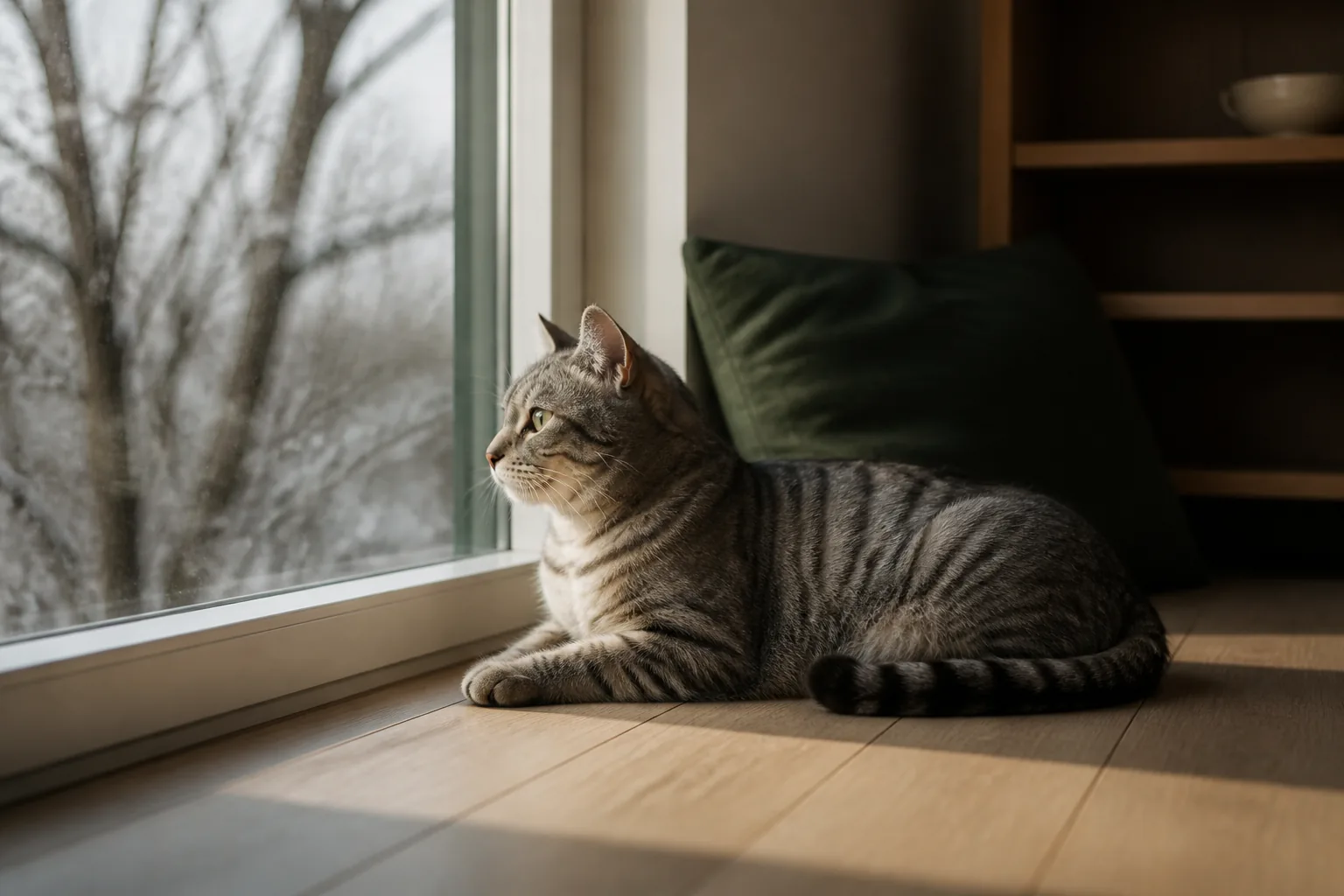
Some indoor cats may move less in winter, but a small study cannot tell us what most cats do. In a study of six young indoor cats, movement was lowest in winter despite controlled room temperature; movement was measured, not play alone.
The practical distinction is between a gradual change in routine and a new health concern. A seasonal explanation should not replace checking a sudden or persistent change with your veterinarian.
Why cats play less in winter when the room never gets cold
Parker and colleagues followed six indoor cats for 21 consecutive days in each of the four seasons. The cats wore UWB tags that logged distance moved; their food sat on RFID scales that logged every visit. Room temperature stayed at 21–23°C year-round and humidity at 40%.
So when winter activity dropped, cold could not explain it. What did change across the year was natural light reaching the room:
| Season | Daylight | Daily movement |
|---|---|---|
| Spring | 14h 21m | Peak |
| Summer | 14h 56m | High |
| Autumn | 9h 51m | Peak |
| Winter | 9h 56m | Lowest |
Notice that autumn and winter have nearly identical daylight — 9h51 versus 9h56 — yet autumn was a movement peak and winter the trough. Photoperiod alone does not explain the pattern either. Something about the transition into winter, not the raw hours of light, tracks the drop.
Activity swings harder than appetite
The same study measured how sharply each rhythm rose and fell across the day. Activity amplitude came in at 618±53 against 178±24 for feeding (P<0.01) — cats' movement swings roughly three times harder than their eating does.
Broken out by season, the gap holds:
| Season | Activity amplitude | Feeding amplitude |
|---|---|---|
| Autumn | 371±53 | 212±41 |
| Winter | 585±87 | 278±64 |
The practical reading: a cat whose play collapses in January has not necessarily changed how much it eats. If both drop together, that is a different signal, and worth a vet call rather than a new toy.
The 4 p.m. clue
One finding reframes the whole question. Across the year the cats showed three feeding peaks, and the one at 16:00 appeared after the caretaker left the room. Feeding at 16:00 was significantly higher than in the 60 minutes before or the 40 minutes after (P<0.001).
Cats were not simply following the sun. They were working around the humans.
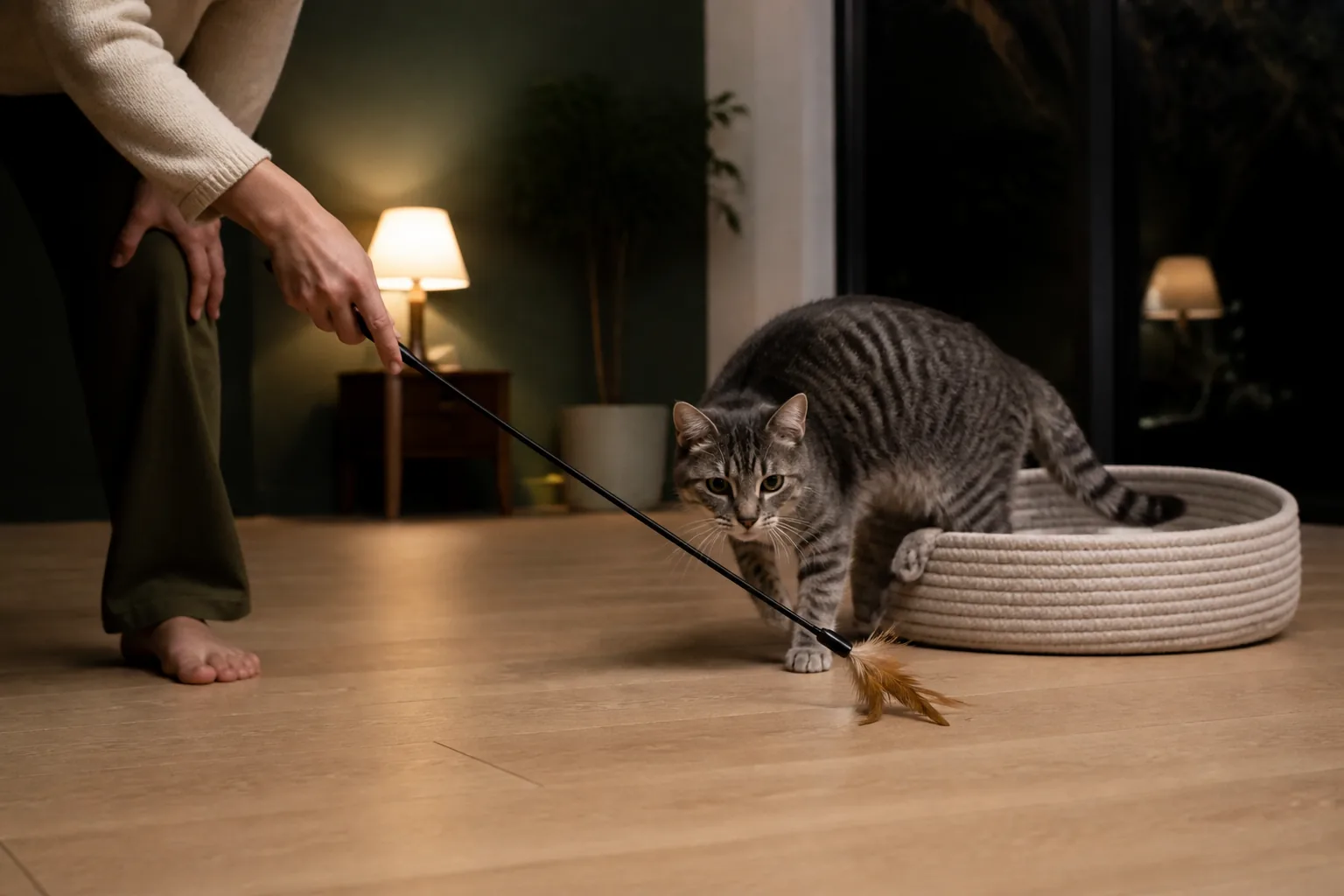
That is the most usable thing in the paper. If your cat seems flat in winter, look at what changed in your schedule between October and January — you are probably home at different hours, leaving at different hours, and going to bed earlier. The cat's day is built around yours.
The observed rhythms also varied across the day. That does not establish a universal timetable for pet cats: your cat may be active at times that differ from those recorded in this colony.
What this study cannot tell you
Six cats. All from the same research colony. All aged seven months at the start, which means they were growing throughout — age and season are tangled together, and the authors say so themselves. Two of them were employed by Royal Canin, which ran the facility.
So this is not proof that indoor cats slow down every winter. It is one carefully instrumented look at six young cats in a room where the temperature never moved, and its value lies in what it rules out: cold, in a heated home, is not the driver.
A separate four-year record of 38 cats fed freely in southern France found voluntary intake varies by season too, which at least suggests the pattern is not an artefact of one small colony. But that study ran in a Mediterranean climate with outdoor access conditions — not a heated flat in Manchester or Toronto.
What to actually do
Three things follow from the data rather than from folklore:
Offer play when your cat is receptive. Try a short, supervised session at a time your cat already seems alert. Stop if it withdraws or appears uncomfortable. This is a practical suggestion, not an intervention tested by this paper; the study cannot tell us whether a heated bed would change activity.
Watch activity alongside other signs. Normal eating does not prove that reduced activity is harmless. Contact your vet for sudden or persistent changes, pain, or altered appetite, drinking or litter-box habits. Avoid forcing exercise on a cat that may be unwell.
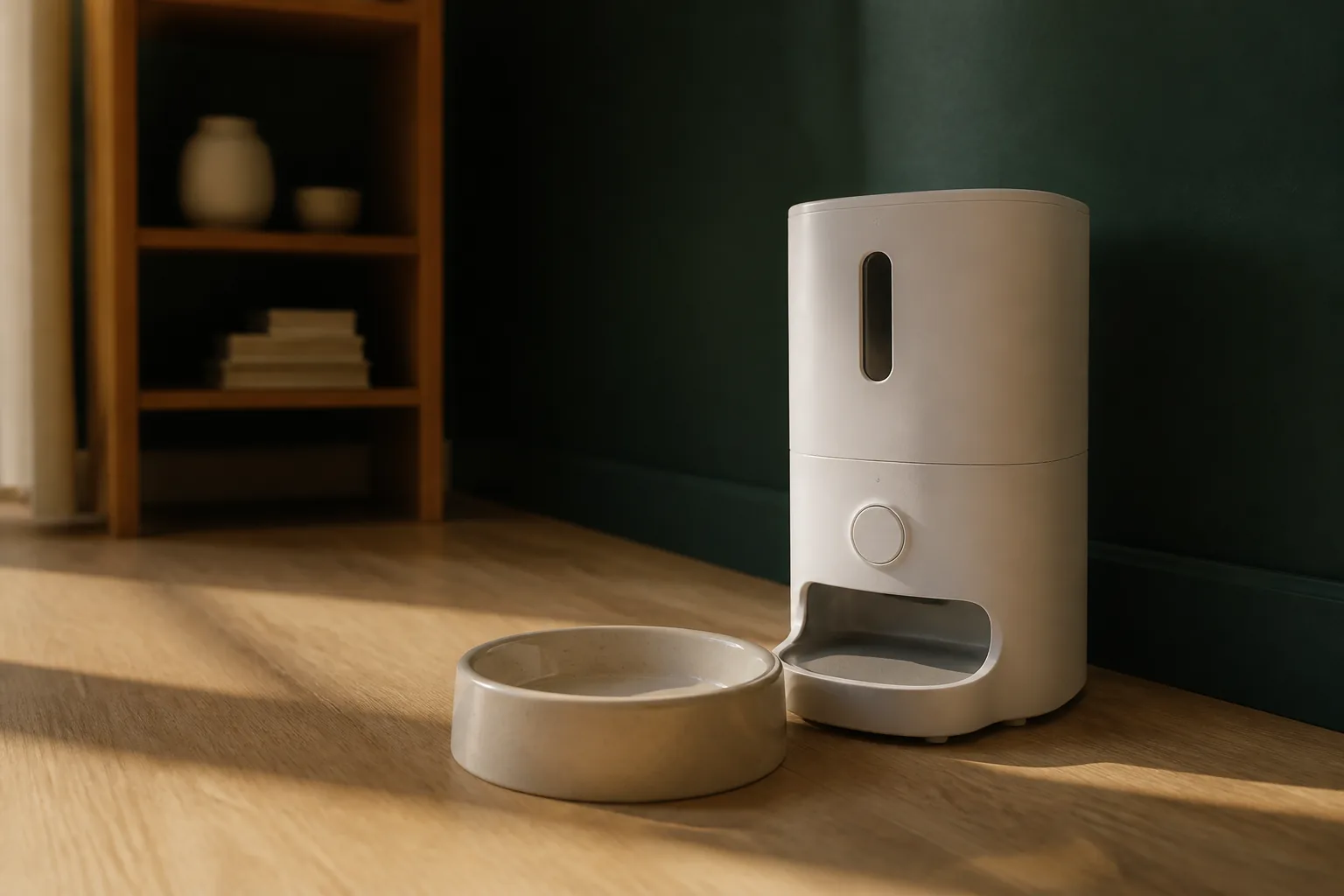
Keep a simple routine record. Note when you offer food and play, and how your cat responds, so you can discuss changes with your vet. If you use a timed feeder, check how its portions are measured, rather than increasing food automatically because the season changed.
Winter also brings coat changes that can look like lethargy when a cat spends longer grooming or gets uncomfortable. If that is the shape of what you are seeing, seasonal coat behaviour is the more likely explanation than a mood shift. A cat that has started avoiding handling may also be dealing with mats forming where it cannot reach rather than a seasonal slump.
For resting and activity setups we have tested and sourced ourselves, see our product range.
Sources
- Parker M, Challet E, Deputte B, Ract-Madoux B, Faustin M, Serra J (2022). Seasonal effects on locomotor and feeding rhythms in indoor cats. Journal of Veterinary Behavior 48:56–67. DOI 10.1016/j.jveb.2021.05.005. Open access; full text read. Six cats, Royal Canin research facility; two authors employed by Royal Canin. Cats were in a growth phase throughout, so age and season are confounded — stated by the authors.
- Serisier S, Feugier A, Delmotte S, Biourge V, German AJ (2014). Seasonal Variation in the Voluntary Food Intake of Domesticated Cats. PLoS One 9(4):e96071. PMCID PMC3997493. Open access; full text read. 38 cats, four years (2006–2009), free feeding, southern France.
No controlled trial has tested whether changing indoor lighting or play scheduling restores winter activity in pet cats. The recommendations above are inferences from measured rhythms, not tested interventions.
Written with AI assistance; all data points, limitations and source readings verified against the original open-access papers by the author.