Editorial — Published 2026-09-02 — By Wangzian, Pet Lifestyle Curator
Longhair Cat Matting Behind the Ears
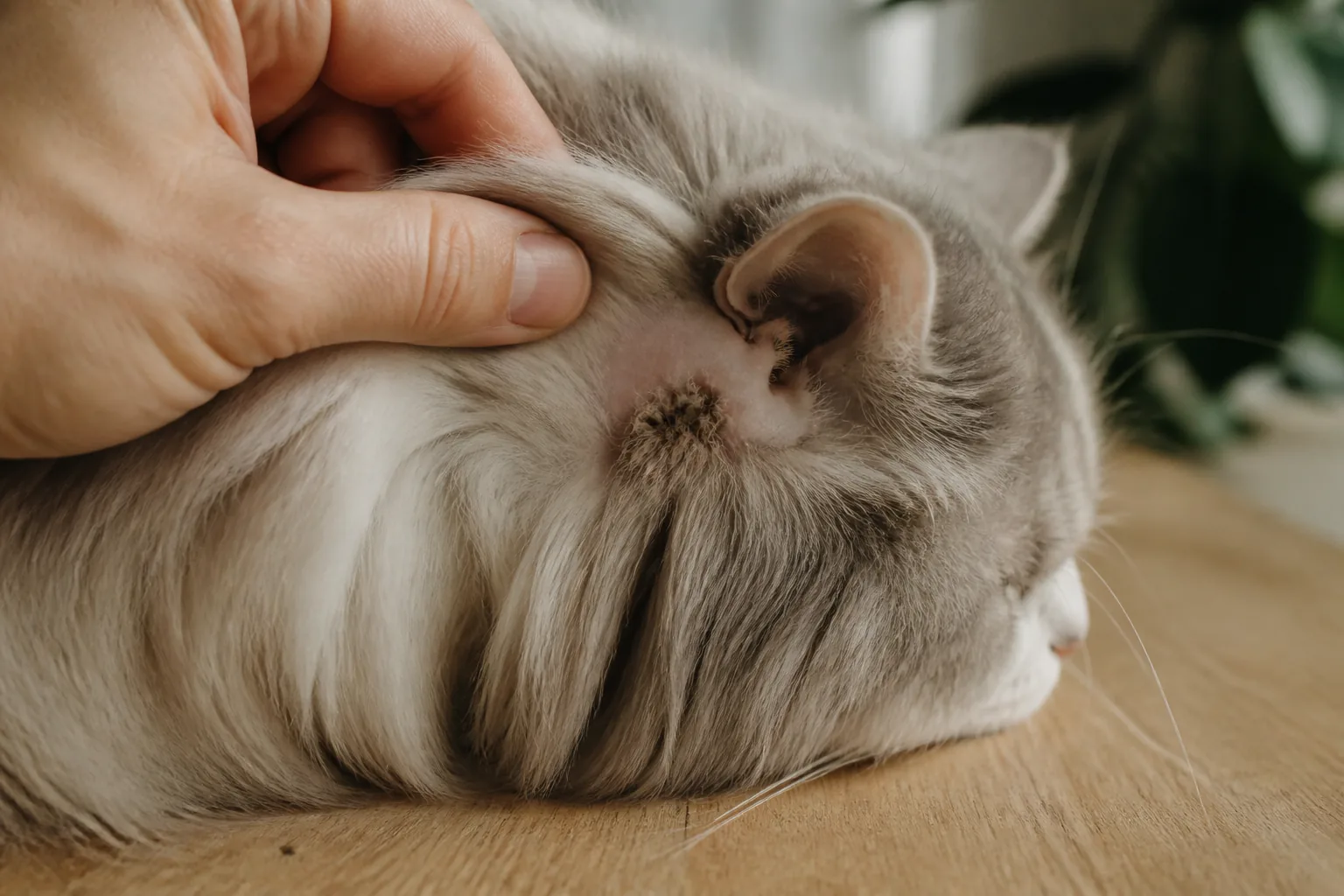
Long-haired cats can develop mats behind the ears when loose hairs become tangled in a hard-to-groom area. Check gently and avoid pulling; a tight or painful mat needs professional help. The studies below concern grooming and swallowed hair, not proof that the ears always mat first.
It is tempting to assume that long-haired cats spend more time grooming to compensate. One small study did not find a statistically significant difference, which is not the same as proving the groups groom identically.
The tongue cannot get there
A cat's tongue is covered in backward-facing keratin papillae. That is what makes licking function as a comb — the papillae catch loose hair and pull it out of the coat, which is also why so much of it ends up swallowed.
Everywhere the tongue reaches, the cat has a comb. Behind the ears, on top of the head, and under the chin, it does not. Those areas get groomed by licking a forepaw and wiping it over the fur. A wet paw smooths the surface and redistributes oils. It does not separate hairs from each other, and separation is the thing that prevents a mat.
So the mat behind the ear is not a sign your cat is neglecting itself. It is the one spot where the cat's own tool does not work.
Longhairs do not groom more to compensate
This is the finding that changed how I think about it.
A 2019 study in Journal of Feline Medicine and Surgery recorded 10 adult cats on webcam for a continuous 24-hour period and compared the behavioural time budget for grooming between longhair and shorthair cats. The result: no significant difference. Same time spent, same grooming patterns.
That is worth sitting with. The coat is longer, the surface area to maintain is larger, the hair is more prone to tangling — and the maintenance effort stays flat.
The consequence shows up in what comes off the cat. In a separate 2015 Royal Canin study, seven longhair and seven shorthair cats were brushed on a fixed schedule and their faecal hair excretion measured directly. After a three-day purge, longhairs produced 6.31 g of hair in faeces against 2.45 g for shorthairs — about 2.5 times more. On a standard low-fibre diet, longhair daily faecal hair excretion ran 1512 mg against 1627 mg for shorthairs, which sounds equal until you remember the longhairs had far more hair to shed in the first place.
| Longhair | Shorthair | |
|---|---|---|
| Grooming time budget (2019, n=10) | no significant difference | no significant difference |
| Hair recovered per brushing phase (2015) | 519–553 mg | 311–317 mg |
| Faecal hair after 3-day purge (2015) | 6.31 g | 2.45 g |
Roughly 1.7 times more hair comes off the coat per brushing session, with the same amount of self-grooming applied to it. The gap has to go somewhere. Some of it is swallowed. Some of it stays in the coat and becomes the mat behind the ear.
Both studies are small — 10 cats and 21 cats, research colonies, not homes. Neither one set out to study matting, and I could not find a study that did.
What a mat actually is, and why pulling is the wrong move
A mat forms when shed hairs stay trapped among growing hairs and twist. It starts loose and close to the skin, then tightens as more hair is caught. By the time it is visible on the surface, the tight end is already against the skin.
That geometry is why pulling fails. Tension on the outside of the mat transfers straight to the skin underneath, which on a cat is thin and mobile enough to tent up into the mat. This is the mechanism behind the injuries groomers see when owners take scissors to a mat: the skin lifts into the blade because it is being pulled along with the hair.
If a mat is tight enough that you cannot slide a comb between it and the skin, it is past the point of home removal.
What works on a loose mat
For a mat you can still get a comb under:
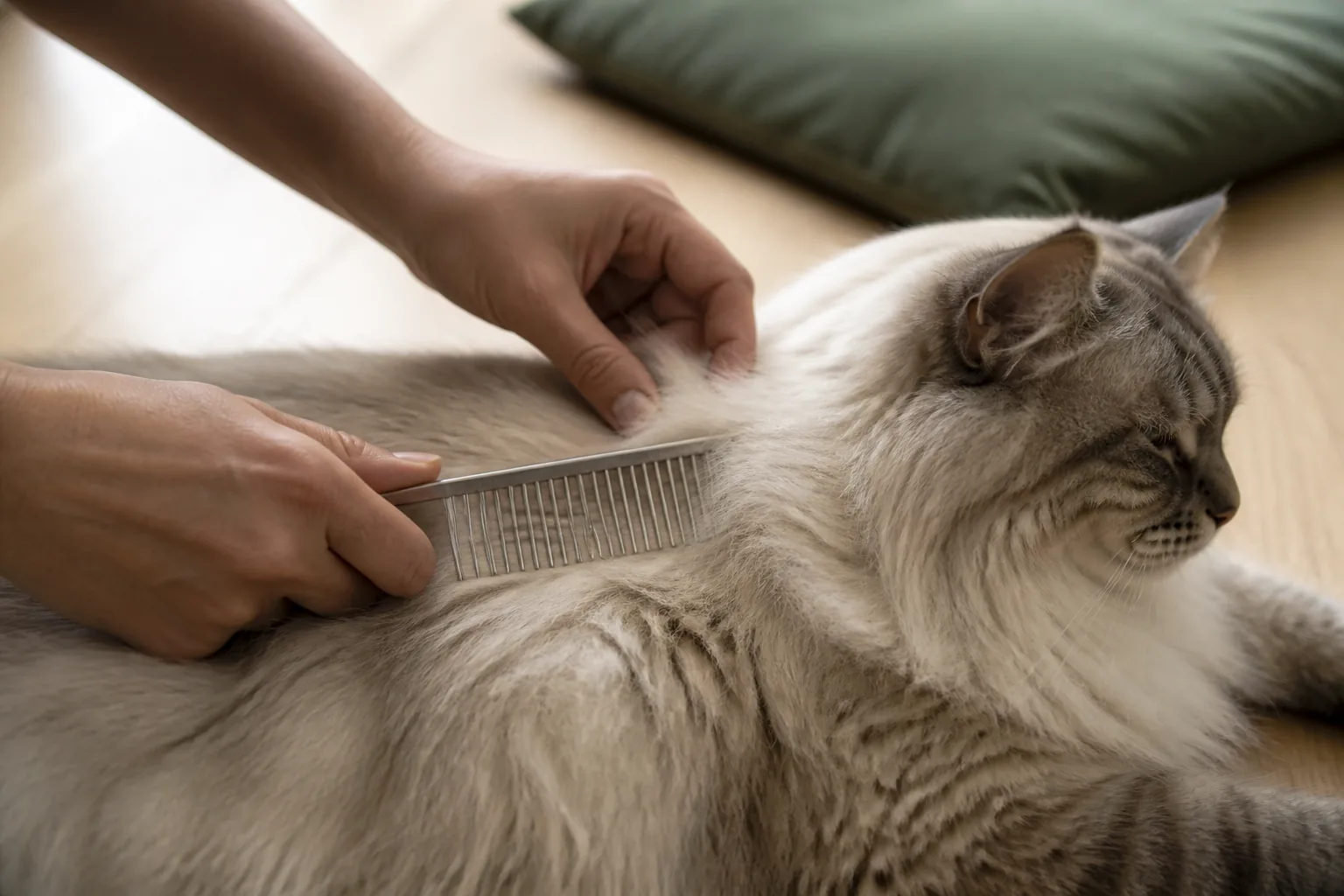
- Work from the outside in. Hold the base of the mat against the skin with your fingers, so any tension you apply stops at your hand instead of the skin. Pick at the far edge with a wide-tooth comb, a few hairs at a time.
- Do not force a comb underneath. Work only on loose hairs that separate without resistance. If you cannot clearly distinguish the mat from the skin, stop and ask a qualified groomer or veterinarian.
- Stop at 60 seconds. This is the rule that actually made a difference for us. A cat that has learned mat-work always hurts will not let you near the area next time, and the next mat will be worse than this one.
- Do not wet it. Water tightens a mat. Bathing a matted cat is how a scattered set of tangles becomes a solid sheet.
We work on the trouble spots first during a normal session, while the cat's patience is highest, then finish along the back where it is pleasant — the same ending-on-the-easy-part logic that governs getting a cat used to being brushed in the first place.
When to stop and book a groomer
Hand it over if any of these apply: the mat is flat against the skin with no gap, it covers an area wider than a coin, the skin under it looks pink or damp, there are several mats joined into a sheet, or the cat growls when you touch the area.
That last one deserves separating out. A cat that tolerates handling everywhere except one spot may be telling you the skin under the mat is already sore. Mats trap moisture and prevent air reaching the skin, and what is underneath can be inflamed before anything is visible from outside. If the skin turns out to need looking at, our guide to taking your cat to the vet covers making that trip less stressful than the mat itself.
Severe matting may require professional clipping. A veterinarian should decide whether sedation is needed for that individual cat; it is not an automatic requirement, and sedatives should never be given without veterinary direction.
Prevention is a frequency problem
Mats behind the ears form over weeks, not days. Checking that specific spot twice a week takes about ten seconds and catches them while a comb still slides under.
That is a different task from seasonal coat maintenance. The volume of hair coming off changes through the year — we covered what actually gets measured in do cats shed more in autumn — but the behind-the-ear check is worth doing at the same rate regardless of season, because the cause is anatomical rather than seasonal.
One thing the 2015 study raises that is outside brushing entirely: in longhair cats, moving from a 6% fibre diet to 11% increased faecal hair excretion by 81%, and 15% fibre by 113%. In shorthairs, the same diets did nothing measurable. That is about hair passing through the gut rather than hair in the coat, so it will not prevent a mat — but if your longhair is also bringing up hairballs, the two problems share a cause and one of them has a dietary lever. All the authors worked for a pet-food manufacturer, which is worth knowing when reading a fibre result.
What we use
A wide-tooth comb does the mat work; a slicker brush is for the routine coat maintenance that stops mats forming. We keep the comb next to the brush, because the check and the fix belong in the same thirty seconds.
We do not sell a dematting rake, and I would not use one behind the ears. Those tools cut through a mat with hooked blades, and the place where the skin is thinnest and most mobile is the worst place to bring a blade you cannot see under.
Sources
- Kim HS, Hong JS, Park CW, Cho KH, Kim YY. "Evaluation of grooming behaviour and apparent digestibility method in cats." Journal of Feline Medicine and Surgery 21(4):373–378, 2019. PMID 30001671. 10 adult cats, 24-hour webcam observation. Abstract read in full; full text paywalled. The finding used here is the absence of a longhair/shorthair difference in grooming time budget.
- Weber M, Sams L, Feugier A, Michel S, Biourge V. "Influence of the dietary fibre levels on faecal hair excretion after 14 days in short and long-haired domestic cats." Veterinary Medicine and Science 1(1):30–37, 2015. PMCID PMC5645811, PMID 29067172. 21 research cats. Open access, read in full. All authors were Royal Canin employees at the time of writing.
- The comb technique, the 60-second rule, and the twice-weekly check are from our own test room and office cats. No controls, no measurement — experience, not evidence.
- I looked for a controlled study on mat formation, mat location, or dematting technique in cats and did not find one. The anatomical explanation here is inference from tongue structure and grooming reach, not a tested claim. If you know of a study, tell us and we will update this page.
Written by Wangzian at XueQiu Pets, drafted with AI assistance and fact-checked against the sources above.