Editorial — Published 2026-08-21 — By Wangzian, Pet Lifestyle Curator
Automatic Feeder Portion Size for Cats: The Standard Formula Overfeeds, and a Meta-Analysis Says So
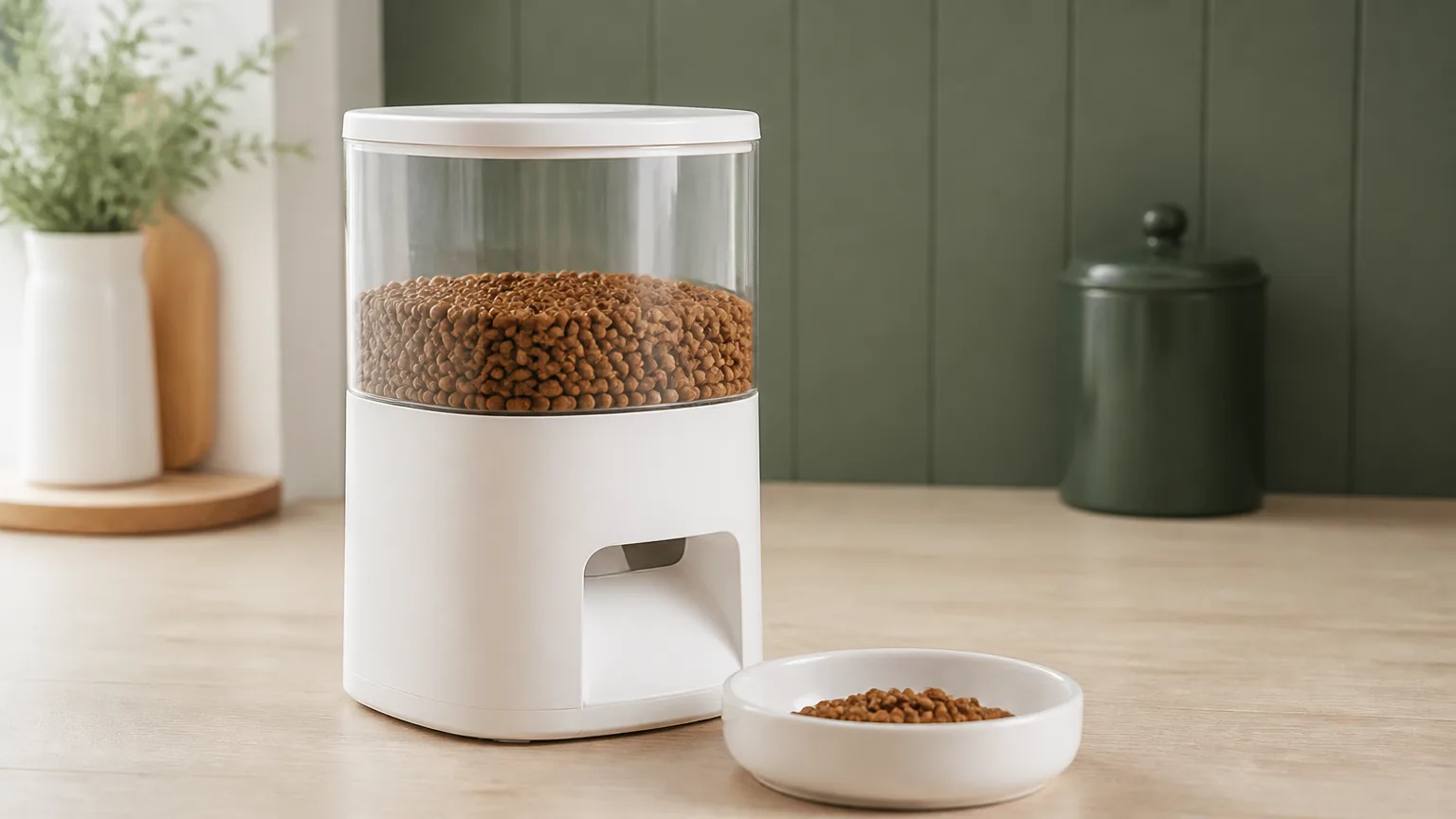
The right automatic feeder portion size for cats starts at roughly 55 kcal per kilogram of body weight per day, split across however many meals you want, then corrected by what the scale says three weeks later. That figure comes from 115 treatment groups, and it is meaningfully lower than the formula most feeding charts still print.
An automatic feeder removes your one correction mechanism. Scooping by hand, you notice the bag emptying faster than usual. A feeder dispenses the same wrong number 730 times a year without flinching.
The number, and where it comes from
In 2010 a team pulled together every English-language publication from 1933 to 2009 reporting how much energy adult cats need to hold weight steady. Forty-two papers, 1,933 cats, 141 treatment groups; after discarding groups with drifting weight or incomplete data, 115 remained.
The mean: 55.1 kcal per kg of body weight per day, or 222.1 kcal daily for an average cat. A 4 kg cat needs about 220 kcal; a 5 kg cat, about 275.
Compare that to the National Research Council formula feeding charts have used for years — 100 kcal/kg BW^-0.67 for light and normal cats. The meta-analysis produced 56.2 kcal/kg BW^-0.966 for the same group, and states the conclusion plainly: NRC recommendations over-predict requirements for light and normal-weight cats, and over time that surplus "could lead to weight gain."
Heavier cats need less per kilogram, not more
This is what trips people up when scaling a portion by weight.
| Weight class | Definition | kcal/kg/day | Treatment groups |
|---|---|---|---|
| Light | Under 3 kg | 62.8 | 19 |
| Normal | 3.0–5.5 kg | 56.3 | 79 |
| Heavy | Over 5.5 kg | 43.9 | 17 |
A 6 kg cat does not need 50% more food than a 4 kg cat — per kilogram it needs roughly 22% less (P < 0.01). Multiply a per-kilo figure straight through and you overfeed the cat that can least afford it.
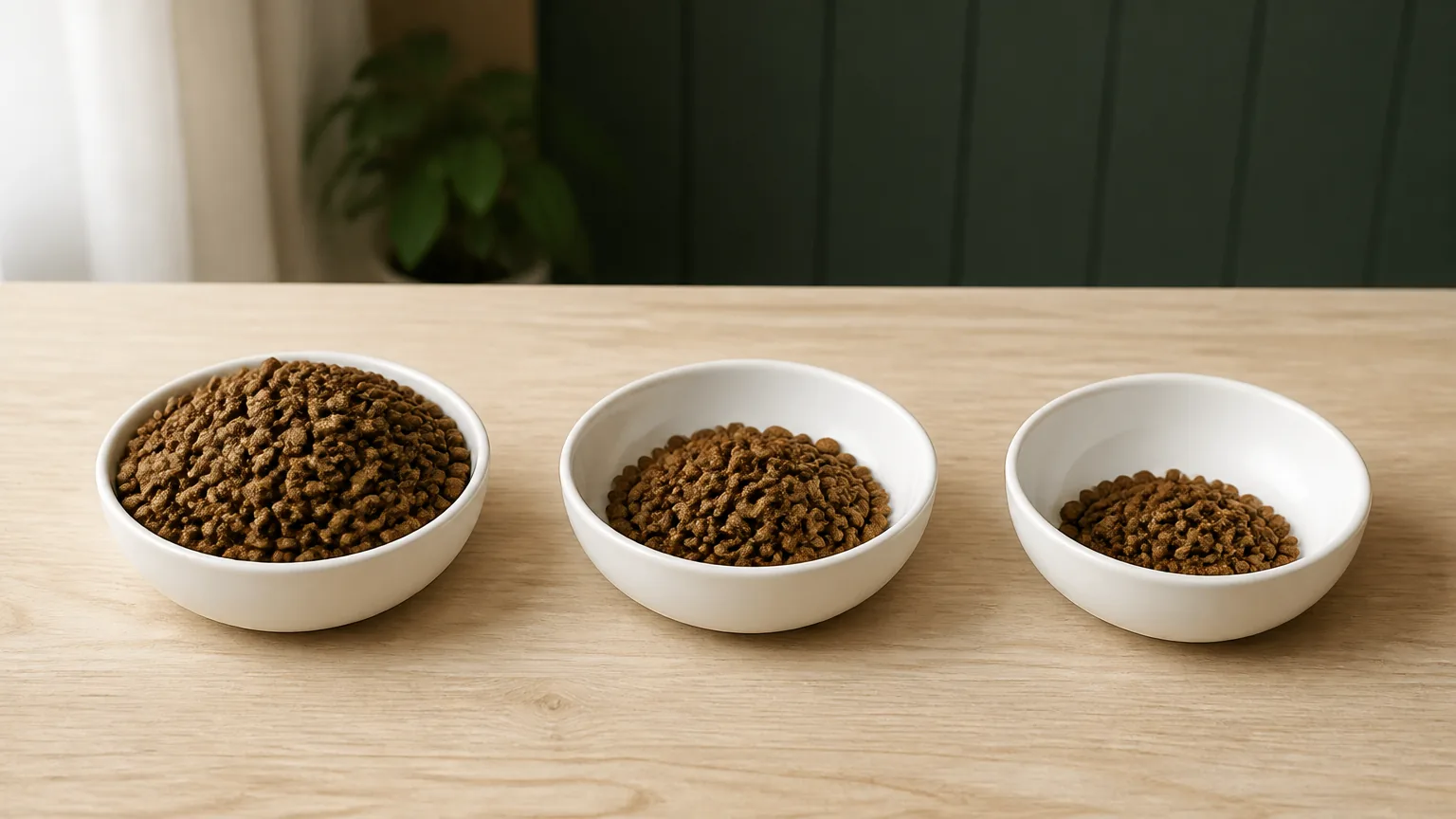
Neutering moves the number by about 10%
Neutered cats needed 56.6 kcal/kg against 63.2 kcal/kg for entire cats — a 10.4% difference, statistically significant. Most pet cats are neutered, so the lower figure is the relevant one. If your feeder still runs the portion you set when the cat was six months old and intact, that is a real gap.
Age matters less than the marketing suggests. Young cats (6 months to 2 years) sat at 59.4 kcal/kg, adults at 48.4, seniors also 48.4 — statistically indistinguishable, though only seven treatment groups reported senior data.
Why your cat may not match any of these numbers
The most useful thing in the paper is not a number. It is the spread.
Daily requirements ranged from 122.5 to 401.0 kcal — per kilogram, from 29.0 to 85.5. Two cats of identical weight can differ nearly threefold.
The body-weight model explained only 45% of that variation; run on lean body mass, 69%. The authors' conclusion: lean mass is the best predictor, and body weight alone "may not be an accurate prediction."
You cannot measure lean mass at home. You can treat 55 kcal/kg as an opening bid, and let the scale settle it.
Turning kcal into a feeder setting
Feeders dispense by volume or weight, not calories, so there is a conversion step where errors creep in.
- Find the kcal/kg on the packet. Use the per-kilogram figure over per-cup — cup measures vary with kibble shape and fill.
- Divide the daily target by energy density. A 4 kg neutered cat at 55 kcal/kg needs about 220 kcal. At 3,800 kcal/kg, that is roughly 58 g per day.
- Divide by meals. Four meals means about 14–15 g each.
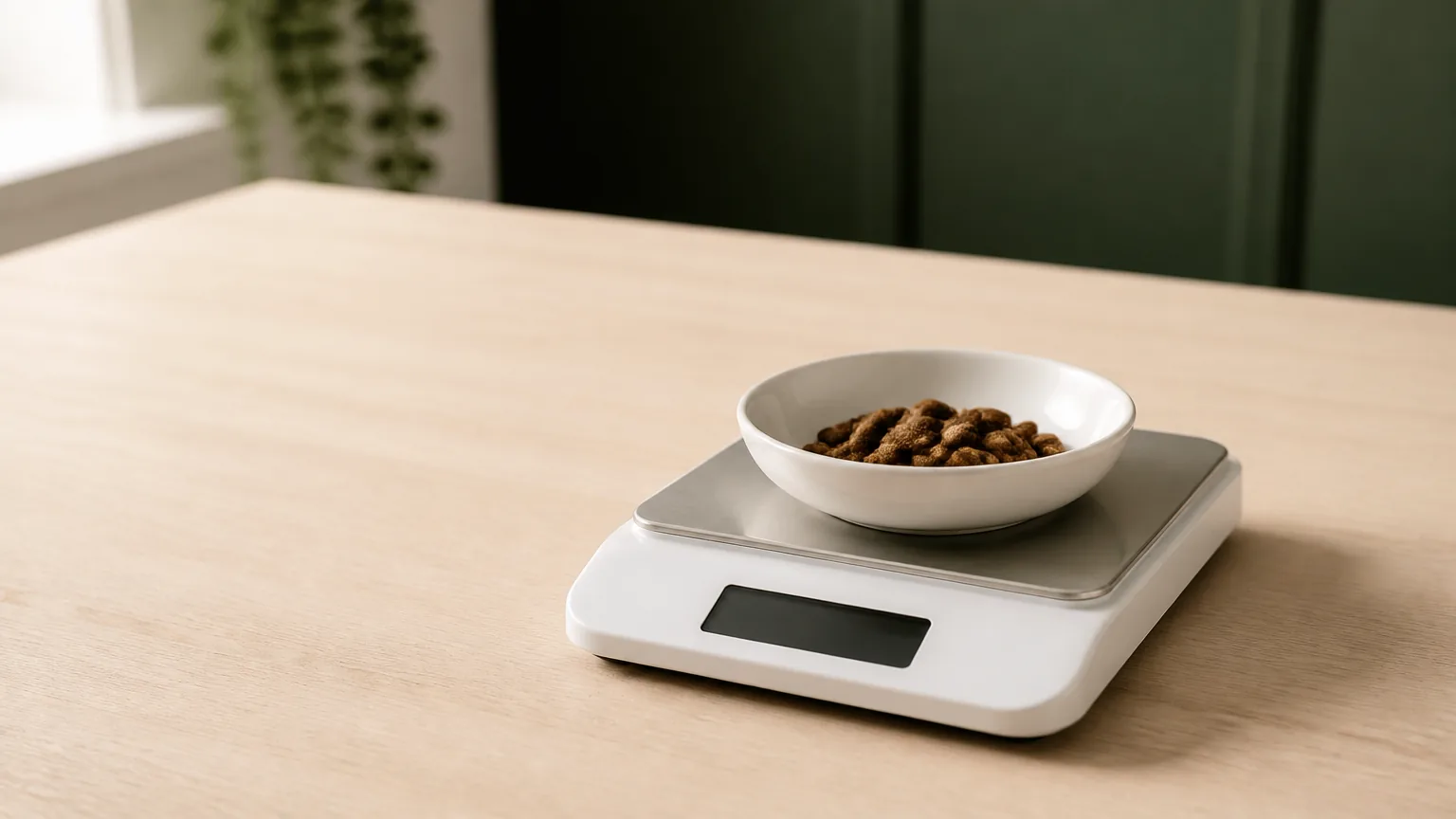
- Weigh what the feeder actually dispenses. Run your target portion into a bowl on a kitchen scale, three times, and average. Auger-driven feeders vary between cycles; the number in the app is a nominal setting, not a measurement.
- Weigh the cat every two weeks for six weeks. Same scale, same time of day.
Step 4 is the one people skip, and it decides whether any of the preceding arithmetic survives contact with the machine.
That machine-versus-person gap is larger than most people expect. In a six-month trial, cats fed the identical calorie target by hand reached ideal body condition 0% of the time, against 83.2% for the feeder group — the full breakdown is in our automatic pet feeder guide.
Wet food changes the arithmetic
Wet food runs roughly 70–80% moisture, so calorie density per gram is a fraction of dry. A portion that looks generous in the tray may sit well under target. There is also a spoilage limit unrelated to portion size — where the two-hour rule holds and where it breaks is covered in how long wet food can sit in an automatic feeder.
Meal frequency is a separate question
Splitting 220 kcal into two meals or five changes the schedule, not the total. Whether frequency itself affects weight is a different argument, and the controlled trial on it measured something narrower than the headlines suggested — that is set out in free feeding vs scheduled feeding.
What matters here is that more meals means smaller portions, and smaller portions expose dispensing error. A feeder 2 g off per cycle matters far more at 14 g than at 55 g.
Where this evidence stops
Almost none of these cats lived in a house. Of 123 treatment groups, 120 were colony cats; three were pets. The authors note there are no published reports on energy expenditure of cats in domestic homes — and suspect home cats may need more, having more freedom to move.
There is no body condition scoring. Cats were sorted by weight alone, assuming weight approximates condition. A muscular 5.6 kg cat and an obese 5.6 kg cat landed in the same bucket.
The extremes are barely covered. The prediction equations for light and heavy cats both returned an adjusted R² of 0.000 — the paper says so directly. Seven treatment groups for senior cats.
Method shifted the result. Indirect calorimetry gave 50.0 kcal/kg, feeding trials 58.6, doubly-labelled water 59.2 (P < 0.01). Some spread is the cats; some is the instrument.
Colony populations standing in for pet cats is a pattern we keep hitting — the same limitation shaped how long it takes a cat to accept a new litter box, where the cats were purpose-bred and pre-screened.
A note on who did the work
The paper states it received no specific grant from any funding agency, public, commercial or not-for-profit. It also states the literature review, meta-analysis and writing were conducted at the Waltham Centre for Pet Nutrition, which belongs to a pet food manufacturer, and cites unpublished Waltham results supporting one methodological assumption. Both facts are in the paper. Neither invalidates a meta-analysis of forty-two independent publications, but you are entitled to weigh them.
What we sell, and what we do not
We make a programmable automatic feeder. It dispenses dry food on a schedule you set. It does not know your cat's lean body mass, and neither does any other feeder on the market — which is exactly why step 4, weighing what actually comes out, matters more than any setting in any app.
We have run no feeding trials of our own. Nothing above was tested on our product.
---
Sources
- Bermingham EN, Thomas DG, Morris PJ, Hawthorne AJ (2010). Energy requirements of adult cats. British Journal of Nutrition 103(8):1083-93. Meta-analysis, full text read. 42 publications, 1,933 cats, 115 treatment groups after exclusions. Declares no specific grant; work conducted at the Waltham Centre for Pet Nutrition.
- National Research Council maintenance equations (100 kcal/kg BW^-0.67 for light and normal cats; 130 kcal/kg BW^-0.40 for heavy cats) are quoted as reported and compared within Bermingham et al. 2010, not read separately.
What we do not claim: we hold no feeding data of our own. The 55 kcal/kg figure is a population mean drawn overwhelmingly from colony cats, and the same dataset shows individual requirements spanning nearly threefold. Treat it as a starting point corrected by weighing your cat. Unexpected weight change warrants a vet, not a feeder adjustment — it is a symptom before it is a maths problem.
Related reading
- How Long Can Wet Food Sit in an Automatic Feeder? The Two-Hour Rule and Where It Breaks
- Free Feeding vs Scheduled Feeding Cats: What the Controlled Trial Actually Measured
- How Long Does It Take a Cat to Accept a New Litter Box? In One Study, No Adjustment Period Appeared at All