Editorial — Published 2026-08-03 — By Wangzian, Pet Lifestyle Curator
Do Cooling Mats Work for Cats? What Five Cats Taught Us in One Summer
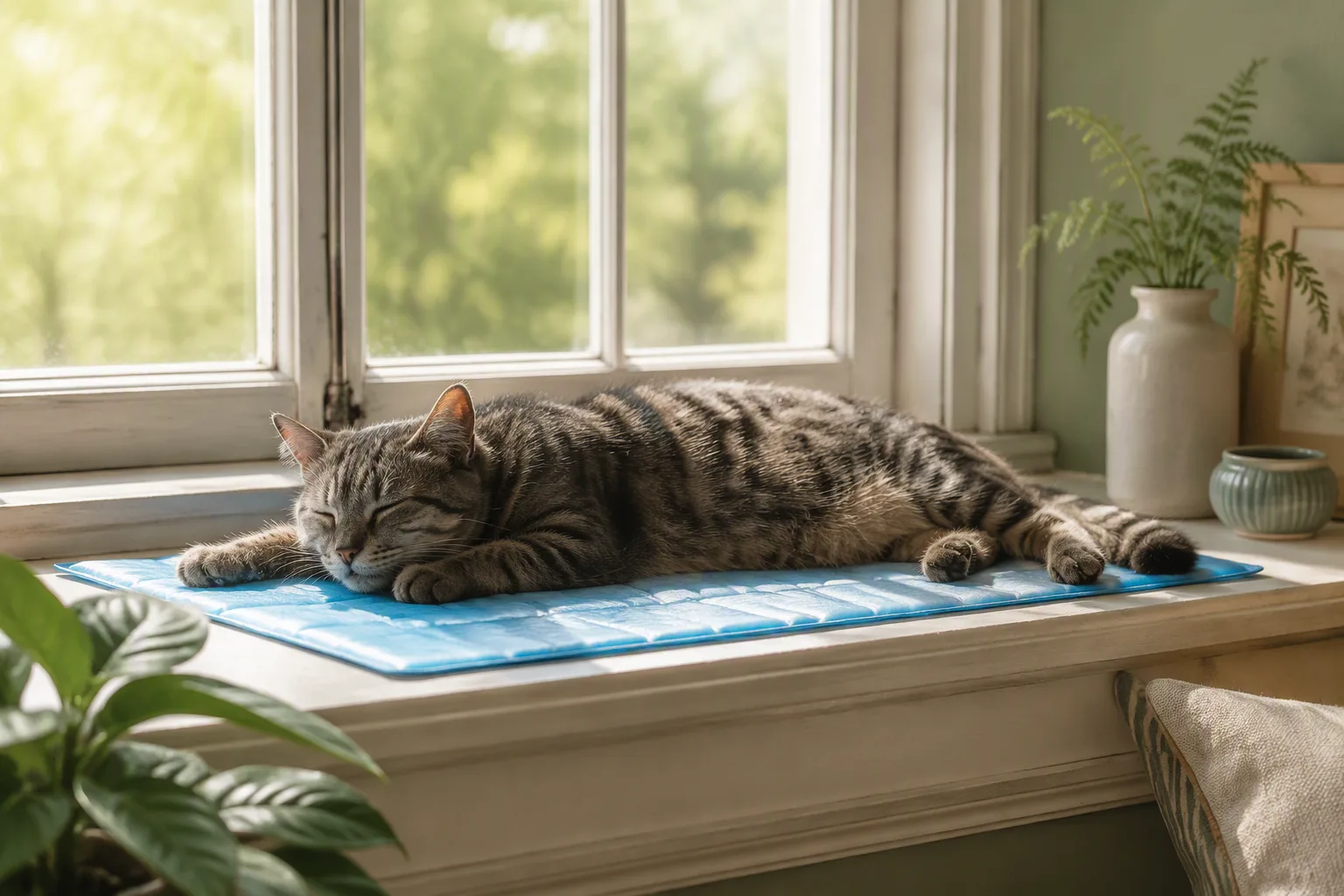
Short answer: cooling mats do work for cats — the physics is identical to dogs, and a gel mat will sit 5–7°C below room temperature under a resting body. The catch is behavioral, not thermal. In our test room, three of five cats used the mat regularly, one used it only in the hottest week, and one never touched it. Whether a cooling mat "works" for your cat is mostly a question of whether your cat agrees to lie on it.
That gap between physics and feline opinion is the whole story, and it's why so many owners report a cooling mat was a waste of money while others swear by it.
Why cats are a harder sell than dogs
Dogs will flop onto whatever surface is coolest. Cats negotiate.
Part of it is thermal biology. A cat's thermoneutral zone — the ambient range where it doesn't need to spend energy heating or cooling itself — sits roughly between 30°C and 38°C, noticeably higher than ours. Cats evolved from desert ancestors and genuinely like being warm. At 28°C, when you're uncomfortable, your cat is often still in its comfort band and has no reason to seek a cool surface.
The other part is texture. Cats make surface decisions with their paw pads and their whiskers before they commit their body. A gel mat's slick vinyl is nothing like the fabric, cardboard, or fur they normally choose. Two of our five test cats approached the mat, tapped it, felt the cool slick surface, and walked away — a rejection that had nothing to do with temperature.
What actually made cats use it
We ran our five test-room cats through a summer with the same mats we tested on dogs in the dog cooling mat guide. Three changes moved the needle:
1. Put it where they already sleep, not where you want them to sleep. The single biggest factor. When we placed a mat in a new corner, usage was near zero. When we placed the same mat on the windowsill spot and the top shelf of the cat tree — places they'd already chosen — two cats adopted it within a day.
2. Cover half of it. Laying a thin cotton tea towel over one half of the mat gave a texture bridge. Cats would lie on the fabric side first, then over several days migrate onto the bare gel. The cat who "never touched it" started using it in week three after we added a towel.
3. Never trap them on it. We tried lining a cat bed entirely with mat material. Result: complete avoidance. Cats need to be able to step off and self-regulate. A mat should be one option in a room, never the only surface.
When a cat actually needs cooling
Here's the part worth taking seriously. Because cats tolerate heat better than dogs, the signs that they've stopped coping are subtler — and appear later.
| Sign | What it means |
|---|---|
| Sprawling out, flat on side, seeking tile or bath | Normal heat management, no concern |
| Grooming more than usual | Early self-cooling via saliva evaporation; watch water intake |
| Restlessness, seeking new cool spots repeatedly | Heat is becoming uncomfortable; add cooling options |
| Open-mouth panting | Abnormal in cats — call a vet |
| Drooling, lethargy, vomiting, red gums | Heat stress escalating; emergency |
That fourth row is the one to memorize. Panting in a dog is a cooling mechanism; panting in a cat is a distress signal. According to the Cornell Feline Health Center, open-mouth breathing in cats warrants immediate veterinary attention — it can indicate heat stress, respiratory disease, or cardiac trouble, and none of those wait. If you're unsure how heat emergencies escalate, the same logic we mapped out for dogs in signs of heatstroke in dogs applies, but the threshold for calling a vet in cats is far lower.
Cooling mat vs. the alternatives cats often prefer
Honest comparison from a summer of watching:
- Ceramic or tile floor: free, and several cats will always choose it over any product. Bathroom tile was the most popular "cooling surface" in our test room, beating the mats.
- Elevated mesh bed: airflow underneath does more for a cat than contact cooling does, and cats tend to accept the fabric texture readily.
- A cool room with shade: closing curtains on the sunny side dropped our test room by 2–3°C, which helped every cat, including the mat refusers.
- Water intake: this one is underrated. A dehydrated cat cools less efficiently, and cats are chronically poor drinkers. We saw more heat-related restlessness in the cats who drank least, which is part of why we're strict about fountain maintenance — a fountain the cat avoids because it smells stale is worse than no fountain.
A cooling mat is a good addition to this list, not a replacement for it. We keep mats, mesh beds, and clean water on the same supply rotation precisely because different cats pick different solutions.
So should you buy one?
Buy one if: you have a flat-faced breed (Persians and Himalayans handle heat poorly), an overweight or senior cat, a long-haired cat, or a home without air conditioning. In those cases, even a 50% chance your cat adopts it is worth the price of one mat.
Skip it if: your cat already has tile, shade, and good airflow, and shows none of the early signs above. You'd be buying a product to solve a problem your house has already solved.
And if you do buy one, budget three weeks before you judge it. Two of our three adopters didn't use the mat at all in the first week. Cats decide slowly, and a mat that looks ignored on day four is often in daily use by day twenty.
Sources referenced: Cornell Feline Health Center (vet.cornell.edu) guidance on feline respiratory distress and heat stress; feline thermoneutral zone figures from published small-animal thermoregulation literature; behavioral observations from our own five-cat test room over one summer.
Related reading
- Dog Cooling Mat Guide: How to Keep Your Dog Cool in Summer
- How Often Should You Clean a Cat Water Fountain?
- XueQiu Pets water, feeding and replacement parts