Editorial — Published 2026-08-11 — By Wangzian, Pet Lifestyle Curator
Does Feliscratch Actually Work? Three Studies, and Who Paid for Them
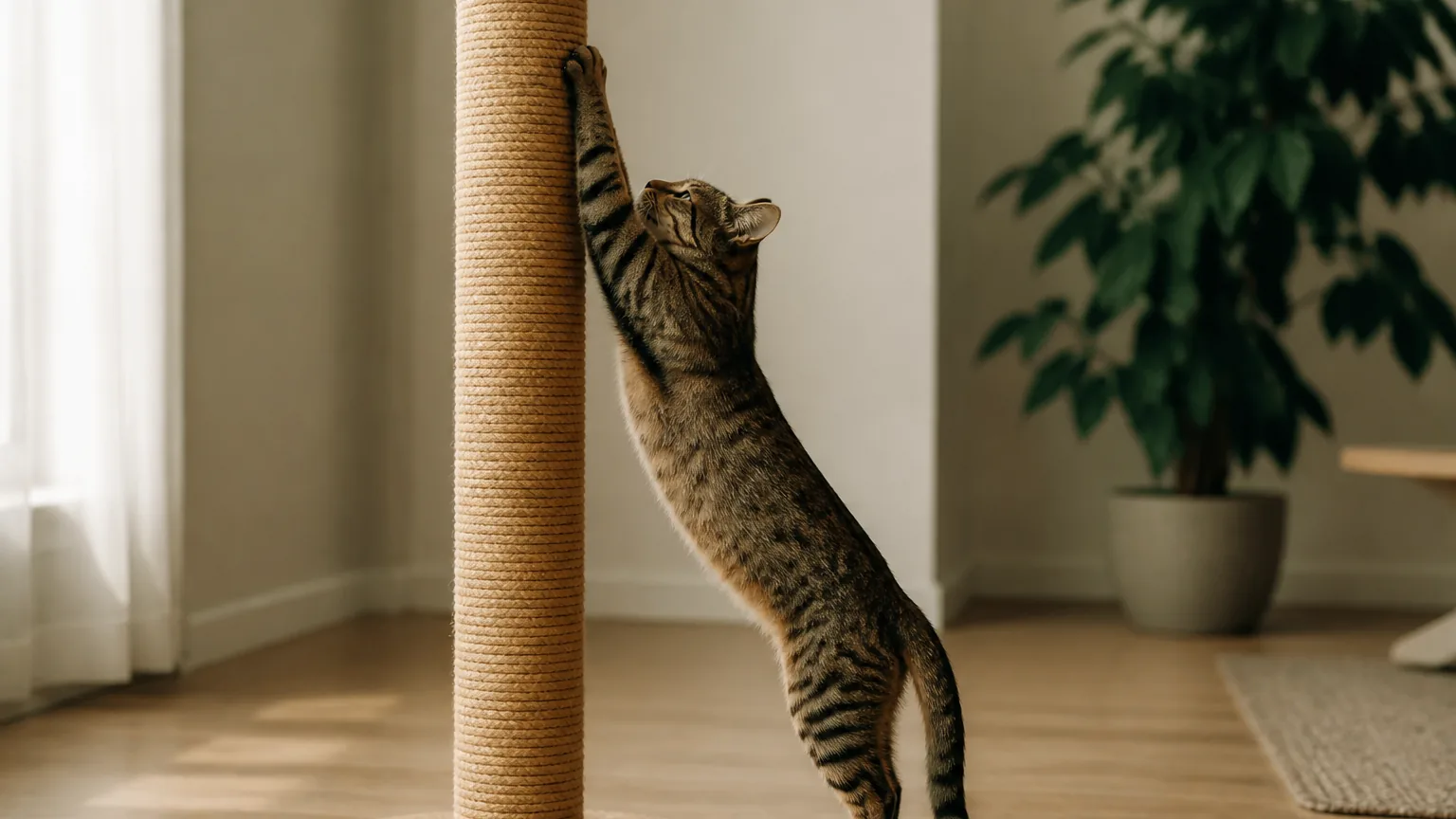
Probably, but the evidence is thinner than the packaging suggests. A veterinary evidence review graded it weak: three studies exist, the two that found clear benefit both have a commercial tie to the manufacturer, and the one independent trial missed statistical significance at p = 0.06.
That is not the same as saying it does not work. It is saying nobody has yet proven it does, to the standard you would want before spending money on it.
What the three studies actually found
In 2021 a University College Dublin student ran a formal PICO review for Veterinary Evidence, peer-reviewed by two feline specialists. The question was narrow: does the synthetic feline interdigital semiochemical, plus a scratching post, beat a scratching post alone?
Three studies existed. Here is all of them.
| Study | Design | Cats | Result |
|---|---|---|---|
| Cozzi et al. 2013 | Randomised, blinded, crossover | 19 | Scratching duration 44.2s with FIS vs 11.1s placebo. Significant. |
| Beck et al. 2018 | Open, uncontrolled, no placebo | 166 | 89% reduced or stopped unwanted scratching |
| Zhang & McGlone 2020 | Randomised, unblinded, placebo | 20 | 4.49 vs 3.71 interactions. p = 0.06 — not significant. |
Now the part that changes how you read that table.
Cozzi 2013 reported no commercial funding. But one of its authors, Pageat, had previously developed Feliway for Ceva, and in 2017 obtained the US patent for Feliscratch itself.
Beck 2018 — the 89% figure, the one you see quoted everywhere — was funded by Ceva Animal Health, the company that manufactures the product. It also had no placebo group and no control. Owners self-reported improvement over time. Cats settle into new homes over two weeks regardless of what you spray on the furniture.
Zhang & McGlone 2020 is the only trial with no commercial connection. It is also the only one that failed to reach significance.
The pattern is hard to unsee: the two studies showing clear benefit both trace back to the patent holder or the manufacturer, and the independent one did not replicate it.
What the independent study found instead
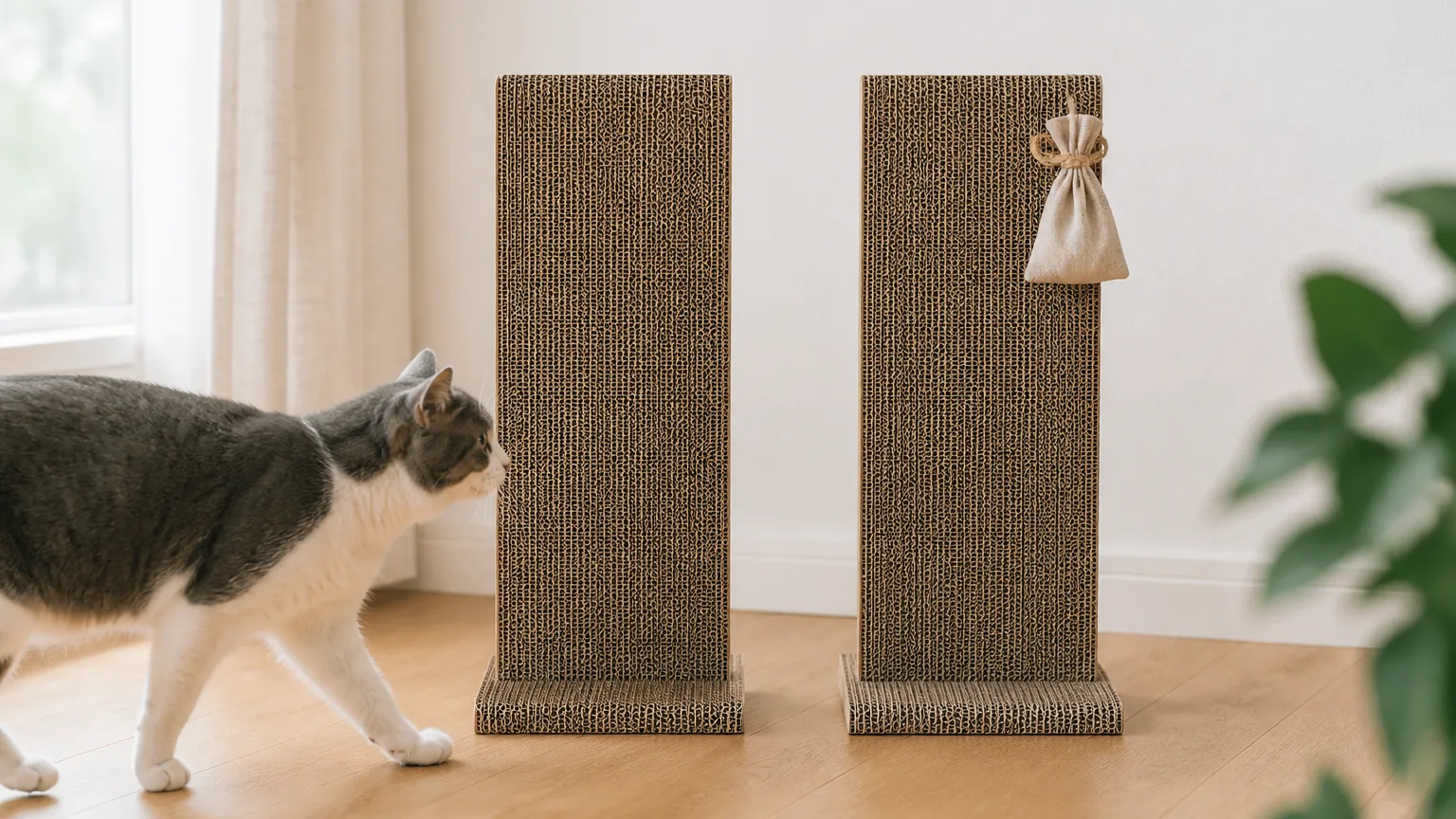
Zhang and McGlone tested 36 in-home cats across three experiments, filmed on night-vision cameras over a week. The third experiment is the interesting one. Each cat got two identical cardboard scratchers — one plain, one carrying an added scent. Three scents were tested: catnip, powdered silver vine fruit gall, and Feliscratch.
Catnip and silver vine both significantly increased scratching. Feliscratch produced scratching levels statistically indistinguishable from an unscented sock.
A sachet of silver vine costs a few dollars and lasts months. That is the practical finding, and it came from the study with nothing to sell.
⚠️ One caveat the reviewer flagged, and it is a real one: Zhang applied the FIS to a sock hung on the post rather than squeezing the gel directly onto it as the instructions specify. That is a genuine deviation from label use, and it may explain the null result. So this is not proof the product fails — it is a failure to demonstrate that it works under a modified protocol.
What none of the studies tested
Only Beck 2018 used cats with an actual history of destructive scratching — and that is the study with no control group.
Cozzi's 19 cats had no history of problem scratching. Zhang's cats were ordinary housecats. So the two better-designed studies measured whether a scent makes a cat scratch a post it was already willing to use. That is a different question from whether it stops a cat wrecking your sofa.
If your cat already uses a post and you want it to use a second one, the evidence is mildly encouraging. If your cat is shredding the arm of your couch, almost nothing in this literature speaks to your situation.
What to do instead, in order
Zhang's first two experiments are more useful than the third, and nobody quotes them.
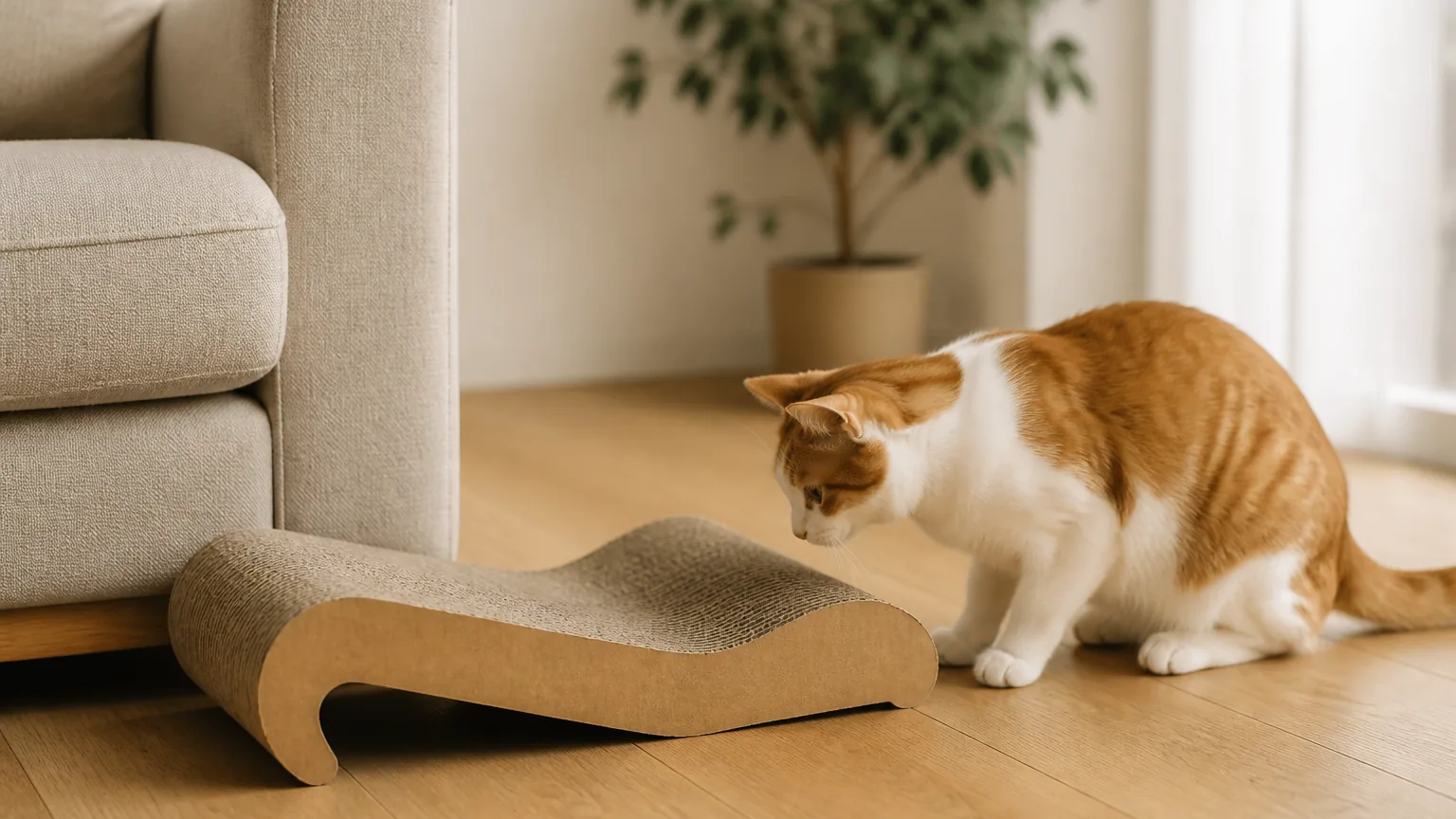
Get the orientation right. Cats preferred the tall standing scratcher over the S-shaped horizontal pad. If your cat ignores its scratcher, the shape may be the problem before the scent is.
Get the texture right. Given four vertical scratchers, cats spent the most time on cardboard and rope. Sofa fabric came last. Carpet landed in the middle — which matters, because a carpet-covered post teaches a cat that carpet is for scratching, and your floor is carpet.
Then add scent — the cheap kind. Catnip or silver vine, both of which outperformed the commercial pheromone in the only independent test.
Height and placement. At least three feet, sturdy enough not to wobble, and positioned where the cat actually spends time. A post hidden in a spare room is furniture, not enrichment.
We sell both textures the study favoured — a sisal scratch mat and a corrugated cardboard lounger — and the honest framing is that the material and position matter more than anything you spray on them.
So does Feliscratch actually work, and should you buy it?
If you have already fixed orientation, texture, height and placement and the cat still will not use the post, Feliscratch is a reasonable next thing to try. It is not dangerous and there is some evidence behind it.
But it should not be the first thing you buy, and the "9 out of 10 cats" figure on the box comes from an uncontrolled study funded by the manufacturer. Try silver vine first. It won the only head-to-head against the product, and it costs a fraction as much.
For why cats scratch in the first place, and which surfaces they choose when nobody intervenes, see why cats scratch furniture. For a similar case of a widely repeated claim that shrinks when you read the source, our review of the cat feeding evidence walks through a study that lost its qualifiers the same way.
There is also a prior question worth asking before any of this: whether the post is genuinely being refused, or whether it is being used while the sofa gets destroyed anyway. Those are different problems with different fixes, and we set out the evidence for each in why does my cat ignore the scratching post.
Sources
- Goins M (2021). Use of the feline interdigital semiochemical (FIS) to redirect unwanted scratching behaviour in cats. Veterinary Evidence 6(4). DOI 10.18849/VE.V6I4.400. Peer-reviewed PICO knowledge summary. Strength of evidence graded weak. Author declares no conflicts of interest.
- Zhang L, McGlone JJ (2020). Scratcher preferences of adult in-home cats and effects of olfactory supplements on cat scratching. Applied Animal Behaviour Science 227:104997. 36 in-home cats, three experiments, video-recorded over one week.
- Cozzi A, Lafont Lecuelle C, Monneret P, et al. (2013). Induction of scratching behaviour in cats: efficacy of synthetic feline interdigital semiochemical. Journal of Feline Medicine and Surgery 15(10):872. DOI 10.1177/1098612X13479114.
- Beck A, De Jaeger X, Collin J-F, Tynes V (2018). Effect of a synthetic feline pheromone for managing unwanted scratching. International Journal of Applied Research in Veterinary Medicine 16(1).
Funding disclosures and study limitations above are quoted from the Veterinary Evidence review, which reports them in its own appraisal section. We have reproduced them rather than omitting them, including the caveat that weakens our own conclusion.
Related reading
- Why Do Cats Scratch Furniture (And What Actually Stops It)
- Free Feeding vs Scheduled Feeding Cats: What the Controlled Trial Actually Measured
- XueQiu Pets scratchers and scratch mats