Editorial — Published 2026-08-09 — By Wangzian, Pet Lifestyle Curator
Free Feeding vs Scheduled Feeding Cats: What the Controlled Trial Actually Measured
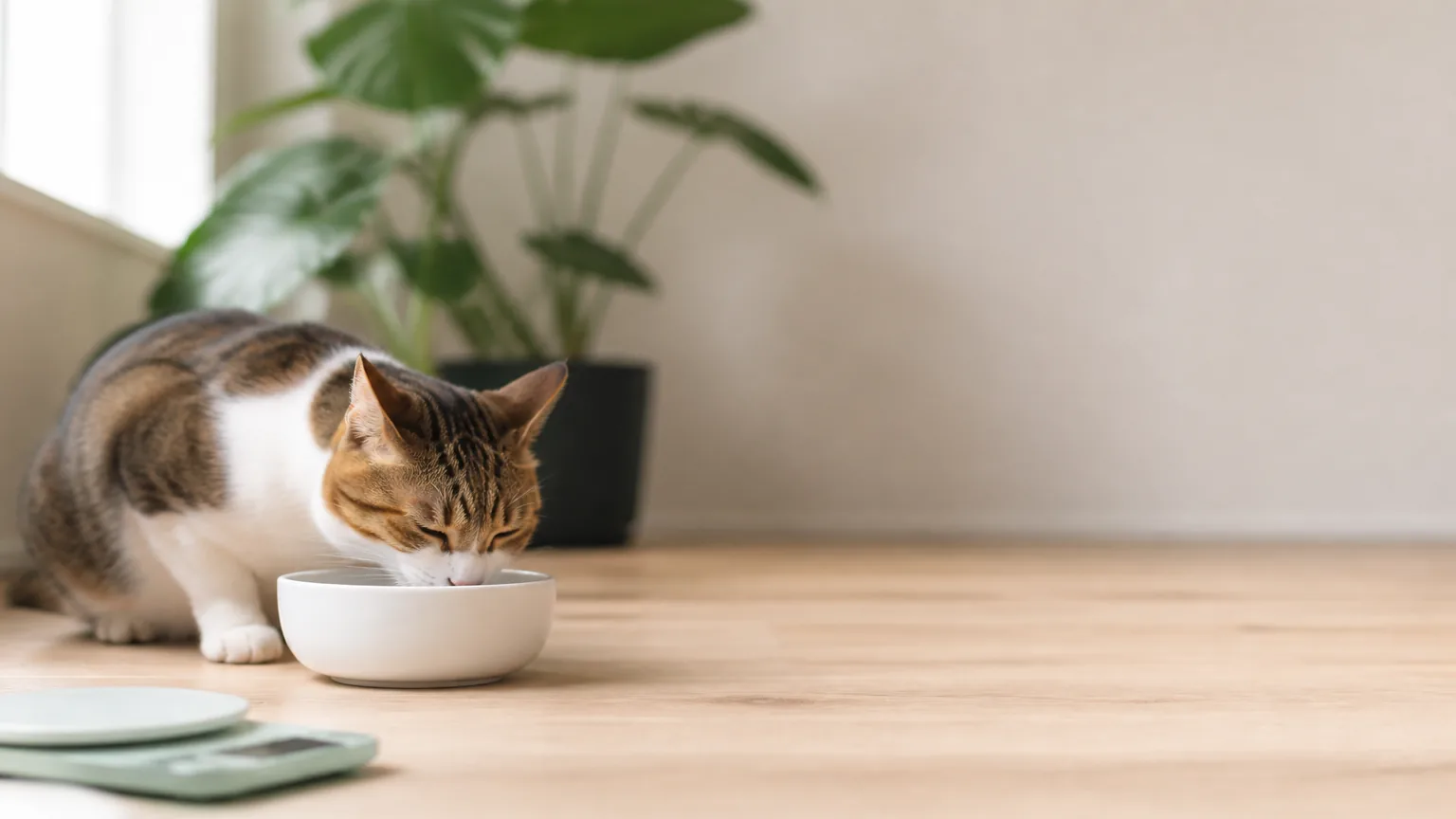
Scheduled feeding wins for most indoor cats, and the margin is larger than the usual advice suggests. A University of Guelph crossover trial found cats fed once daily had higher satiety hormones than the same cats fed four times daily. Free feeding was never tested against either.
That last sentence matters, and almost nobody says it out loud. Read on for who should ignore all of this.
What the trial did
Eight healthy adult cats, average 4.34 kg, body condition score 5.4 out of 9. Each cat ate the same canned food, at the same total calories, under two regimens: one meal at 08:00, or four meals spread from 08:00 to 18:30. Three 21-day periods, with each cat serving as its own control.
That design is the reason this study is worth more than a survey. Cats vary enormously in appetite and activity, and comparing a cat to itself removes that noise entirely.
On day 14 they drew two fasted and eleven postprandial blood samples across 24 hours, then tracked physical activity from day 15 to 21.
The result that reverses common advice
The standard recommendation — including a published consensus statement on reducing feline stress — is to split the daily ration into several small meals. The hormone data pointed the other way.
| Measure | Once daily vs four times daily |
|---|---|
| GLP-1 and GIP (satiety signals) | Higher on one meal (P<0.05) |
| PYY (satiety) | Trended higher on one meal (P<0.1) |
| Postprandial amino acids | Greater response on one meal (P<0.05) |
| Insulin | Greater on one meal (P<0.05) |
| Leptin, blood glucose | No difference |
| Body weight | No difference |
| Physical activity | Higher on four meals (P<0.05) |
| Energy expenditure | No difference |
| Fasting respiratory quotient | Lower on one meal (P<0.05) |
Two things stand out.
Satiety improved on fewer meals. Cats eating once daily showed a stronger satiety-hormone response, which is the opposite of the "little and often keeps them satisfied" logic most of us were given.
A lower fasting respiratory quotient suggests more fat being burned relative to carbohydrate between meals. Combined with the stronger amino acid response — which supports protein synthesis — the authors concluded once-daily feeding may help maintain lean body mass.
That second point matters more with age. Cats can lose roughly a third of their lean mass between ages 1–7 and age 15. Anything that protects muscle in an older cat is worth attention.
The finding that cuts the other way
Cats fed four times daily were more physically active (P<0.05).
The authors are direct about the likely reason: anticipation. A cat expecting a meal moves around more. For an indoor cat whose main health risk is inactivity and weight gain, four small meals buy you four bursts of movement a day.
So the trial does not hand you a clean winner. It hands you a trade: satiety and lean mass on one side, daily movement on the other.
What about free feeding?
Here is the part most articles gloss over. This study did not test free feeding. It compared one meal against four. Both are scheduled.
The evidence on free feeding is messier and comes from surveys rather than controlled trials, which means it cannot separate cause from effect. Some studies link free-choice feeding to weight gain; others do not. One frequently cited survey found cats fed twice daily were more likely to be obese than cats fed free-choice — the reverse of what you would expect, and a good illustration of why survey data on this question should be held loosely.
What can be said with more confidence is mechanical, not statistical: a bowl that is always full removes your ability to notice a change in appetite. Appetite loss is one of the earliest signals of illness in cats, and free feeding hides it. In a multi-cat house it also hides who is eating what.
What we actually do
Five cats, and we do not run one regimen across all of them.
Three eat twice daily on a fixed schedule. Two — both over ten — eat three times, because they lost condition on twice and gained it back on three. The trial's finding on lean mass is about hormones and amino acids under controlled conditions; the cat in front of you gets a vote.
The rule we hold to regardless of schedule: portion by weight, not by scoop. A kitchen scale costs less than one vet visit for a weight-related problem, and volume measures on kibble drift by a surprising margin depending on how you fill the cup.
If you are moving from free feeding to scheduled, do it over two weeks. Cats that have always had food available will complain, and the complaint is loudest in the first three days. Splitting the ration into more meals during the transition makes it easier, then consolidate later if you want to.
Wet food adds a constraint that dry food does not: it cannot sit out. We covered the two-hour limit, and what the bowl contamination research says about cleaning it, in how long wet food can safely sit in an automatic feeder.
One caveat on the meal-count question. A later six-month trial ran six meals a day against two, holding calories constant, and found no difference at all in weekly weight loss — what mattered was whether a machine or a person measured the portion. We set that against the once-daily finding above in our automatic pet feeder guide.
Whatever schedule you land on, water access should stay constant. Intake tracks food moisture more than most owners realise, which we went through in why cats under-drink. And if you are considering equipment to run the schedule for you, our feeding and water range includes both timed feeders and plain bowls — a plain bowl and a phone alarm does the same job for a single-cat household.
Who should ignore the once-daily finding
- Kittens and cats under one year. Growing animals need more frequent feeding; this trial used adults aged 1–4.
- Diabetic cats, or any cat on insulin. Feeding times are tied to the insulin schedule. That is a vet's decision, not a blog's.
- Cats with kidney disease, hyperthyroidism, or a history of hepatic lipidosis. Long fasts carry real risk in these animals.
- Cats that vomit bile in the morning. Some cats bring up bile after a long empty stomach. More frequent, smaller meals is the standard fix.
- Underweight or geriatric cats losing condition. Ours are the example. The hormone result did not survive contact with two ten-year-olds.
What this study cannot tell you
Eight cats. Small, even for a crossover. Small studies detect large effects and miss modest ones.
Twenty-one days per period. Long enough for hormone adaptation, nowhere near long enough to show what happens to body weight or body composition over a year. Body weight did not differ — over three weeks, which is exactly what you would expect either way.
Healthy young adults, ages 1–4. The lean-mass argument is aimed at older cats, but older cats were not in the study. That is an extrapolation, and the authors present it as one.
Canned food only. Dry food has different satiety and water dynamics. The results do not transfer automatically.
Laboratory housing. These cats lived in a controlled room with fixed lighting and no competing animals. Your kitchen is not that.
And the honest summary of the free-feeding question: the controlled evidence compares scheduled regimens to each other. The case against free feeding rests mostly on monitoring — you cannot see a problem in a bowl that is always full — rather than on a trial showing it makes cats fat.
---
Sources. Camara A, Verbrugghe A, Cargo-Froom C, Hogan K, DeVries TJ, Sanchez A, Robinson LE, Shoveller AK. The daytime feeding frequency affects appetite-regulating hormones, amino acids, physical activity, and respiratory quotient, but not energy expenditure, in adult cats fed regimens for 21 days. PLoS ONE 2020; 15(9): e0238522, doi:10.1371/journal.pone.0238522 — eight cats, replicated incomplete Latin square, three 21-day periods; University of Guelph Animal Care approval AUP#3881. Note on funding: co-author A. Verbrugghe holds the Royal Canin Veterinary Diets Endowed Chair at the Ontario Veterinary College; the authors declare no competing interests. Courcier EA et al. on feeding frequency and obesity prevalence, cited within the above. Lean body mass loss with age figures are from the review literature cited in the same paper.
How this was made. Written by Wangzian. The trial figures above are quoted from the published paper, which we read in full rather than from press coverage of it — the widely circulated headline "feed cats once a day" omits both the physical activity result and the fact that free feeding was never tested. We feed five cats on two different schedules and sell timed feeders as well as plain bowls, which is a commercial interest that the closing recommendation argues against. Drafting assistance from an AI writing tool; source selection, figures and conclusions are our own.
Related reading
- How Long Can Wet Food Sit in an Automatic Feeder? The Two-Hour Rule and Where It Breaks
- Why Is My Cat Not Drinking Water? What Six Fountains and One Vet Bill Taught Us
- The Cat Water Fountain Guide: Everything We Got Right, and the Parts We Got Wrong
- XueQiu Pets feeding and water range