Editorial — Published 2026-08-14 — By Wangzian, Pet Lifestyle Curator
Does Litter Box Size Matter for Cats? A 78-Cat Study Says Yes — With One Catch
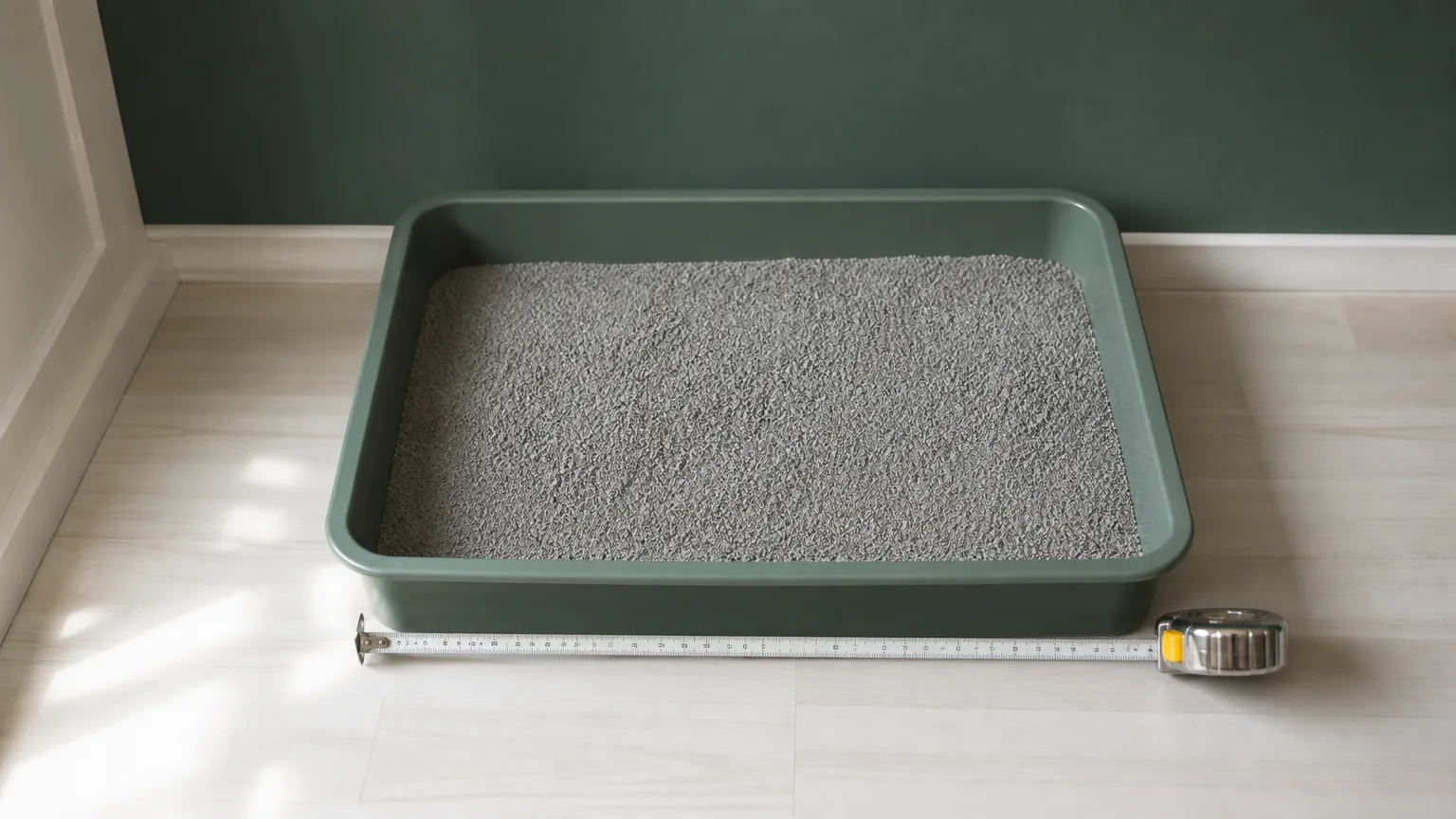
Yes, and the effect is large. When 78 cats were given a free choice between 40cm, 50cm and 60cm boxes, they used the 50cm and 60cm boxes more than twice as often as the 40cm one. But going from 50cm to 60cm bought almost nothing — and the study was run by an employee of a cat litter company.
What the numbers actually were
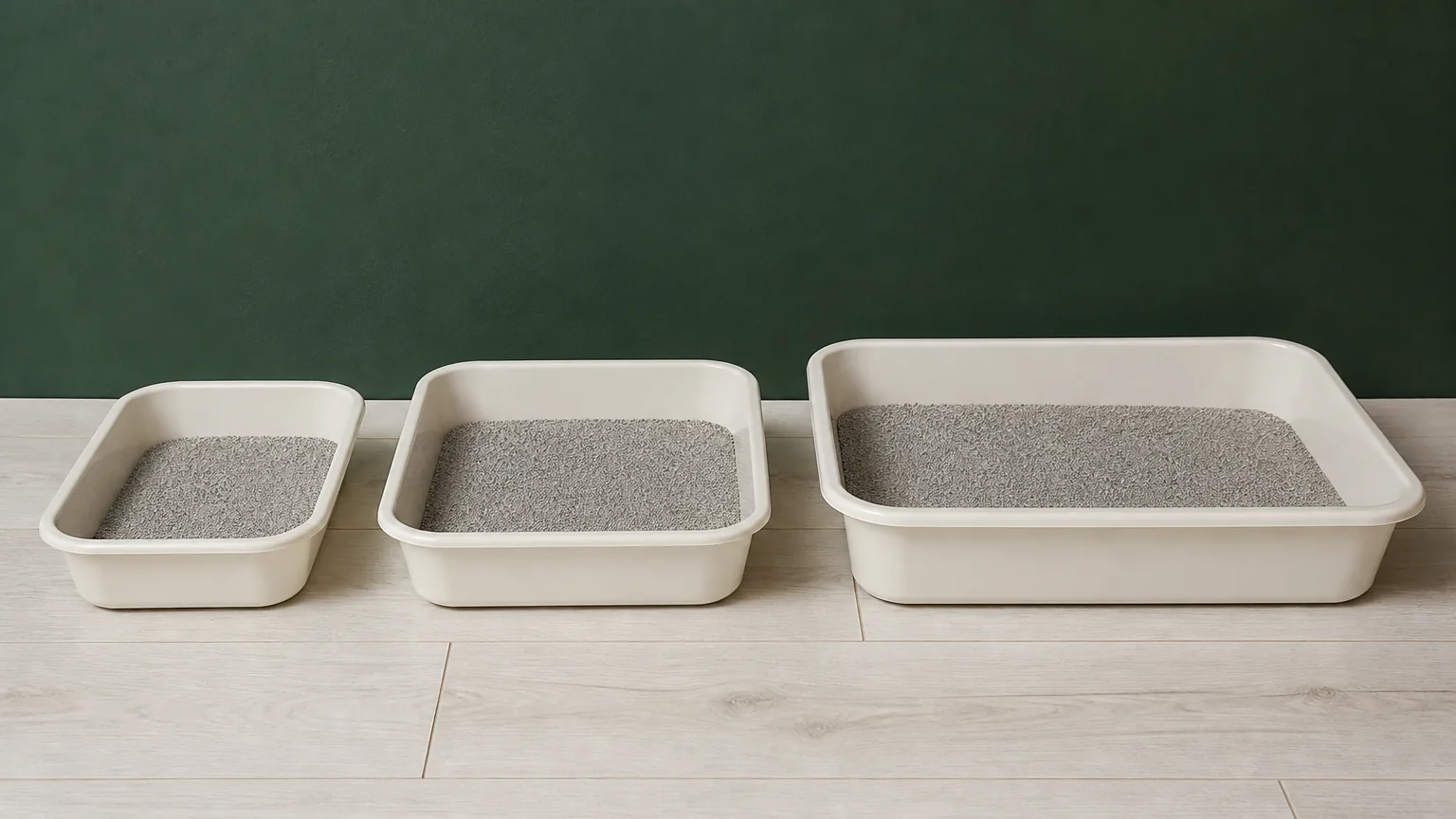
A 2025 study in the Journal of Veterinary Medical Science put three uncovered cardboard boxes — 40cm, 50cm and 60cm wide, all 20cm high and 35cm deep — into three cat cafés and filmed what happened over three days. Each room's own usual box stayed in its usual place as a control. Box positions were rotated daily so location could not skew the result.
Here is every recorded elimination:
| Box width | Uses | Share |
|---|---|---|
| 40 cm | 39 | 16.9% |
| 50 cm | 82 | 35.5% |
| 60 cm | 83 | 35.9% |
| The café's usual box | 27 | 11.7% |
231 events in total. The gap between predicted and observed use was significant at P<0.0001.
Two things in that table are worth more than the headline.
The 60cm box won by one single use. 83 versus 82. After three days and 231 events, the extra 10cm of width produced a difference of one. Anyone telling you bigger is always better is not reading this table — the curve flattens hard after 50cm.
The cafés' own boxes came last. 11.7%, below even the 40cm test box. Those weren't small: one measured 40 × 52.5cm, the other 40.5 × 50.5cm — both at or above the 50cm mark that supposedly wins. So size alone did not explain it. The authors point at the litter: both cafés used non-clumping litter, while all three test boxes held clumping clay. Which means the litter inside can override the box dimension entirely, and a size-only answer to this question is incomplete.
Where 50cm comes from
The number is not arbitrary. The researchers measured the thoracic and lumbar vertebrae of 102 cats — a length that stays stable no matter how the cat is standing, unlike the usual nose-to-tail-base measurement that changes with posture. The average came to 35.3cm. Multiply by 1.5 and you get 53cm, which is where the 50cm reference size came from.
That gives the old "1.5 times your cat's length" rule of thumb something it never had: a measurement you can actually take without a wriggling cat ruining it. The advice was already circulating on Reddit and in vet blogs; what was missing was the anatomical basis and a use count to back it.
For a medium mixed-breed cat, 50cm is the working number. The study explicitly flags that most participants were medium-sized mixed breeds and that larger cats will need more — so if you have a Maine Coon, this study does not cover you, and the authors say so.
The conflict of interest, stated plainly
The first author is an employee of Lion Pet Co., Ltd. — a company that sells cat litter and litter boxes. The paper discloses this. It also mentions, in the methods, that experiments 2 and 3 used a "Cat litter box developed by a veterinarian, Lion Pet Co., Ltd." and three litter products all made by Lion Pet.
So a litter company ran a study finding that cats prefer bigger boxes and clumping clay litter, using its own products, and the company sells both.
That does not make the results wrong. Three details argue for taking them seriously:
- The design was a free-choice preference test filmed on video, not a survey of owner opinions. The cats voted with their bodies and someone counted.
- Box positions rotated daily to cancel out location preference.
- The finding replicates independent work. Guy, Hopson and Vanderstichel (2014) compared 56 × 38cm against 86 × 39cm boxes in real homes and also found cats preferred the larger one. Different country, different team, no litter company, same direction.
What the funding should make you cautious about is not the direction of the effect but the specific product recommendation that follows from it. "Cats prefer boxes ≥50cm" is supported by two independent lines of evidence. "Therefore buy this particular box and this particular litter" is the part with a commercial interest attached.
What this does not tell you
The house-soiling result gets quoted the most and deserves the most caution. In experiment 3, 20 cats with existing elimination problems were given the preferred box and the preferred litter together. Urination inside the box rose significantly, and accidents outside it fell.
But the box and the litter were changed at the same time, so the study cannot tell you which one did the work. Given that the cafés' own large-but-non-clumping boxes came dead last in experiment 1, the litter may be carrying more of the effect than the dimension is.
Two more limits worth knowing:
- Defecation did not follow the pattern. The bias was significant for urination (P<0.01) but not for defecation. Whatever drives box choice, it shows up more clearly when cats pee.
- Experiment 3 had no untreated control group — every cat received the intervention, in a crossover order. Improvement over two weeks is not proof the box caused it.
So does litter box size matter for cats — in practice?
If your cat is eliminating outside the box, the veterinary route comes first: the study's own authors screened out cats with medical causes using urine tests, X-rays and ultrasound before enrolling them. Idiopathic cystitis and other conditions look exactly like a litter box preference problem from the outside.
If medical causes are ruled out, the practical reading is:
- Measure your cat's back, not the box. Feel along the spine from the base of the neck to the hips. Multiply by 1.5. For an average cat that lands near 50cm.
- Stop at around 50cm unless your cat is large. The data shows no meaningful gain from 60cm, and a smaller footprint is easier to place in a real room — which is the entire reason the researchers chose to test the smallest comfortable size rather than the biggest.
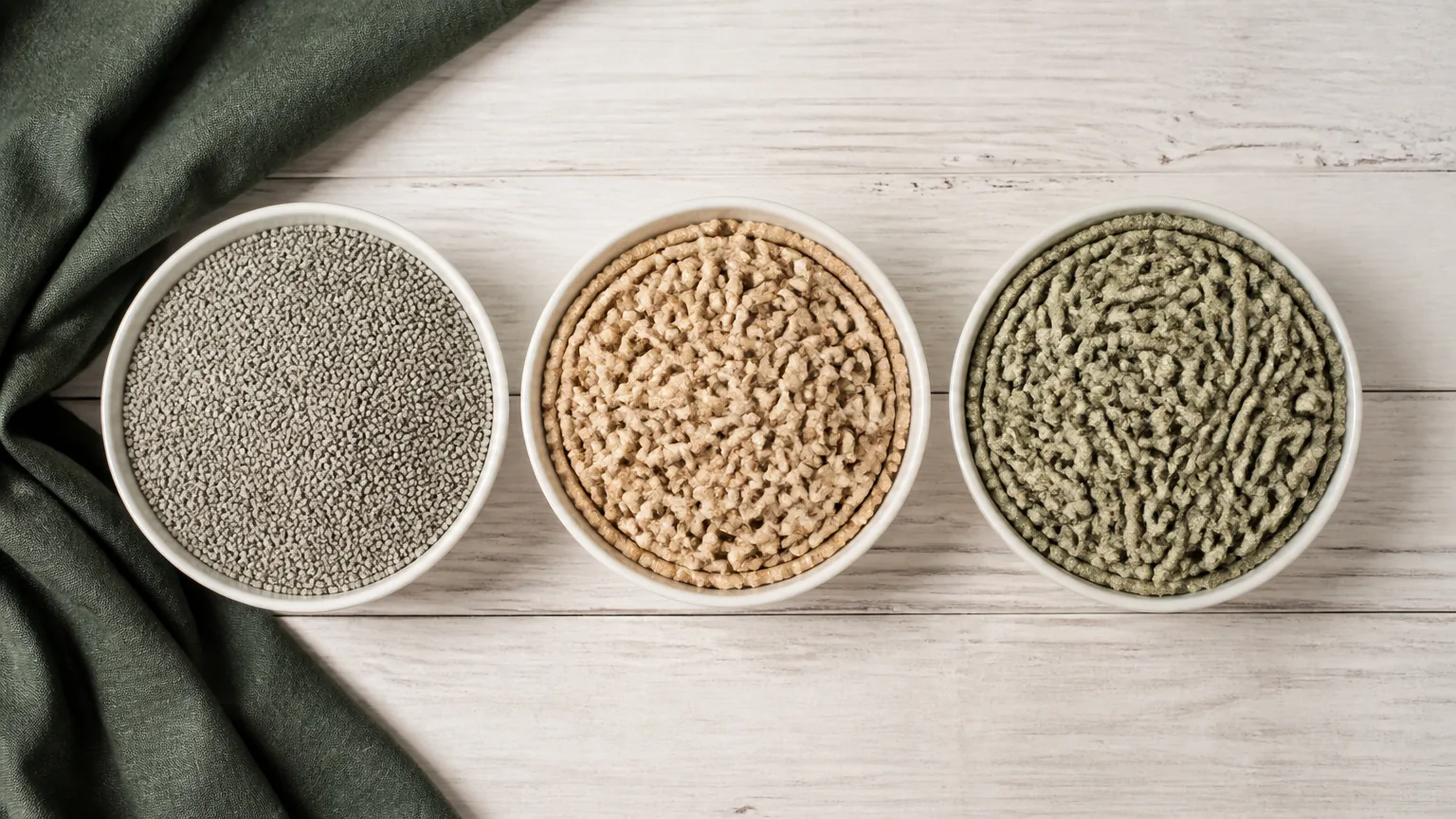
- Check what's inside before replacing the box. Clumping clay drew 258 uses against 152 for wood and 66 for paper. If your large box is filled with pellets, the box may not be the problem.
- Height and cover were not tested here. All test boxes were 20cm high and uncovered. This study says nothing about lids.
- A 50cm box still has to fit somewhere. In a one-bedroom flat that is the binding constraint, and it usually pushes people toward a smaller covered box instead. Why that trade often goes the wrong way is covered in where to put a litter box in a small apartment.
We do not sell litter boxes
Worth stating outright: we have no litter box to sell you, so there is no product at the end of this article. If there were, you would be right to weigh this write-up the same way I have asked you to weigh the Lion Pet study.
The one adjacent thing we do make is a lidded waste bin for scooped litter — a disposal problem, not a box-size one. It does not make your cat's box any bigger.
For behaviour that looks like a litter box problem but isn't, why cats scratch furniture covers the same trap from a different angle: the obvious explanation for a cat's behaviour is often not the one the evidence supports. And if you are reading this because something changed in your cat's routine recently, what carrier training actually fixes documents a case where a well-run study found a real effect — just not the one everyone quotes it for.
---
Sources
- Iwabuchi-Inoue Y, Hattori Y, Kikusui T (2025). Litter box size and litter type preference and their associated behavioral changes in cats. Journal of Veterinary Medical Science 87(6):614–620. DOI 10.1292/jvms.24-0468. Open access, full text read. Experiment 1: 78 cats, three cat cafés, three days, 231 recorded eliminations. Experiment 2: 46 cats, litter type. Experiment 3: 20 cats with existing house-soiling. Conflict of interest declared in the paper: the first author is an employee of Lion Pet Co., Ltd., which manufactures the litter and litter box used in experiments 2 and 3.
- Guy NC, Hopson M, Vanderstichel R (2014). Litterbox size preference in domestic cats (Felis catus). Journal of Veterinary Behavior 9:78–82. DOI 10.1016/j.jveb.2013.11.001. Cited here as the independent replication of the size effect (56 × 38cm vs 86 × 39cm, larger preferred). Referenced via the 2025 paper's discussion section; we have not read the full text, and the exact use counts are therefore not quoted.
On the numbers: every figure in the table above is taken directly from Table 1 of the 2025 paper. The 60cm-beats-50cm-by-one observation, the last-place finish of the cafés' own boxes, and the urination-versus-defecation split are our readings of that table and of the results section, not claims made in the paper's abstract.
What we do not claim: we sell no litter box and have no data of our own on box size. This is not veterinary advice for your individual cat, and elimination problems warrant a vet visit before a shopping trip.
Related reading
- Why Cats Scratch Furniture — And What the Evidence Actually Supports
- Cat Hides When the Carrier Comes Out? Here Is What Training Actually Fixes
- XueQiu Pets lidded litter waste bin