Editorial — Published 2026-08-24 — By Wangzian, Pet Lifestyle Curator
Where to Put a Litter Box in a Small Apartment: What 3,106 Cats Reveal About the Bathroom Default
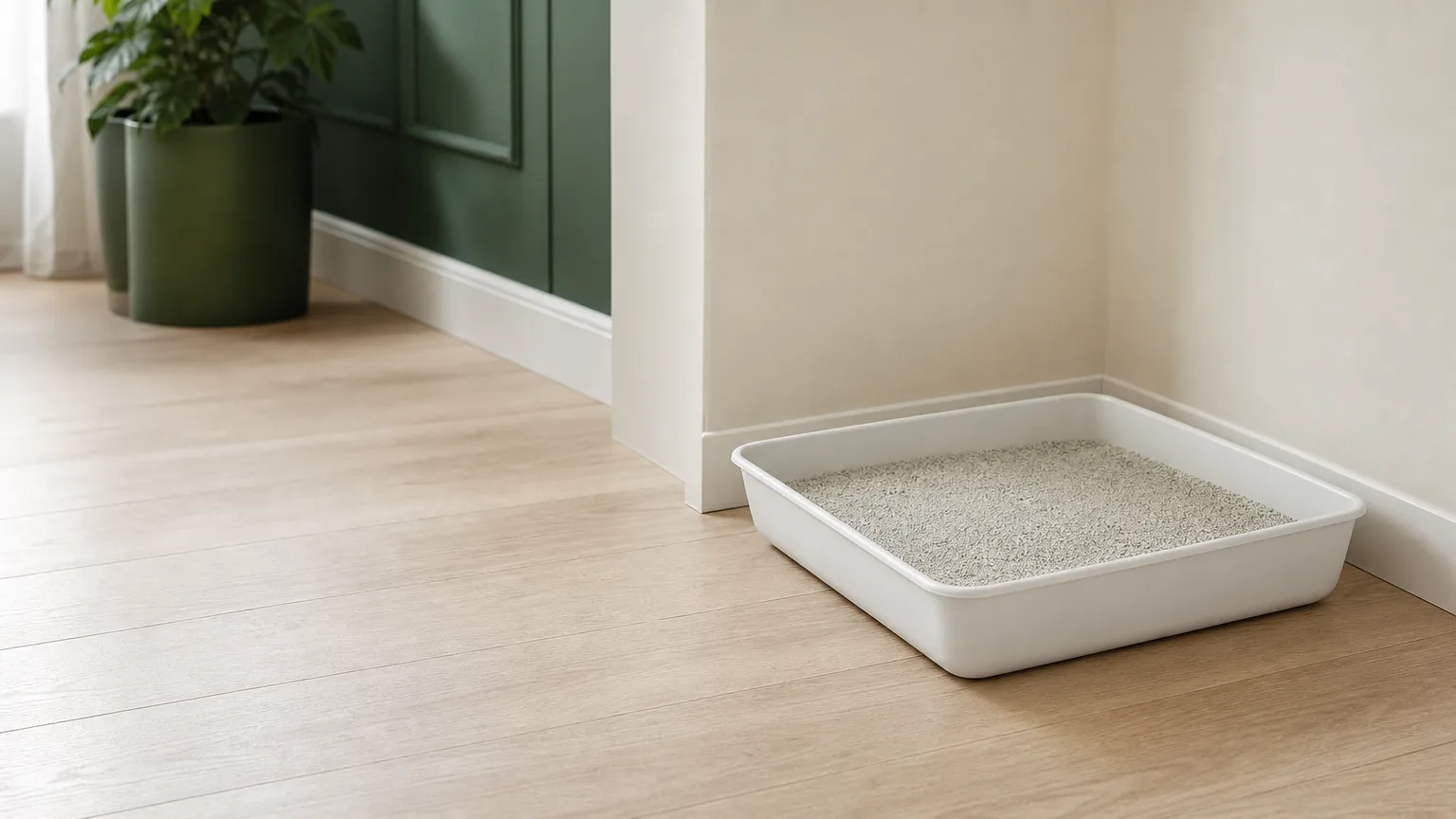
Put the litter box where the cat already spends time, on an escape route with two ways out, and away from food and water. In a survey of 3,106 cats, 51.92% of owners chose the bathroom — and among cats that soiled indoors, 28.25% went right beside the tray rather than in it.
This is the summary page for everything we have written about litter boxes. Each section gives the finding, its size, and where the evidence runs out. Where we have covered something in depth there is a link rather than a repetition.
The number that reframes the whole problem
Most placement advice assumes your cat dislikes the box. The Italian data suggest something different.
Of 520 cats reported soiling indoors, 28.25% eliminated near the litter box and 64.64% consistently used the same spot. A cat that repeatedly goes to one specific place a metre from its tray is not expressing a preference for your rug. It is telling you something about the tray or its surroundings that stops it completing the trip.
Only 17.12% of those cats had a known health problem, so this is overwhelmingly behavioural or environmental rather than medical. Get a vet to rule out disease first anyway — nearly half of the ones with a health issue had urinary tract disease.
Where people actually put a litter box in a small apartment
The survey ran in Italy, where 69.86% of respondents lived in apartments and 69.51% had no garden. That makes it an unusually good match for anyone reading this in a flat.
| Practice | Share of households |
|---|---|
| Litter box in the bathroom | 51.92% |
| Only one litter box in the home | 47.33% |
| Covered box | 51.38% |
| Scooped at least daily | 80.58% |
| Fully replaced at least weekly | 59.11% |
The median household had 1 box per cat. In multi-cat homes the median dropped to 0.7 — fewer boxes than cats. The paper states plainly that this runs contrary to what the research recommends.
The bathroom is not automatically wrong
Half of these owners chose the bathroom, and the overall soiling rate was 16.74% — lower than the 51% to 79% reported in earlier clinical samples. So the bathroom default is not producing an epidemic.
What matters is what the bathroom is like in your flat. Three things make any location fail:
A single entrance. A box in a narrow alcove or behind a door has one way in and one way out. In a multi-cat home that is a place to get cornered.
Traffic and noise. A washing machine on spin cycle beside the tray is a reason to go elsewhere.
A door that closes. The most common small-flat failure is not placement at all — it is the bathroom door being shut for six hours.
The number that is genuinely hard to interpret
One figure in this survey deserves scepticism rather than repetition.
The soiling rate came in at 16.74%. The researchers had powered the study expecting roughly 65%, based on two earlier clinical samples reporting 59–79% and 51.2%. That is a very large gap.
Three explanations are plausible and the data cannot separate them. Italian owners may genuinely manage litter better. The earlier figures came from cats already referred for behaviour problems, so they were never going to represent the general population. Or owners who volunteer for a litter survey are simply not typical.
The honest reading is that 16.74% is a floor for self-reporting households, not a population rate. Treat it as evidence that most flats work fine, not as a benchmark to measure yours against.
Distance from food and water
This is the rule everyone repeats, and it has less measured support than you would expect. The frequently quoted separation figures come from convention rather than controlled trials.
We went through what the spacing evidence does and does not establish in how far apart should litter boxes be — the short version is that the exact distance is far less settled than the confident numbers online suggest.
In a studio flat you may not have the option anyway. Prioritise in this order: separate rooms if possible, then opposite corners, then any physical barrier that breaks line of sight between the tray and the bowl.
Size beats position
If your flat only allows one location, spend your effort on the box rather than the spot.
Larger boxes get used more, and the effect is substantial — the detail, including who funded the study that found it, is in does litter box size matter for cats.
This creates a real tension in small flats. The box that performs best is bigger than the one that fits neatly beside the toilet. A useful compromise: a large uncovered tray in a low-traffic corner usually beats a small covered one in the theoretically perfect location.
Covered boxes in small spaces
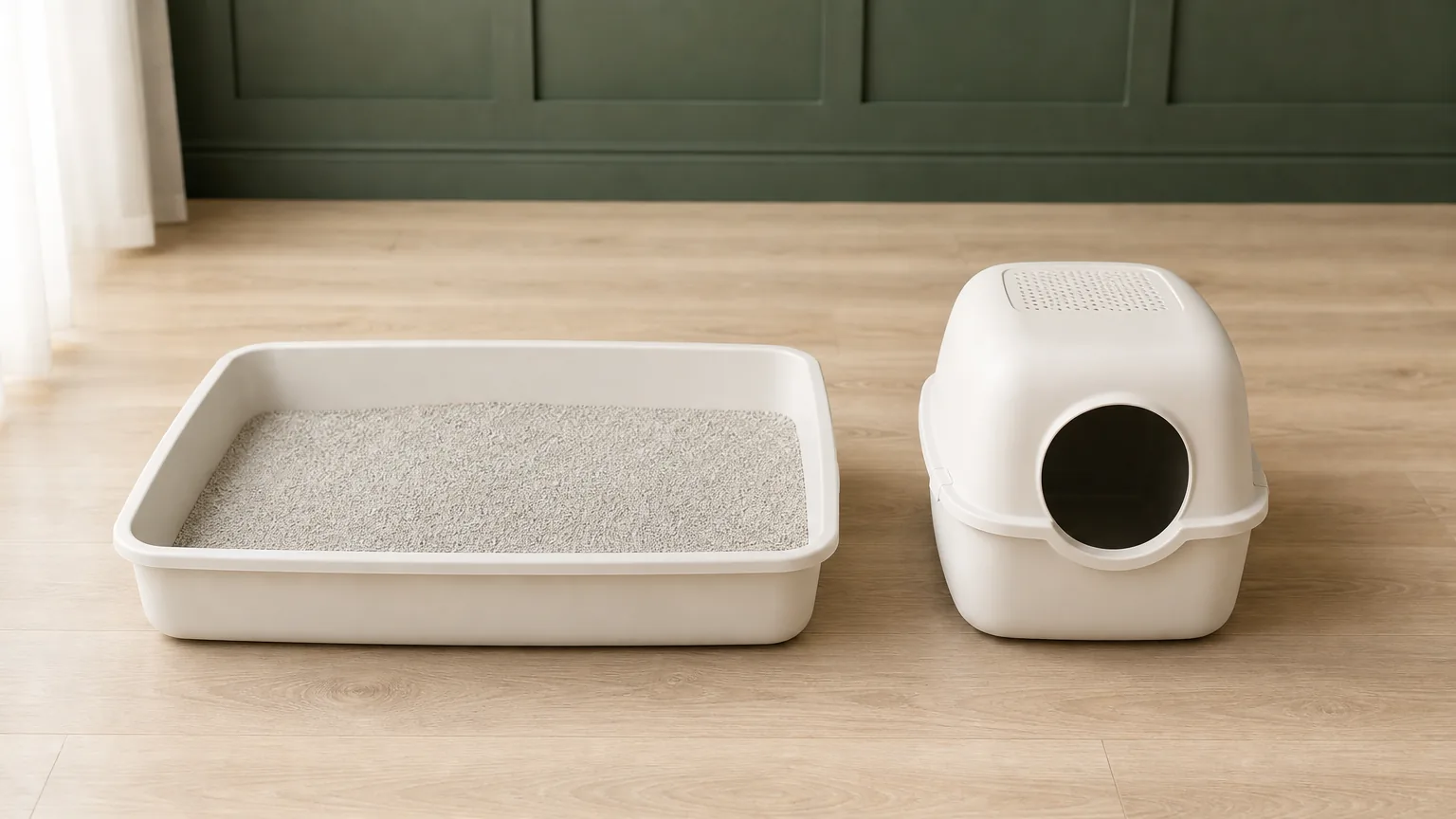
51.38% of these households used a covered box, which makes sense when the tray sits in a living space.
The trade-off is documented in the paper: covers limit scatter and trap odour, which is exactly why they can backfire. Trapped odour means the inside of a covered box is worse per unit of neglect than an open tray, and the cover stops you seeing how dirty it is. The authors also note a cover must still fit the cat — a hood that forces a large cat to crouch is a reason to avoid the box.
If you use a covered box in a small flat, scoop it more often than you think you need to, not less.
How many boxes fit in a one-bedroom
The standard advice is one per cat plus one. In a 45 m² flat with two cats, that is three trays, which is not realistic for most people.
What the data show is that 47.33% of households run a single box and the majority still report no soiling. The rule is a target, not a threshold.
If you cannot hit it, prioritise differently: two boxes in genuinely separate locations beat three boxes lined up against the same wall. Cats treat a row of trays in one spot as a single resource, which defeats the purpose in a multi-cat home.
The most common realistic setup for two cats in a one-bedroom is one tray in the bathroom and one somewhere structurally different — a hallway nook, a balcony with year-round access, or under a console table.
What to do if the cat is going beside the box
Ordered by how well the evidence supports it:
- See a vet first. 17.12% of soiling cats had a medical problem, and urinary disease was almost half of those.
- Check the box is not simply full. The single most common fixable cause.
- Add a second exit. Move the tray away from the wall or out of the alcove so there are two ways out.
- Go bigger before you go elsewhere. Size has stronger evidence behind it than location.
- Change one variable at a time. Otherwise you learn nothing from the result.
- Do not add a box in the same spot. Two trays touching each other read as one.
For the transition period when you do move or replace a tray, how long it takes a cat to accept a new litter box covers what a controlled study found about adjustment time — the answer is shorter than the internet claims.
Where this evidence stops
It is a survey, not an experiment. Cross-sectional design shows associations only. Nobody moved a litter box and measured what happened.
The sample recruited itself. The authors describe their method as a social media version of snowball sampling. Owners willing to complete a litter questionnaire are plausibly more diligent than average, which may be part of why the soiling rate came in at 16.74% against an expected 65%.
The soiling data are recalled, not observed. Owners reported from memory. A third could not describe the posture their cat used.
It is one country, skewed north. 52.74% of respondents came from Northern Italy, which is heavily urbanised. That makes it a good match for apartment readers and a poor one for anyone with outdoor access.
Outdoor access was never asked. The authors flag this omission themselves.
Nobody has run the study you want. There is no controlled trial that takes small flats, moves the tray to defined positions, and measures soiling. Every placement rule in circulation, including the ones above, is inference from surveys and general feline behaviour.
A note on who funded what
The authors declare no conflict of interest. No company paid for this work and no product was tested in it.
That is worth stating because it is unusual in this field. Much of the litter-box literature we have covered carries a commercial thread: the size study was authored by someone employed by a litter manufacturer, and in our guide to automatic feeders the trial was funded by the company that made the device being tested. Neither fact invalidates those results, but the absence of any such tie here is a point in this paper's favour.
What we sell, and what we do not
We do not make litter boxes. Our closest product is a lidded waste bin for what you scoop out, which solves a different problem entirely.
So there is no recommendation at the end of this page. Nothing above was tested on anything we sell, and the advice does not route to a purchase from us. Deciding where to put a litter box in a small apartment costs nothing except the willingness to move it twice and watch what changes.
---
Sources
- Tateo A, Ricci-Bonot C, Felici M, Zappaterra M, Nanni Costa L, Houpt K, Padalino B (2023). Litter Management Practices and House-Soiling in Italian Cats. Animals (Basel) 13(14):2382. Open access, full text read. Cross-sectional online survey, 3,106 cats, Italy, March–May 2022. Powered for 2,737 responses at 3% precision. Authors declare no conflict of interest.
- The size, spacing and transition findings referenced above are covered in full in the linked articles and are not restated here.
What we do not claim: we hold no data of our own on litter box placement. Everything above is drawn from one self-selected survey in one country plus inference from prior work, and the controlled experiment that would settle the question has not been run. Sudden changes in elimination behaviour warrant a vet visit before any furniture is moved.
Related reading
- Does Litter Box Size Matter for Cats? A 78-Cat Study Says Yes — With One Catch
- How Far Apart Should Litter Boxes Be? A 421-Owner Study Says You Are Asking the Wrong Question
- How Long Does It Take a Cat to Accept a New Litter Box? In One Study, No Adjustment Period Appeared at All