Editorial — Published 2026-08-02 — By Wangzian, Pet Lifestyle Curator
Dog Cooling Mat vs Cooling Vest: Which One Your Dog Actually Needs
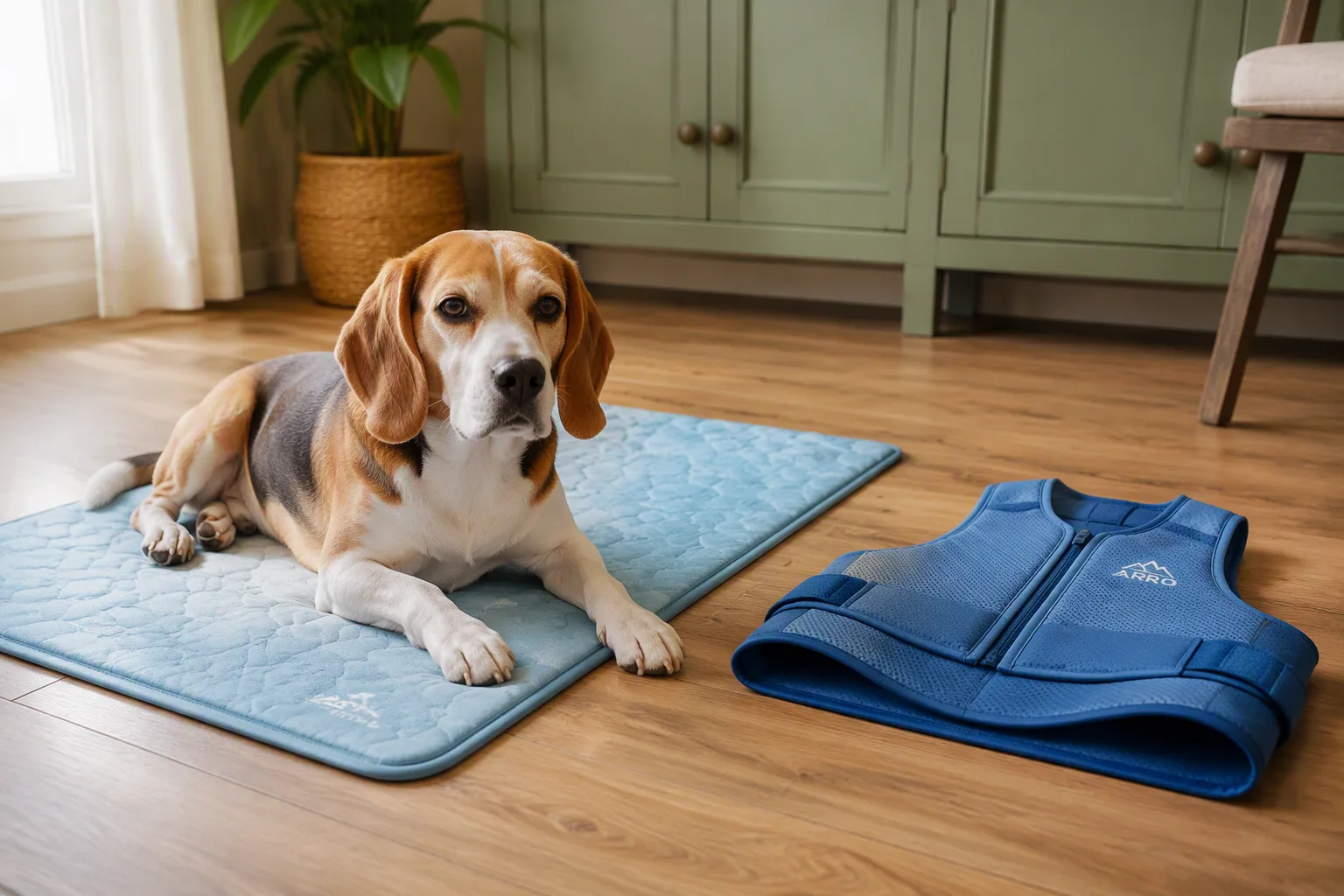
Short answer: buy a cooling mat if your dog spends hot hours resting indoors, and a cooling vest only if you need to move a dog through heat — walks, car trips, outdoor work. They solve different problems. A mat can't follow your dog outside, and a vest on a dog lying in a warm room actively traps heat.
That last part is where most of the money gets wasted. We watched it happen with our own dog before we understood the mechanism.
The two devices work on opposite principles
A cooling mat works by conduction. Heat moves from the dog's belly and chest — the thinnest-furred, best-radiating parts of the body — directly into the gel or water beneath. It needs body contact and stillness to work. In our testing, a pressure-activated gel mat held 5–7°C below room temperature for the first 30 minutes of continuous lying, which we documented in the dog cooling mat guide.
A cooling vest works by evaporation. You soak it, and as water evaporates off the fabric it pulls heat from the dog's back and sides. Evaporation needs two things a mat doesn't: airflow across the surface, and air dry enough to accept more moisture.
That difference decides everything about when each one helps.
Our summer test, briefly
We ran both on our office beagle Mango across a summer, logging his resting respiratory rate as the practical measure — a dog that's cooling well breathes slower at rest.
| Condition | Mat | Vest |
|---|---|---|
| Indoors, 30°C, still air, resting | Clear benefit | No measurable benefit |
| Walking, 30°C, dry, breeze | Not applicable | Clear benefit, ~40 min |
| Walking, 31°C, humid (rainy season) | Not applicable | Marginal, then worse |
| Car, AC running | Good | Unnecessary |
| Balcony, shaded, breezy | Moderate | Good |
The row worth staring at is the humid walk. On a muggy day the vest stopped evaporating within about 20 minutes and became a warm wet layer over Mango's back — insulation, not cooling. He was visibly more uncomfortable in it than without it. That's not a product defect; it's physics doing exactly what physics does when the air is already saturated.
When a vest actively hurts
Three situations where we now leave the vest at home:
- Humidity above roughly 70%. Evaporation stalls. The vest becomes a heat blanket. This is the single biggest mistake owners make with vests, and it's most common in exactly the coastal-summer conditions where people buy them.
- No airflow. A vest indoors, on a still day, or in a crate does nothing useful. Evaporation needs moving air across the fabric.
- Left on after it dries. A dry vest is just an extra layer of clothing on a hot dog. Vests need re-wetting every 30–45 minutes in dry heat, and taking off entirely when you get home.
A mat has no equivalent failure mode. The worst a mat does is get ignored.
When each one is the right buy
Buy the mat if: your dog is indoors during peak heat, you have no air conditioning, your dog is a senior or overweight, or your dog naps in a sunny spot. This covers most household dogs. It's also the better first purchase because it requires nothing from you — no soaking, no timing, no monitoring.
Buy the vest if: you walk in heat by necessity, your climate is dry, you do outdoor sports with your dog, or you transport a dog without AC. In dry conditions a soaked vest genuinely extends how long a dog can tolerate movement in heat.
Buy both if: you have a heat-vulnerable dog — flat-faced breeds, thick double coats, seniors — and live somewhere with real summers. They cover different halves of the day.
Buy neither if: your dog already has tile floors, shade, airflow, and you can shift walks to dawn and dusk. Timing beats equipment. Moving a walk from 1 pm to 7 am does more than any product on this page.
What both devices don't do
Neither one treats heatstroke. This matters because owning cooling gear can create false confidence.
A mat lowers skin temperature at contact points. A vest slows heat gain during movement. Neither reverses a core temperature that's already climbing. If your dog shows frantic panting that won't settle, ropey drool, brick-red gums, or unsteady walking, that's an emergency and the protocol is different — cool with room-temperature water, add airflow, and call a vet. We laid out the escalation order in signs of heatstroke in dogs, and it's worth reading before you need it.
Both devices also do nothing for hydration, which quietly drives heat tolerance. A dog that drinks well pants more efficiently, and panting is the main cooling system. Same principle we apply to cats and fountain maintenance: the equipment only works if the water stays appealing enough to drink. We keep cooling gear and water supplies on one seasonal checklist for that reason.
The honest recommendation
For most owners reading this in a normal house with a normal dog: get the mat, skip the vest, and put the difference toward shifting your walk schedule and keeping water fresh. Add a vest later if you find yourself repeatedly needing to move your dog through dry heat.
If you live somewhere humid, be especially skeptical of vests. Ours spent most of last summer in a drawer, and Mango was better off for it.
---
How this was made: written by Wangzian based on a summer of side-by-side testing with our own dog in our office and test room, with drafting assistance from an AI writing tool. Observations, measurements and conclusions are our own. Sources referenced: American Kennel Club Canine Health Foundation (akcchf.org) heat-safety guidance; manufacturer instructions for the mats and vest tested.
Related reading
- Dog Cooling Mat Guide: How to Keep Your Dog Cool in Summer
- Signs of Heatstroke in Dogs: What I Watch For After One Close Call
- XueQiu Pets water, feeding and replacement parts