Editorial — Published 2026-08-16 — By Wangzian, Pet Lifestyle Curator
How Long Before a Vet Visit Should You Start Carrier Training? Nobody Has Measured It

Start now, not on a schedule. No study has compared training for three days against three weeks, so every specific number you will read is an estimate. What the evidence does show is that the carrier is hardest at one specific moment, and it is not the one most advice targets.
How long before a vet visit does page one tell you to start?
I searched the question and wrote down what each result said:
| Source | The number given | Evidence cited |
|---|---|---|
| A Virginia veterinary practice | 3-5 days before the appointment | None |
| A humane society | Until the cat sits inside 7-10 minutes | None |
| CareCredit | Weeks or months before you need to go | None |
| Fear Free | A few days for a kitten, longer for adults | Quotes a named behaviourist |
| A cat clinic blog | 1-2 weeks for the first phase | None |
| AAHA | "Never too early or too late" | None |
Six answers spanning three days to several months. None points to a trial that measured the difference. AAHA's non-answer is arguably the most honest of the six.
This is not a criticism of the people writing them. The number does not exist. Carrier training has been tested against no training, and it works — but no one has published a comparison of one duration against another. Anyone giving you "5 days" is giving you a guess with a decimal point on it.
What we do know, and where it points instead
A 2022 survey in the Journal of Feline Medicine and Surgery asked 277 cat owners to rate the stress of each stage of a vet visit, from 1 to 10. The results are worth reading in order:
| Stage | Median stress | IQR |
|---|---|---|
| Putting the cat in the carrier (at home) | 6 | 2-8 |
| Travel to the clinic | 6 | 4-8 |
| Coming out of the carrier | 5 | 3-7 |
| The consultation | 6 | 4-8 |
| Getting back in the carrier (at the clinic) | 2 | 1-4 |
| Travelling home | 4 | 2-6 |
| Rest of the day at home | 2 | 1-3 |
Same cat. Same carrier. Same afternoon. Going in scores 6, going back in scores 2.
That gap is the most useful thing in the dataset. If the carrier itself were the problem, both numbers would be high. They are not. At the clinic the carrier stops being the thing that takes the cat somewhere and becomes the thing that gets them out — and the score drops by two-thirds.
Look at the spread as well. Putting the cat in at home has an interquartile range of 2 to 8, meaning owners disagree enormously; some cats walk in, others have to be wrestled. Getting back in runs 1 to 4. Nearly everyone agrees on that one.
What this changes about how long carrier training needs
If the difficulty is contextual rather than intrinsic, then the goal of training is not "get the cat used to the box." It is to stop the box predicting a car journey.
That reframing has a practical consequence: a carrier that lives in a cupboard for 51 weeks a year cannot be fixed in five days, because the problem is not familiarity with the object. It is a learned association, and the only thing that breaks it is the carrier being out and uneventful more often than it is out and followed by a car.
Which is why "how long before the appointment" is close to the wrong question. A carrier left out permanently has no before.
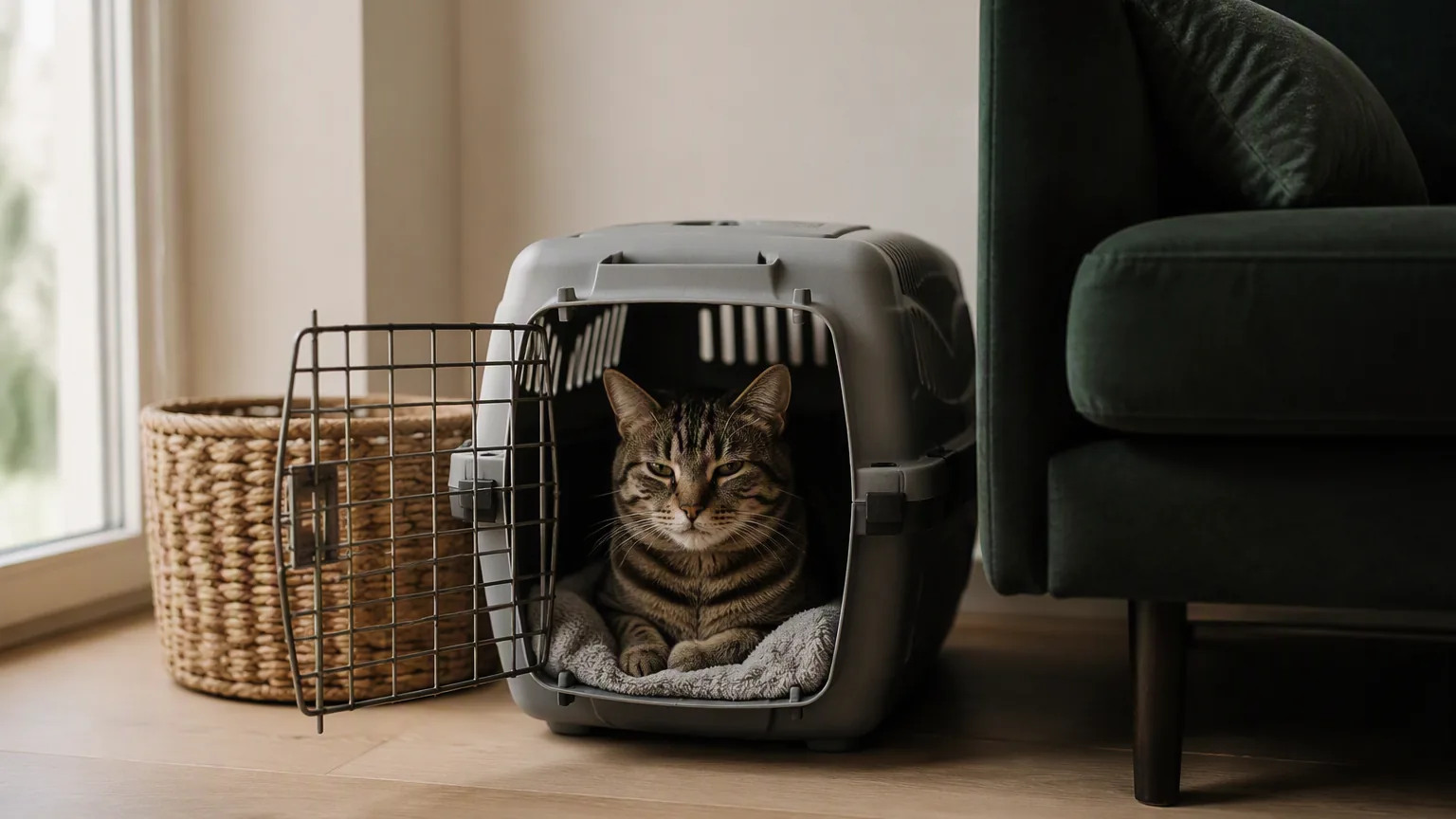
For what training does and does not achieve once you start, cat hides when the carrier comes out covers the controlled trial in detail — including the finding that training reduced stress during the car journey but made no measurable difference to stress inside the consulting room.
The advice gap is enormous
In the same survey, 75.5% of owners — 209 of 277 — had never been given any advice by their clinic on transporting their cat. Only one in five had.
That statistic reframes the whole first page of search results. The question is not being answered badly because it is hard. It is being answered by blog posts because, for three-quarters of owners, nobody at the clinic ever raised it.
And it matters downstream. Of 262 respondents, 31.3% said watching their cat's stress had put them off going to the vet at all. The free-text answers are specific: one owner stretched boosters to 13-month intervals, another delayed a dental appointment, a third weighed whether the stress of the visit outweighed a minor problem.
A cat that does not get examined is a worse outcome than a cat that finds the carrier unpleasant. That is the real cost of the missing advice.
If your appointment is on Thursday
The honest answer is that a few days will not undo years of association, but it is not nothing either. Ranked by what the evidence actually supports:
Get the carrier out today and leave it out. Not for a session. Permanently, or as close as your home allows. The mechanism you are working against is prediction, and prediction is broken by frequency, not by duration of individual sessions.
Feed near it, then in it. Ordinary meals, in the same place the carrier now lives. You are not training a behaviour so much as removing a signal.
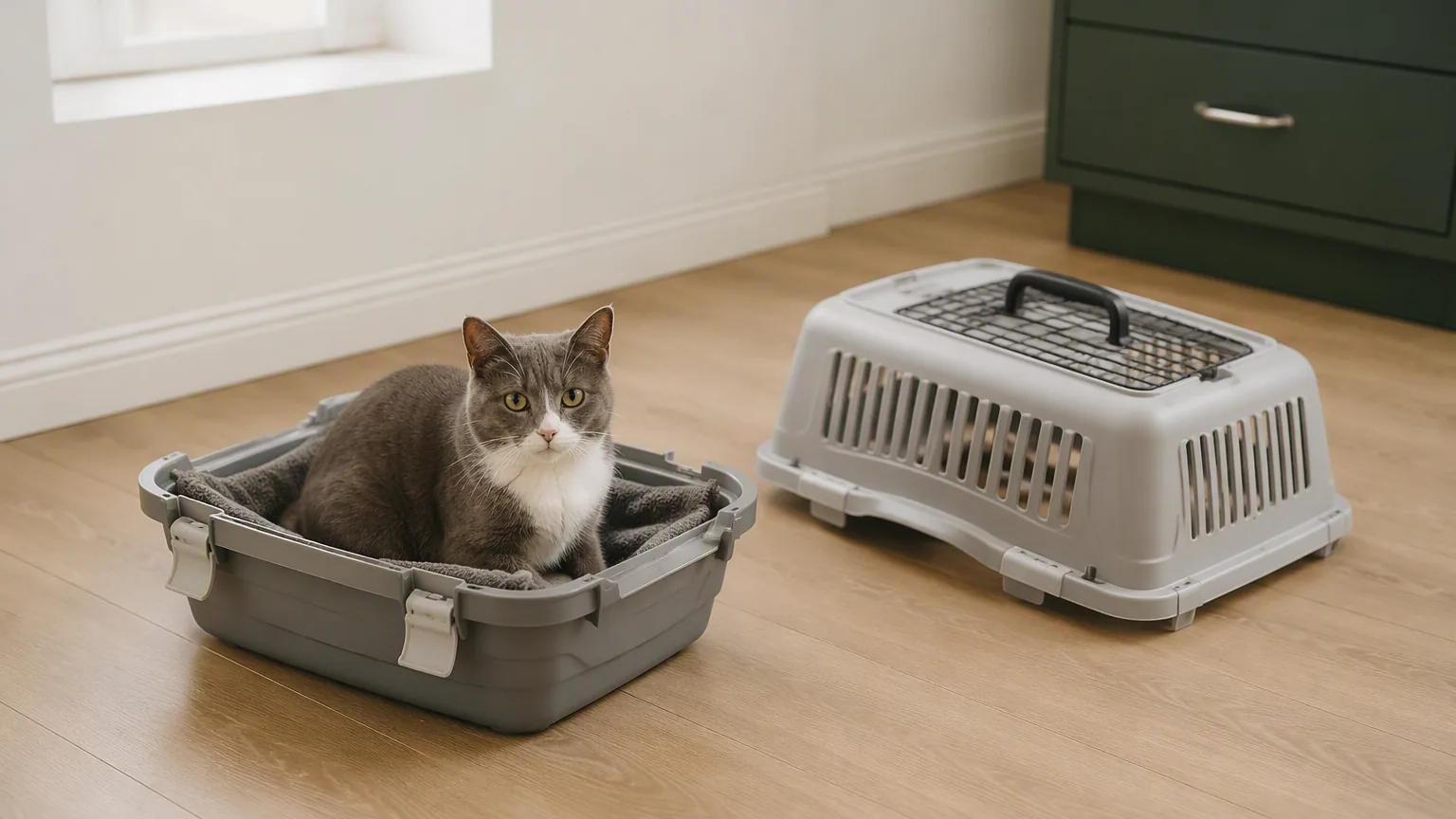
Choose a carrier that comes apart. In the survey, 10.6% of owners had their cat examined in the base of the carrier with the top removed, and only 3.0% saw their cat dragged out. A carrier that unclips turns the worst-rated moment — coming out, median 5 — into a non-event. That is a purchasing decision, not a training one, and it takes effect immediately.
Ask about medication if your cat is genuinely fractious. One trial gave 20 cats with a history of difficult visits a single 100 mg dose of gabapentin 90 minutes before they went into the carrier, against a placebo, blinded and crossed over. Owner-rated stress during transport and examination and vet-rated compliance all improved significantly. Sedation was common, and ataxia, hypersalivation and vomiting were reported; all effects cleared within eight hours. It is prescription-only — this is a conversation with your vet, not a shopping list.
Notice that the intervention with a published number attached to it is the drug, at 90 minutes. Training, which is the thing everyone recommends, has no such number.
What none of this proves
The survey measures perception, not physiology. Owners rated stress from 1 to 10. Nobody measured cortisol or scored behaviour on a validated scale. An owner who finds the return trip easier may be reporting their own relief as much as the cat's.
It is cross-sectional. Owners were asked once, about the past three years. That design can show that two stages score differently; it cannot establish what caused the difference. The context explanation offered above is the most plausible reading of the gap, not a finding the study tested.
The respondents were unusually engaged. The authors say so directly: 78% routinely bring their cat in for booster vaccinations. Among owners in general, the 75.5% advice gap and the 31.3% avoidance figure are more likely to be understated than overstated.
It was funded by MSD Animal Health. The authors state that design, analysis and the decision to publish were independent, and declare no competing interests. Worth knowing regardless.
And the central point stands unresolved. None of this tells you whether three weeks beats three days. It tells you the question has never been tested, which is a different kind of answer, and the only one currently available.
What we sell, and what we do not
We make a ventilated travel carrier. Our listing states a 3-5kg suitable weight but cites no airline or IATA compliance testing, so we do not claim it is cabin-approved — and nothing above is a reason to buy it. The evidence-backed feature here is a carrier that dismantles, which several manufacturers make.
Timing is one piece of a larger picture. Taking your cat to the vet compares all four interventions that have been through a controlled trial and ranks them by how far the evidence actually reaches — including one where the headline result and the regression disagree with each other.
If you want another case where the popular explanation for a cat's behaviour did not survive contact with the data, why cats scratch furniture covers the same shape of problem.
---
Sources
- Caney SMA, Robinson NJ, Gunn-Moore DA, Dean RS (2022). Happy cats: stress in cats and their carers associated with outpatient visits to the clinic. Journal of Feline Medicine and Surgery 24(12):e551-e557. Open access, full text read. All stress medians and percentages above are taken directly from Tables 1-3 and the Results section; n = 277 analysed responses. Funded by MSD Animal Health, with the authors stating independence of design, analysis and publication decision.
- van Haaften KA, Eichstadt Forsythe LR, Stelow EA, et al. (2017). Effects of a single preappointment dose of gabapentin on signs of stress in cats during transportation and veterinary examination. J Am Vet Med Assoc 251(10):1175-1181. Randomised, blinded, crossover trial, 20 cats. Abstract read; full text not obtained — figures quoted here are limited to what the abstract states, and no effect sizes are given because the abstract does not report them.
- Carrier training itself is covered by Pratsch et al. (2018), already discussed in full in the linked article; it is not restated here.
On the search results table: the six sources were recorded from the first page of results for this question on 15 August 2026. They are described by type rather than linked, because the point is the absence of a cited number, not criticism of individual sites.
What we do not claim: we hold no data of our own on carrier training. This is not veterinary advice; medication in particular requires a prescription and an examination. If your cat's distress is new or escalating, that is a reason to see a vet sooner, not later.
Related reading
- Cat Hides When the Carrier Comes Out? Here Is What Training Actually Fixes
- Why Do Cats Scratch Furniture? What the Owner Surveys Actually Found
- XueQiu Pets ventilated pet travel carrier