Editorial — Published 2026-08-30 — By Wangzian, Pet Lifestyle Curator
How Often to Brush a Cat During Shedding Season
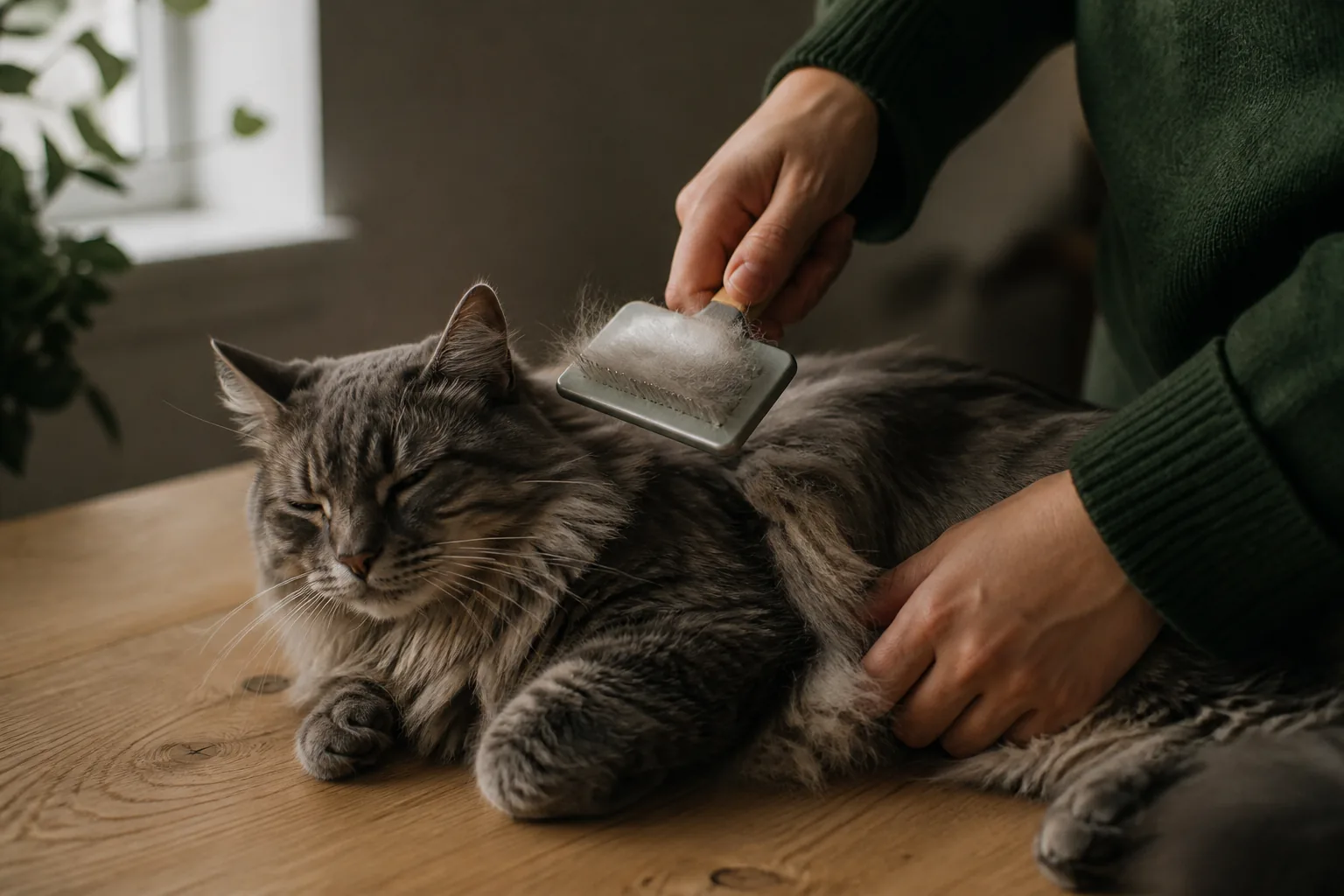
Daily for a longhaired cat, every second or third day for a shorthair — but in two-minute sessions, not one long one. The frequency matters less than most guides suggest. What matters is that you stop while your cat still wants to be there, because a cat who learns to leave the room is a cat you cannot groom at all.
That is the honest version. Below is what changed my mind about why it matters.
The number that reframed this for me
I used to file hairballs under "normal cat stuff." Then I read a 2023 study out of six US specialty hospitals that reviewed 667 cats who had gone to surgery for a gastrointestinal foreign body obstruction. Of those 667, 44 — just 6.6% — were blocked by a hairball.
That is the reassuring half. Here is the other half. Among those 44 cats, 10 were diagnosed with alimentary small cell lymphoma on the biopsy taken during surgery. That is 22.7%. In cats whose vomiting had been going on longer than three weeks, it was 41.7%.
Read that carefully, because it is easy to get backwards. The lymphoma did not come from the hair. The likeliest reading runs the other way: an intestine already diseased moves hair badly, and the hairball is the symptom that finally gets the cat onto an operating table.
The average age of the cats with lymphoma was 12.9 years, against 6.4 years for the cats whose biopsies showed only inflammation.
What this changes about brushing
Brushing removes hair your cat would otherwise swallow. That is the whole mechanism, and it is worth doing.
But brushing is not a treatment for a cat who is vomiting repeatedly. If your ten-year-old has been bringing up hairballs for a month and you respond by buying a better brush, you may be managing the visible part of a problem that needs a vet. In that 2023 series, 20.8% of the cats with chronic signs had already had a previous hairball obstruction — the first one had not been the end of it.
A rough line: hair in the vomit once every few weeks in a longhair during a coat change is unremarkable. Weekly, or with weight loss, or in a cat over ten, is a conversation with your vet — and worth reading our guide to taking your cat to the vet before you book, because how you get them there affects what the vet can actually examine.
The schedule, and why it is a range
Coat length is the main variable, and it is not a small one. In the same study, 84.1% of the obstructed cats were long- or medium-haired. Twenty of 44 were domestic longhairs; nine were Maine Coons.
| Coat | Shedding-season frequency | Session length |
|---|---|---|
| Longhair (Persian, Maine Coon, ragdoll) | Daily | 2–5 min |
| Mediumhair | Every 2nd day | 2–3 min |
| Shorthair | Every 2nd–3rd day | 1–2 min |
| Senior or arthritic, any coat | Daily, gentler | 1–2 min |
The senior row is the one people skip. An arthritic cat cannot twist to reach their own back, so the hair they used to manage themselves is now yours to handle — and they are also the cats least able to tolerate a long session.
Two minutes, and stop early
Here is the part no brush listing tells you.
Cats do not object to grooming. They object to grooming that goes on past the point they agreed to. The behaviour I watch for is the tail: a tail that starts to flick at the tip is a cat about to be done, and if you push past that flick two or three times, you have taught your cat that the brush means being trapped.
So: brush for two minutes, stop while the tail is still, put the brush away in view. Next time is easier. This is the same logic as carrier training — short exposures that end well, rather than one long one that ends badly.
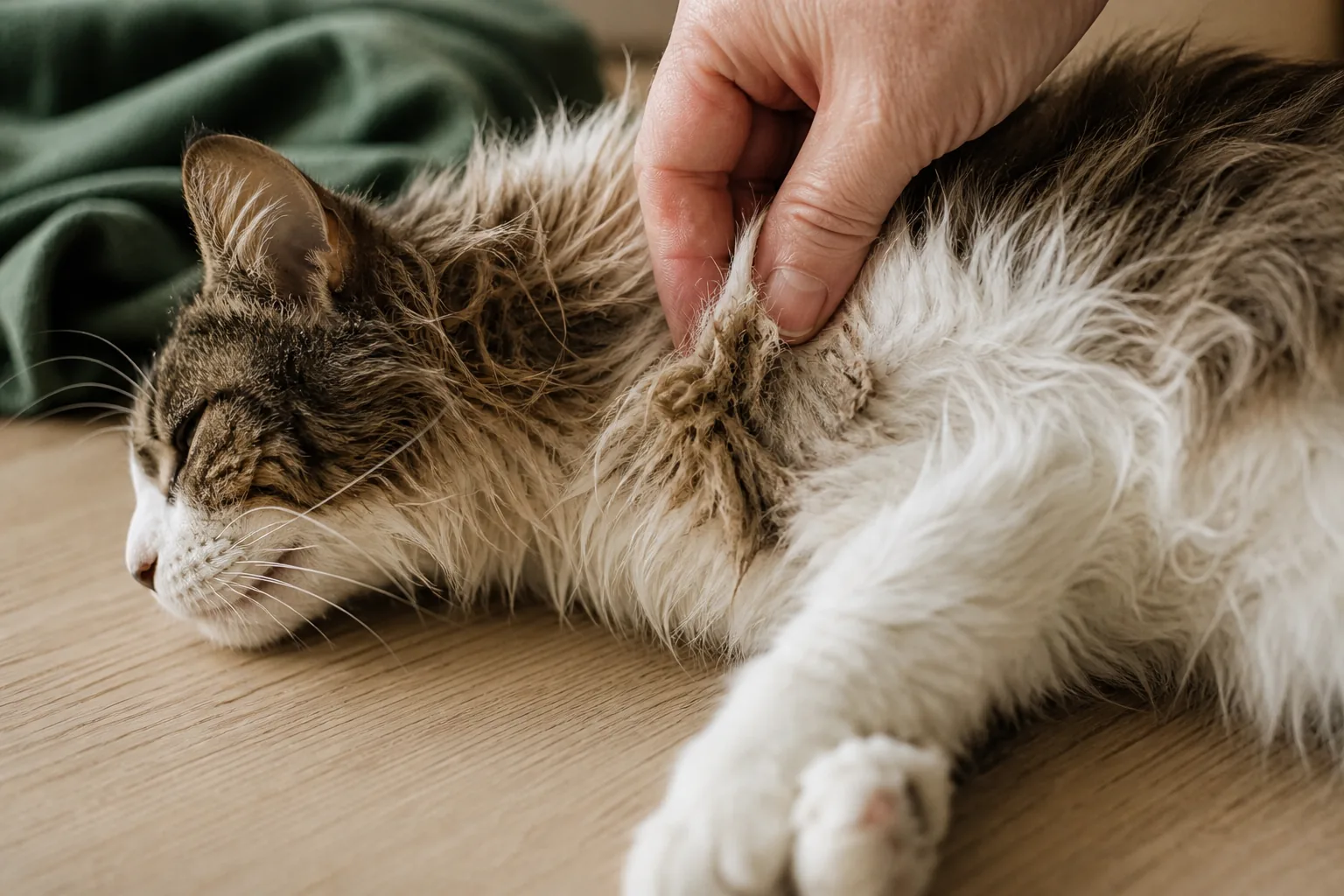
Where you brush matters too. Longhairs mat behind the ears, in the armpits, and at the base of the tail, and those three spots are exactly where a cat is least comfortable being handled. Do them first, while patience is highest, and finish along the back where it is pleasant. Ending on the easy part is what makes the cat willing next time.
If your cat already leaves the room when the brush appears, the problem is no longer the coat — it is an association, and it is fixable the same way we describe fixing an ignored scratching post: change what the object predicts, not how hard you push it.
What we sell, and what we do not
We stock a self-cleaning slicker brush — an ABS slicker with a one-press retracting head that releases the collected hair. The retracting head is the part that earns its place: the reason people abandon slickers is picking hair out of the pins, and a brush you stop using removes nothing.
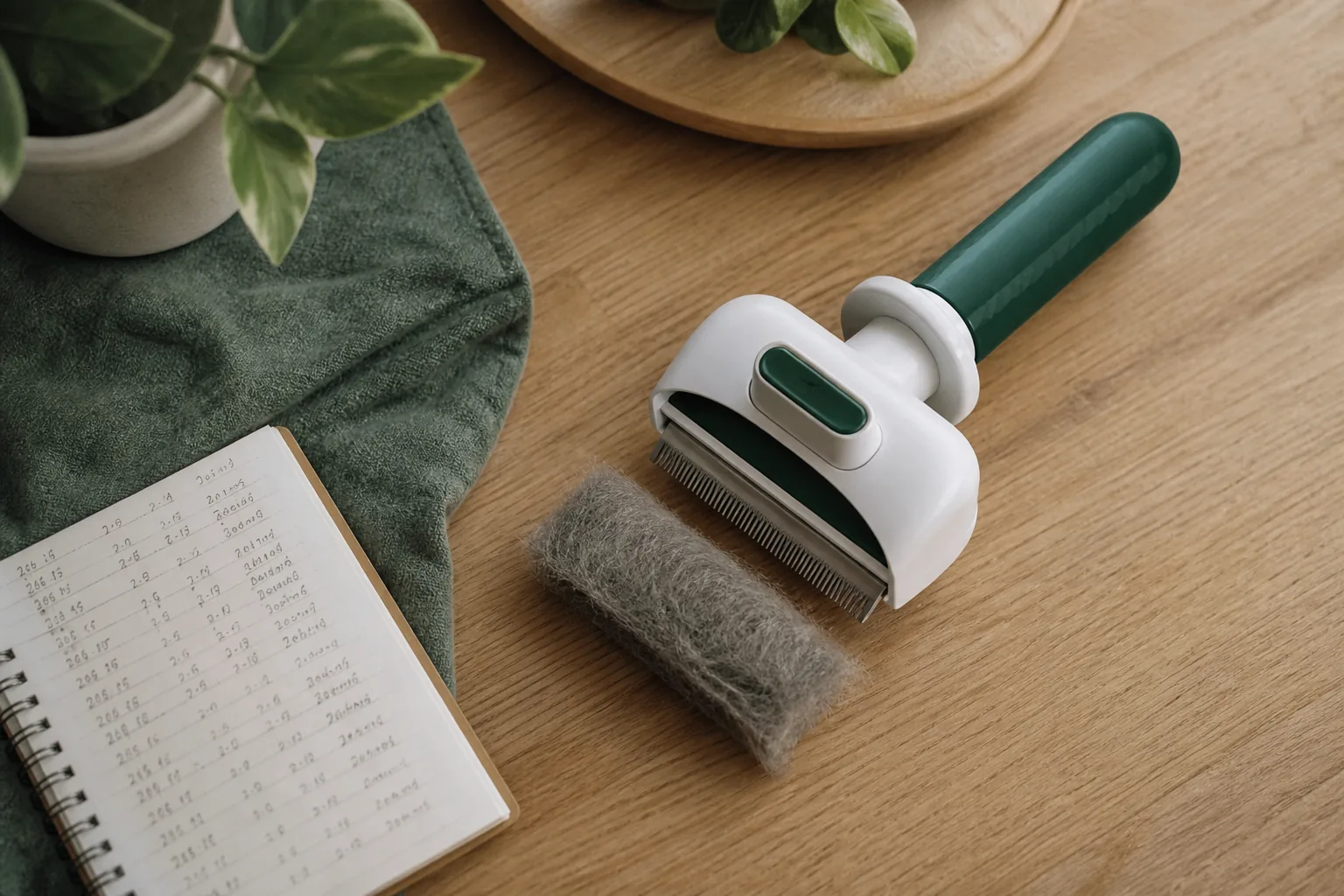
What we do not sell, and will not pretend to: a deshedding blade, a grooming glove, or anything that claims to reduce hairballs by a percentage. We have not tested those claims and there is no trial we can point you to.
We also do not sell a hairball diet. There is published work on dietary fibre and faecal hair excretion, and it is real, but it is not our product line and we have not run those foods past our own cats.
Water, since it comes up
Dry cats have slower gut transit, and hair moves through a dry gut worse. That is a mechanism, not a trial result, and I am flagging it as such. If your cat is a poor drinker, why cats refuse water covers what actually changes intake — placement and bowl type do more than most owners expect.
What I would do tonight
- Check the coat length row above and pick your interval.
- Set a two-minute timer. Stop when it goes, even mid-stroke.
- Do ears, armpits, tail base first. Back last.
- Write down the date of every hairball for a month. If it is more than three, or your cat is over ten, take that list to your vet — a written frequency is far more useful to them than "sometimes."
Point 4 is the one that matters most, and it costs nothing.
Sources
- Pawenski M, Smola CC, Dionne T, Larson M (2023). Histopathologic diagnosis and patient characteristics in cats with small intestinal obstructions secondary to trichobezoars. Journal of Feline Medicine and Surgery 25(9). PMCID PMC10812032. Open access, full text read. Retrospective review, 44 cats from 667 foreign-body surgeries across six private specialty hospitals, January 2016 – July 2022. Authors declared no conflicts of interest and received no funding.
Limitations, stated by the authors and worth your scepticism: the design is retrospective, so it shows association and not cause. Pathologists were not blinded to each cat's age, signs, or other biopsy results. Biopsy number and location were not standardised. There was no treatment follow-up, so no diagnosis could be confirmed against response to therapy. And a separate study the authors cite found histological abnormalities in all 20 clinically healthy cats examined — 17 of whom never developed any signs — which is a strong reason not to read "inflammation on biopsy" as "sick cat."
- Coat-length and session-length guidance above is our own practice from the XueQiu Pets test room, not a study finding. Treat it as a starting point to adjust, not a protocol.
Written by Wangzian, who runs XueQiu Pets and keeps four cats — two of them longhairs who disagree about brushing. Drafted with AI assistance; the study was read in full and the numbers checked against the source by a human before publishing.