Editorial — Published 2026-09-01 — By Wangzian, Pet Lifestyle Curator
How to Get a Cat Used to Being Brushed
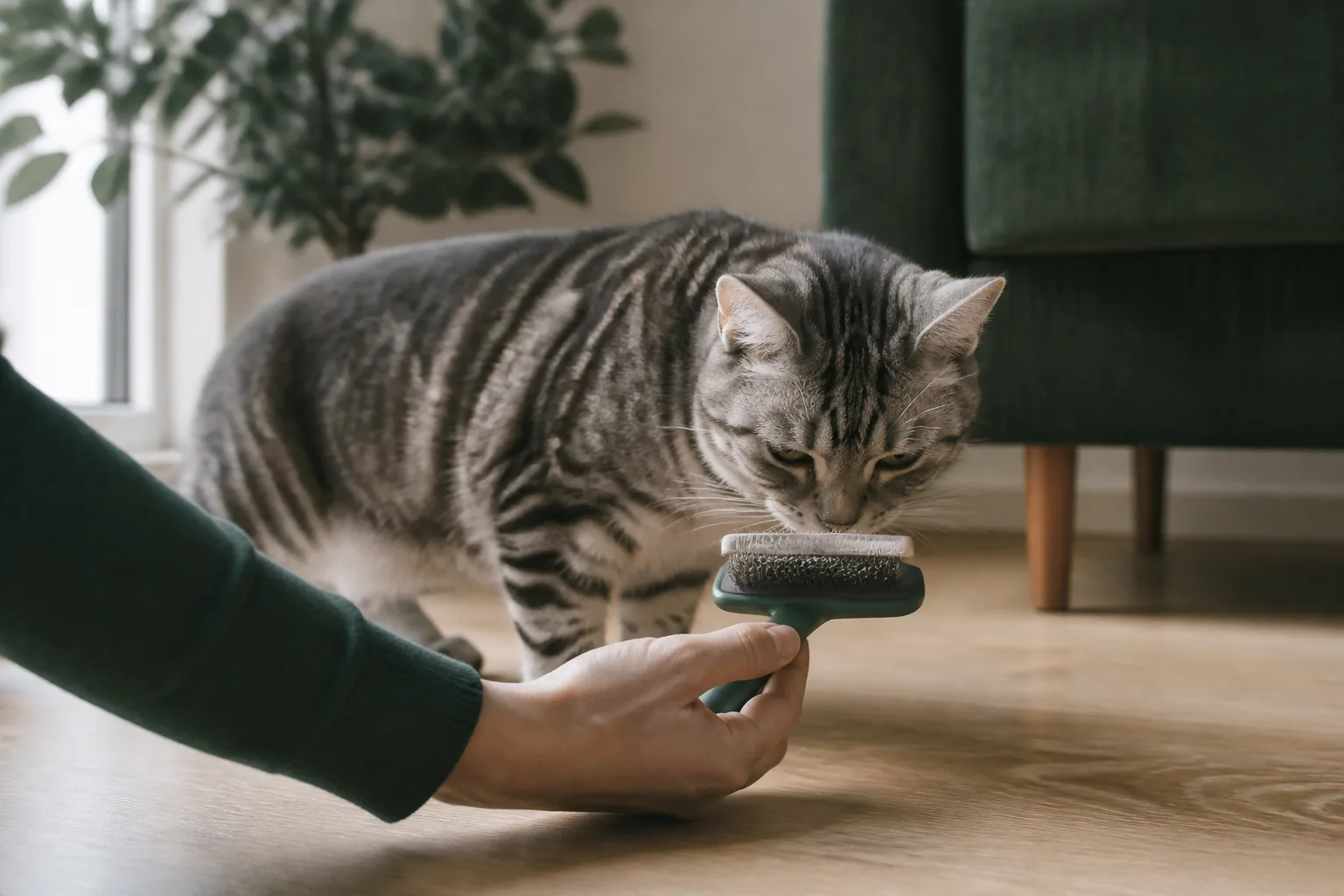
Brush for less time than the cat will tolerate, several times a day, and stop while it is still relaxed. Two or three strokes is a legitimate session. The instinct to push on for "just a bit more" while the cat is still sitting there is the single thing that sets this back the most.
I got this wrong with Mango for about six months.
What we did wrong, specifically
Mango came to us as an adult and disliked being held. Our approach was to wait until she was asleep on the sofa, start brushing, and continue until she left. Reasonable-sounding: she was relaxed at the start, and we stopped as soon as she objected.
It made her worse. By month three she was leaving the room when the brush came out of the drawer.
The problem is what the ending taught her. Every session finished with her wanting out. She had no experience of brushing that ended any other way, so the brush came to predict "an interaction I will need to escape from." We were consistently reinforcing exactly the association we were trying to remove.
The fix: end it early, on purpose
We switched to stopping after three or four strokes while she was still settled. It felt pointless — three strokes removes almost no hair. But within two weeks she stopped leaving the room, and by week four she was walking over when the brush appeared.
What changed was the prediction. Brushing now reliably ended before she was uncomfortable, so there was nothing to escape.
Frequency matters more than session length here. Four two-minute attempts across a day beat one eight-minute session, because tolerance is built by the number of times the cat experiences a good ending, not by total minutes brushed. If you are working out the ongoing schedule once the cat accepts the brush, we covered that separately in our shedding-season brushing schedule.
What the research actually supports
I want to be careful here, because the study I keep coming back to is not about brushing.
A controlled trial published in Preventive Veterinary Medicine in 2014 took 139 cats rated as anxious on admission to an animal shelter and split them into two groups. One group was gently stroked and talked to — the authors call it "gentling" — four times daily for 10 minutes, over 10 days. The other group was not.
The results were not subtle:
| Measure | Gentled | Control |
|---|---|---|
| Negatively valenced mood | IRR 0.61 vs control (P=0.007) | reference |
| Secretory IgA (logeμg/g) | 6.9 ± 0.7 | 5.9 ± 0.5 |
| Pathogen shedding, day 1 → 10 | 32% → 30% | 23% → 52% |
| Developed upper respiratory disease | reference | 2.4× more likely |
Two things stand out. First, the dose: four sessions a day for ten days. That is a frequency pattern, not a duration one, and it matches what worked for us. Second, within the gentled group, cats that responded positively had higher S-IgA (7.03) than cats that responded negatively (6.14) — the handling had to actually be pleasant for the cat to produce the effect. Doing it grudgingly to a cat that hates it is not the same intervention.
The limits matter. These were shelter cats under acute stress, not house cats. The handling was stroking and talking, not brushing. And the outcome measured was immune function and illness, not brushing tolerance. What it supports is that repeated short positive handling changes a cat's emotional state measurably — it does not prove that a specific brushing protocol works, and I have not found a trial that does.
Where to start on the body
Cats tolerate handling very differently depending on location, and starting in the wrong place wastes the early sessions.
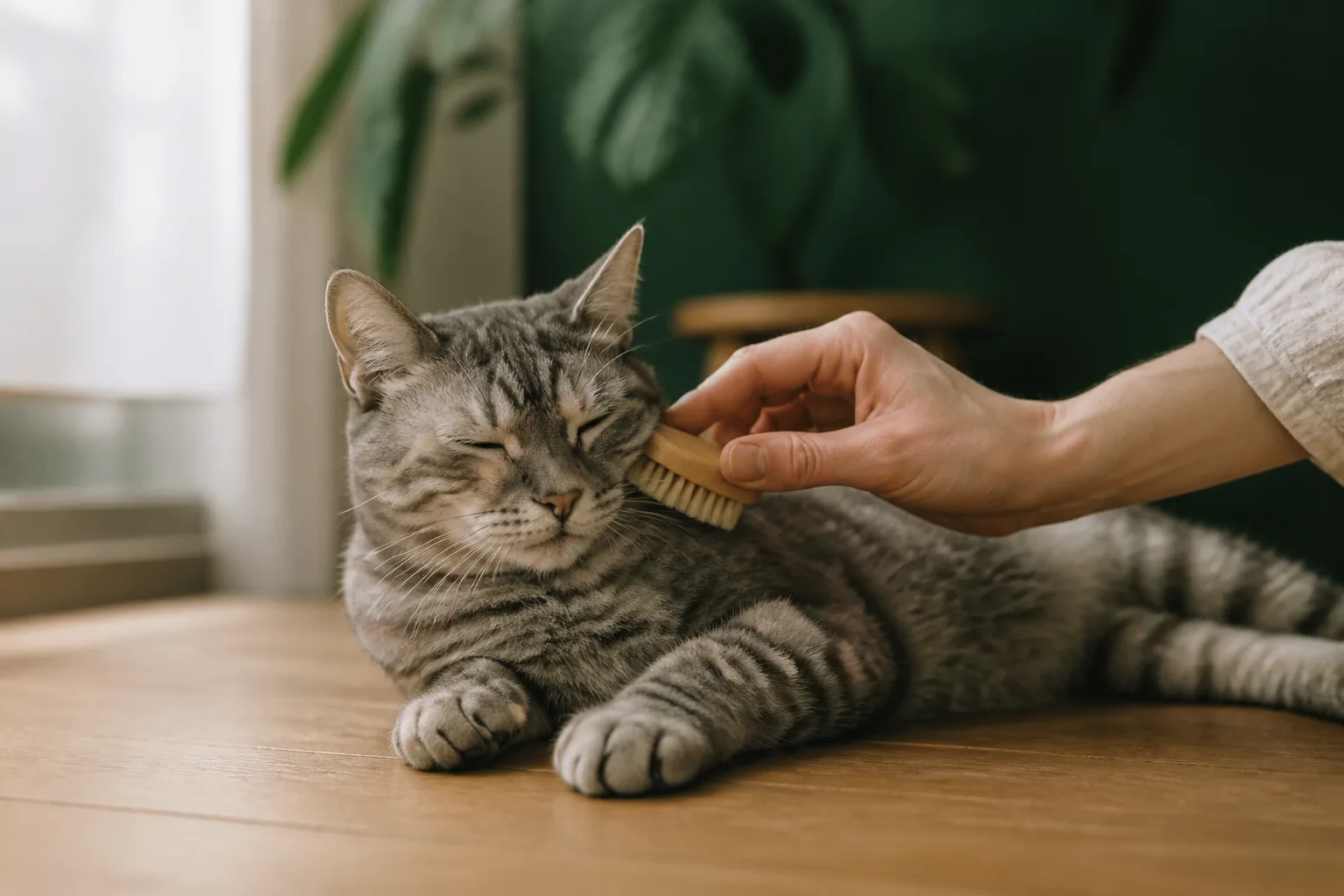
Begin at the cheeks and the base of the ears. These are the areas cats present to you voluntarily when they head-butt, and they are where cats groom each other. Then the shoulders and along the back.
Leave the belly, the tail base and the hind legs until the cat is reliably relaxed for the easy areas. The belly in particular is a defensive area; a cat that rolls over is not usually asking for it to be brushed.
Watch the tail tip rather than the face. A cat that has had enough usually starts with a twitch at the tail tip while the rest of it still looks settled — you get several seconds of warning before the ears go back or it gets up. Stopping at the twitch, rather than at the departure, is what makes the difference.
Practical setup
A few things that removed friction for us:
- Leave the brush out. Ours lives on the shelf by the sofa, not in a drawer. Nothing signals "here comes an event" like fetching a tool.
- Let the cat inspect it first. Ten seconds of sniffing before the first stroke, every time, for the first couple of weeks.
- Do it where the cat already sits. Moving the cat to a "brushing spot" adds a step it has to accept before you even start.
- Pair it with something. We brush before dinner. She now treats the brush as a dinner cue, which does most of the work for us.
- Do not chase a mat on day one. Working on a painful tangle during the trust-building phase undoes weeks of it. Mats behind the ears need addressing, but do that once tolerance is established, or have a groomer handle it.

When the cat is not just reluctant but sore
There is a version of "won't tolerate brushing" that is not behavioural.
If a cat that previously accepted brushing starts objecting — particularly around the hips, spine or hind legs — pain is worth ruling out before you work on the behaviour. Arthritis is common and under-diagnosed in older cats, and it makes handling in those areas genuinely unpleasant. Sudden onset, growling when a specific area is touched, or a cat that has also stopped jumping to its usual spots all point that way. That is a vet conversation, not a training problem, and our guide to taking your cat to the vet covers making that trip less stressful.
Similarly, if the coat itself has changed — see whether that is seasonal or something else before assuming the cat has simply become difficult.
What we use
We keep a self-cleaning slicker brush on the shelf. The retracting head matters less for the cat than for us: being able to clear the pins in one press means the session does not pause while someone picks fur out of the bristles, and a pause is where a settled cat decides to leave.
What we do not sell and will not pretend to: any tool that makes an unwilling cat willing. The tool is not the variable here. Stopping early is.
Sources
- Gourkow N, Hamon SC, Phillips CJC. "Effect of gentle stroking and vocalization on behaviour, mucosal immunity and upper respiratory disease in anxious shelter cats." Preventive Veterinary Medicine 117(1):266–275, 2014. PMID 25064364. Controlled clinical trial, 139 cats. Abstract read in full; full text is paywalled and we have not read it. Findings are from shelter cats under acute stress and concern stroking rather than brushing — see the caveat in the section above.
- Everything about Mango, the tail-tip warning, the six months we spent making it worse, and the two-week and four-week timelines is our own observation in our office and test room. It is one cat, uncontrolled, and reported as experience rather than evidence.
- We looked for a controlled trial specifically on desensitising cats to grooming and did not find one. If you know of it, tell us and we will update this page.
Written by Wangzian at XueQiu Pets, drafted with AI assistance and fact-checked against the source above.