Decide which of the four levels you need
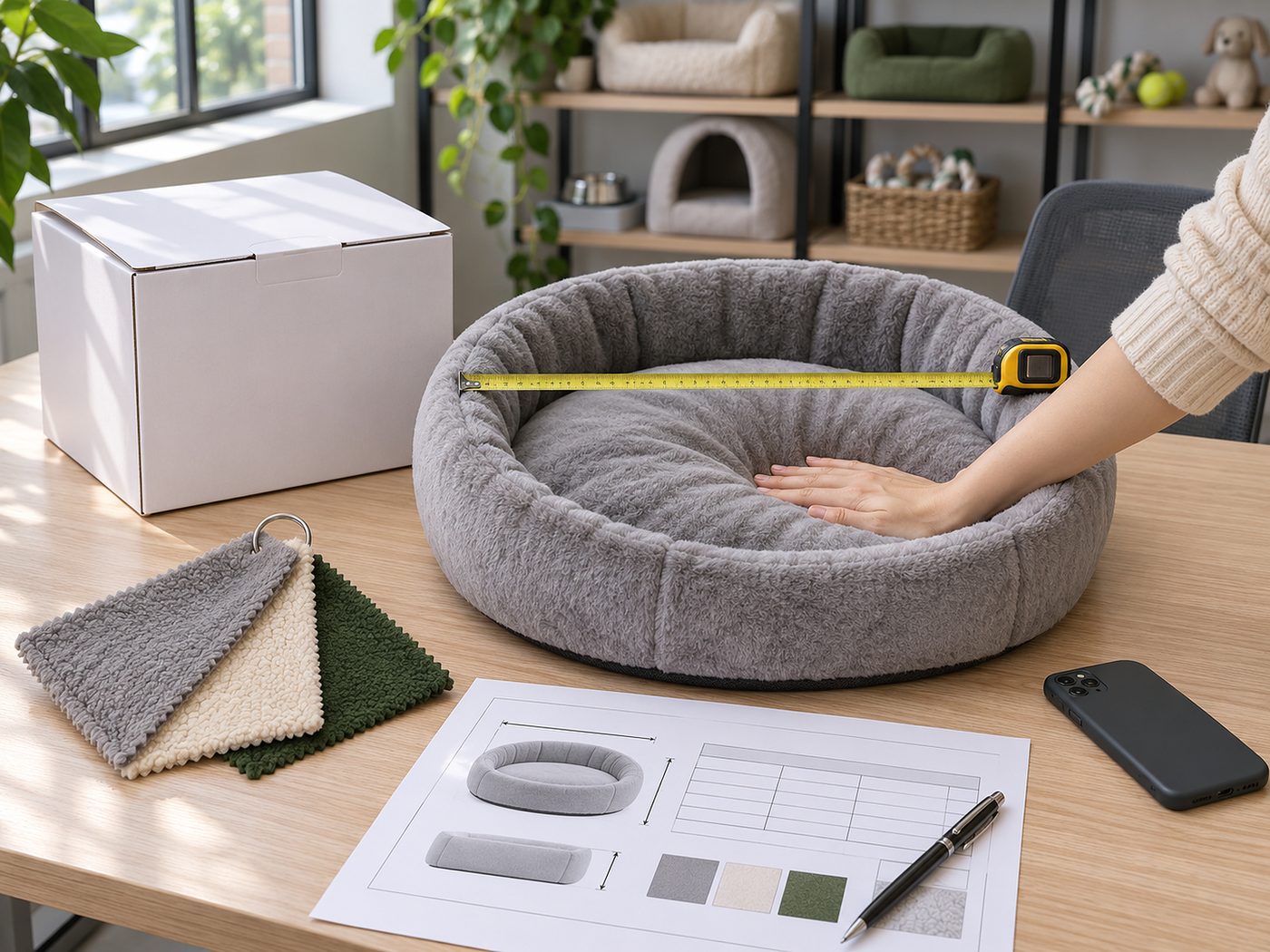
Level one: your logo and barcode on the retail carton and insert, product unchanged. Level two: your logo on the product itself: a printed or woven label on a bed, heat-transfer or jacquard on webbing, pad-printed or embossed on a bowl or housing. Level three: your colourway on an existing mould or fabric. Level four: your shape, which means a new tool. Levels one to three are routine on partner lines at normal MOQ; level four is a project with a one-time tooling cost and a payback you should see at your volume before you commit.
Read the MOQ per level, by product group
Own-logo packaging and colour changes do not usually raise the factory's base MOQ: 200 to 500 per style and size for beds and soft carriers; 500 to 2,000 per style for bowls and feeders; 500 to 1,000 per style for collars and harnesses, with 200 per size and colour; 500 to 1,000 per model and colour for fountains and litter boxes; 50 to 200 per model for wire cages. Branding on the product raises it in specific cases: jacquard-woven webbing with your logo is 2,000 to 3,000 metres per colour. These are the bands on our category pages, from screened 1688 lines; the quote for your brief states the factory's exact number.
Know what tooling actually costs
A new bowl shape on a stainless fountain needs a stamping die, a one-time $2,000 to $5,000 on the lines we quote from. A moulded-in logo on a pump or filter housing is an insert in the existing tool, a few hundred dollars per cavity. Rope toys and moulded rubber chews need tooling and 3,000 pieces or more. Ask for the tooling charge as its own line and for who owns the tool afterwards; on a quote from us it is always stated separately.
Get the artwork approved before the sample, not after
Send print-ready artwork: vector logo, Pantone references, barcode file, and the mandatory US label text for your product (fibre content and country of origin for textiles; cautionary statements where the product has small parts). The factory returns a digital proof; approve it in writing. Then the pre-production sample is made with that packaging, and that sample becomes the standard the bulk order is inspected against.
Put the US label rules on the packaging, not in a later fix
Country of origin ("Made in China") on the product or its packaging under US customs marking rules. Fibre content and manufacturer identity on textile products under the FTC Textile Act. California Proposition 65 warning where a listed chemical is present. These are cheap to print and expensive to sticker over at the warehouse. The compliance checklist guide lists the sources; the factory needs the final text in step four.
Budget the lead time by level
Levels one to three: sampling typically two to four weeks for a stock item with your packaging, then the factory's quoted production lead time. Level four: add the tooling lead time, usually several weeks before the first sample exists. A scope and fee quote within one working day of the brief; a shortlist within one to two weeks. These are the ranges we see; the quote for your brief states the dates we hold ourselves to.
Inspect the branding at the pre-shipment inspection
Logo position and colour against the approved proof, carton print and barcode scan, label text present and legible, insert in every unit. This is checked at the same pre-shipment inspection as dimensions and function, before the balance is released, while the factory can still fix it.