XueQiu PetsSend a brief

Buyer guide · 7 steps

US compliance for imported pet products: what to ask for, item by item.

Pet products are not toys and not medical devices, so there is no single US certification. There is a checklist that depends on what the product is made of and whether it plugs in. This is that list.

US compliance checklist for imported pet products: practical buyer guide by XueQiu Pets

US compliance for pet products imported from China is a per-product checklist rather than one certificate: California Proposition 65 for all consumer goods; FDA food-contact materials for bowls, fountains and feeders; UL or ETL listing for anything mains-powered; California TB 117-2013 for foam in beds; UN38.3 and MSDS for lithium batteries; a heavy-metal test on coatings that animals chew; and a textile fiber-content label. A sourcing agent collects the documents from the factory and checks them against the product, but is not a test laboratory.

Written and reviewed by Wang ZianFounder and sourcing lead

Step by step

7 steps, in the order they happen.

  1. Start with Prop 65 on everything

    California Proposition 65 applies to every consumer product sold into California, which for practical purposes means every US listing. Ask the factory for a test report on the finished product against the listed chemicals, or budget $150 to $400 per SKU for a US or Hong Kong lab. Marketplaces increasingly ask for it at listing time. The chemical list is maintained by California OEHHA: The Proposition 65 List.

  2. Bowls, fountains, feeders: food-contact material

    Stainless steel should be 304 (18/8) with a mill certificate; plastics should have an FDA 21 CFR food-contact declaration for the resin, and a migration test on the finished part if the retailer asks. Ceramic glazes need a lead and cadmium leach test. Ask for all three by name. The resin rules are in 21 CFR Part 177, Indirect Food Additives: Polymers (eCFR).

  3. Anything with a plug: UL or ETL

    Fountains, pumps, heaters, clippers with a wall adapter. US retailers expect a UL or ETL listing. Most Chinese pet factories hold it on the power adapter, not the finished product. Ask which part is listed and get the file number; if your channel needs a finished-product listing, that is a test program of several thousand dollars and six to ten weeks.

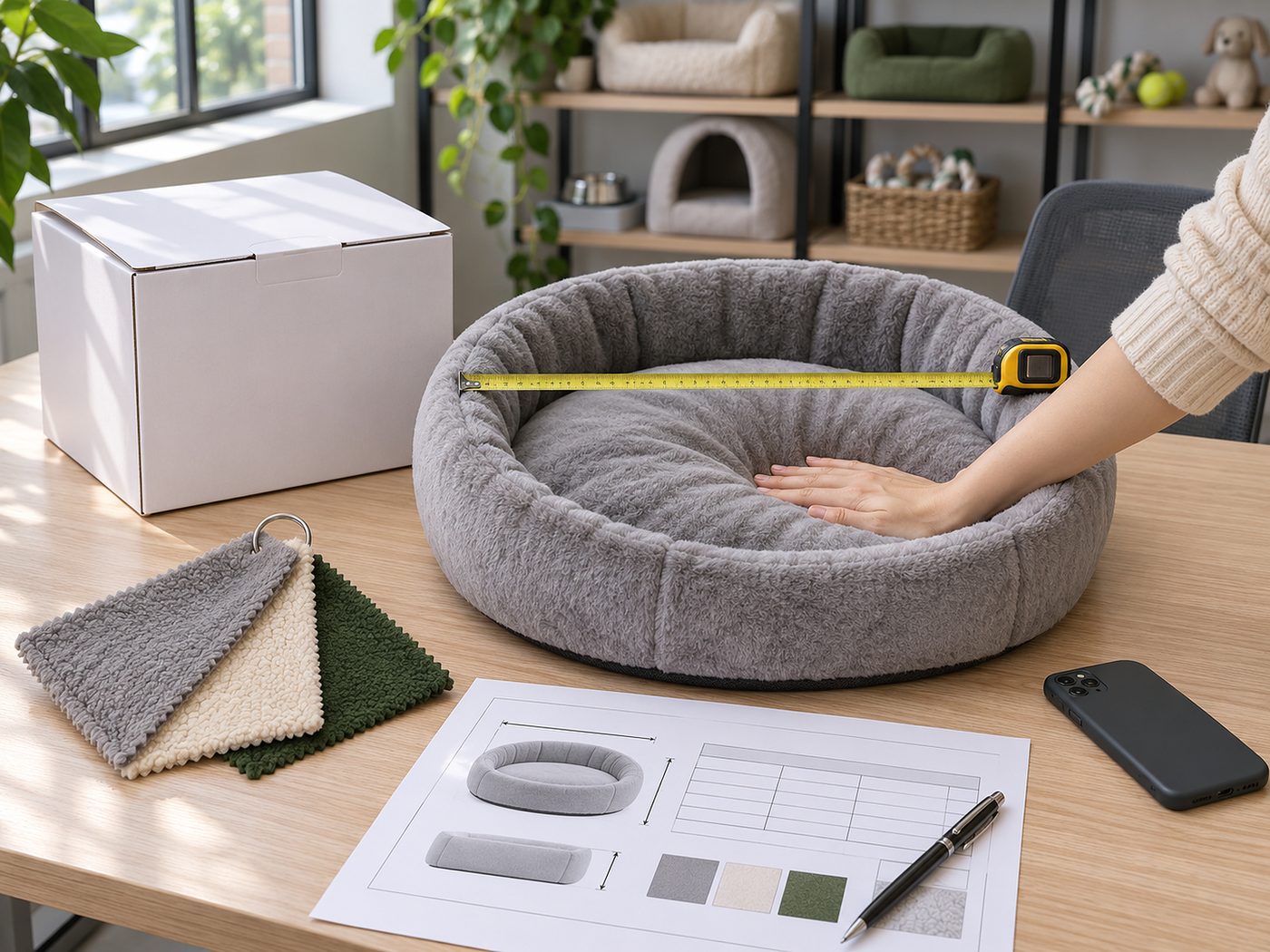
  4. Beds and soft goods: foam and fiber content

    Foam in US furniture-adjacent products should meet California TB 117-2013 (smolder resistance, no added flame retardants required). Every textile product needs a fiber-content and country-of-origin label under the Textile Fiber Products Identification Act. Ask for the foam supplier's TB 117 statement and check the label matches the fabric. Sources: Technical Bulletin 117-2013 (California Bureau of Household Goods and Services, PDF) and the FTC guide Threading Your Way Through the Labeling Requirements Under the Textile and Wool Acts.

  5. Toys and chews: small parts and materials

    There is no federal pet-toy standard, but the CPSC small-parts and sharp-point methods under FHSA are what labs and retailers apply by analogy. Natural rubber should be declared; nylon chews should state the nylon grade; rope toys should have cotton content declared. Prop 65 applies to all of them. The small-parts test method is 16 CFR Part 1501 (eCFR); it is written for children's articles, which is why it applies to pet toys only by analogy.

  6. Cages and wire goods: coating heavy metals

    Birds and small animals chew the bars. Ask for a lead, cadmium and zinc test on the coated wire and a cross-hatch adhesion test on the powder coat. Galvanized wire sheds zinc and should be declared as such.

  7. Batteries: UN38.3 and MSDS

    Cordless clippers, grinders, smart feeders and any product with a lithium cell need a UN38.3 test report and an MSDS for the cell before a forwarder will book sea or air freight. Collect them before the booking, and check the cell brand on the sample matches the report. US transport rules are summarised by the Department of Transportation at PHMSA: Lithium Batteries.
Questions

Asked about this.

Is there one certification for pet products in the US?
No. Pet products are regulated by material and function, not as a category. The list above is what retailers and marketplaces actually ask for; which items apply depends on the product.
Can the Chinese factory just send me its CE certificate?
CE is a European mark and does not satisfy US requirements. A factory that offers CE for a US order is usually offering what it has. Ask for the US items by name.
Who is responsible for compliance, the factory or the importer?
Legally, the US importer of record. The factory supplies documents and test reports; the importer is the one a retailer, marketplace or regulator will ask. That is why we collect documents per product rather than accepting a general factory certificate.
Does XueQiu Pets certify products?
No. We collect the factory's documents, check them against the actual sample, and arrange third-party testing at a lab when a retailer requires it, quoted separately. We do not issue certificates and we do not sign for a result we have not seen.

Apply it

The category pages carry the numbers for each product group.

PreviousMOQ and pricing from Chinese pet factoriesNextFactory audit and pre-shipment inspection in China

Who you work with

Wangzian. Small on purpose.

The person who shortlists your factory is the person who inspects what leaves it. No account manager between you and the line.

Based
Zhejiang, China
Scope
Pet supplies only, all categories
Hours
Weekdays 09:00–18:00 GMT+8 (9pm–6am US Eastern)
Reply
Within one working day
WhatsApp+86 182 5869 0709Emailzian@xueqiupets.com

Or read how we work and how we charge.

Ready to put this to work?

Send a short brief: product, target price, quantity. You get a written scope and the service fee within one working day.