Editorial — Published 2026-08-23 — By Wangzian, Pet Lifestyle Curator
Automatic Pet Feeder Guide: What the Trials Show, Including the Feature That Did Nothing
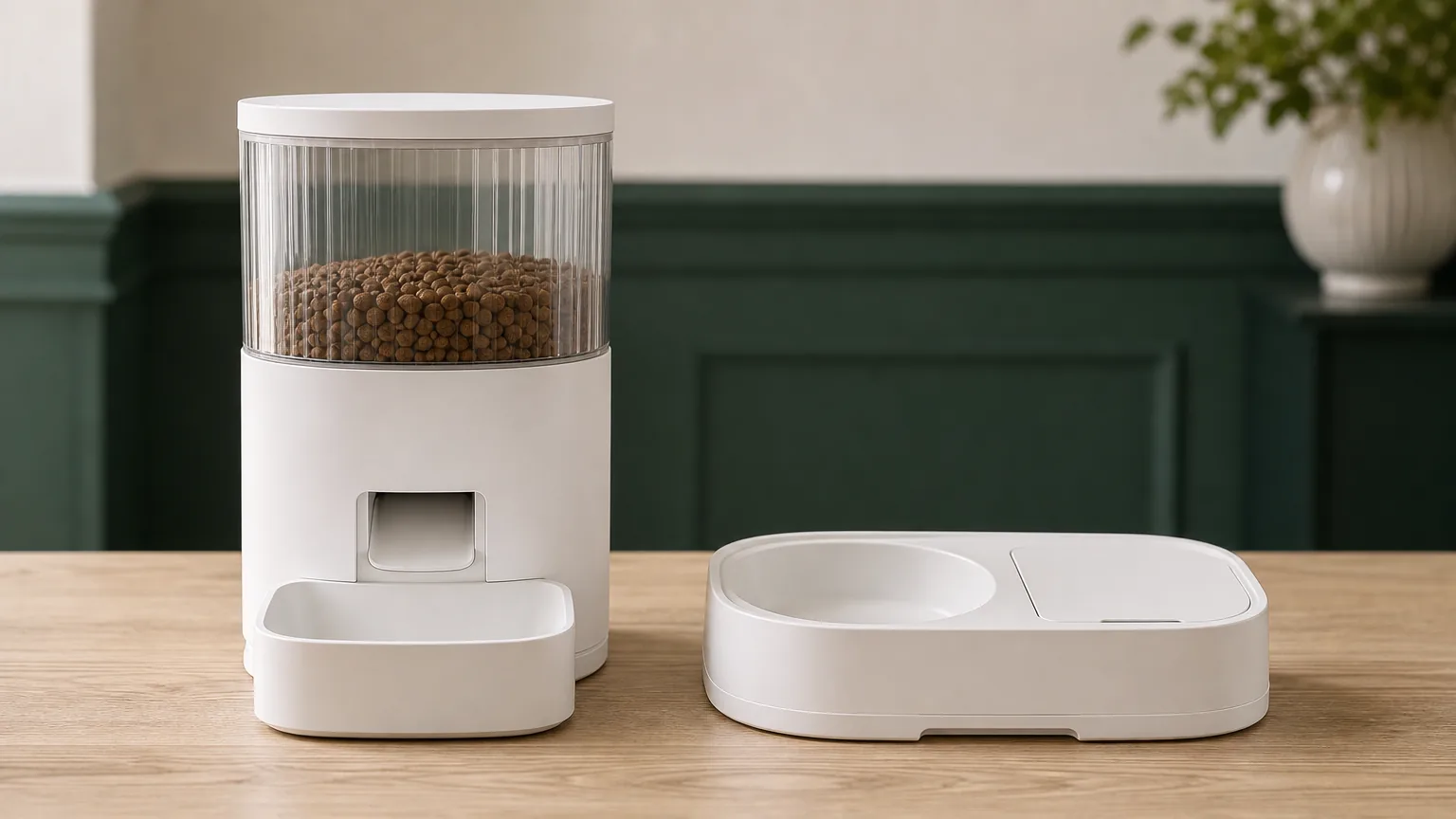
An automatic feeder is worth buying for portion control and cat separation, not for meal frequency. In a 26-week trial, 83.2% of cats on a feeder reached ideal body condition against zero fed from a bowl — but switching from two meals a day to six changed nothing measurable.
This is the summary page for everything we have written about automatic feeders. Each section gives the finding, its size, and the point where the evidence stops. Where we have covered something in depth there is a link rather than a repetition.
The one number that justifies the purchase
A 2022 trial at the University of Tennessee put 23 overweight cats from multi-cat homes on a six-month weight-loss plan. All ate the same prescription diet. All were assigned calories the same way. The only difference was delivery:
| Group | Method | Reached BCS ≤ 6/9 |
|---|---|---|
| A6 | Automatic feeder, 6 meals/day | 83.2% |
| A2 | Automatic feeder, 2 meals/day | 40% |
| B2 | Traditional bowl, 2 meals/day | 0% |
That difference was significant (P = 0.006). Not one cat in the bowl group reached ideal body condition.
Owners also rated the plan easier with a feeder — 4.7 and 5.0 against 4.0 for the bowl group (P = 0.011).
The feature that did nothing
Six meals a day against two, same total calories, same food:
- Weekly weight loss: 0.68% across all groups. No difference.
- Calorie intake per kg: 37.6 for two meals, 38.0 for six. No difference.
- Food-seeking behaviours: no difference between the two feeder groups.
The authors' conclusion is blunt: increased meal frequency has little clinical effect on weight loss in cats.
This matters because "programmable up to N meals per day" is the headline feature on nearly every feeder listing. The trial says the number itself is not what helps. What helped was that a machine, rather than a person, controlled the portion.
We looked at meal frequency separately, where a different trial found something genuinely surprising about once-daily feeding, in free feeding vs scheduled feeding.
Why the machine beats the human
The trial measured three begging behaviours, and the bowl group did all of them more:
| Behaviour | P |
|---|---|
| Stood at the bowl and begged | 0.030 |
| Followed the owner before feeding | 0.005 |
| Pawed or batted at the owner | 0.024 |
The authors' interpretation: cats began to dissociate the owner from mealtimes. The cat stops asking you because you stopped being the source.
Note what did not improve. Questions about perceived hunger and activity showed no difference across any group. Overall satisfaction showed no difference. The feeder changed who the cat pesters, not how hungry it feels.
What the trial could not separate
Before treating that 83.2% as proof that feeders work, there is a confound the authors raise themselves.
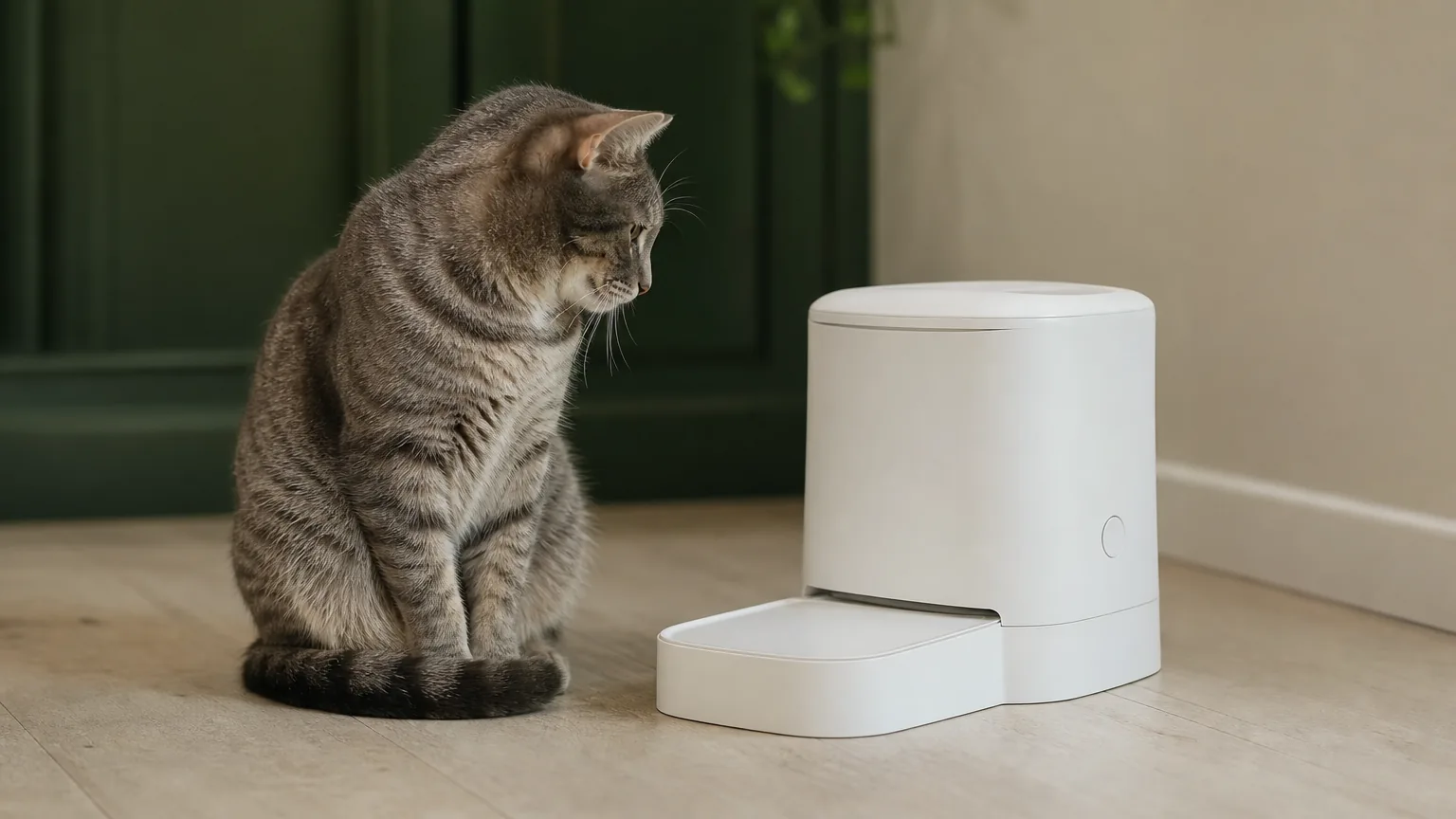
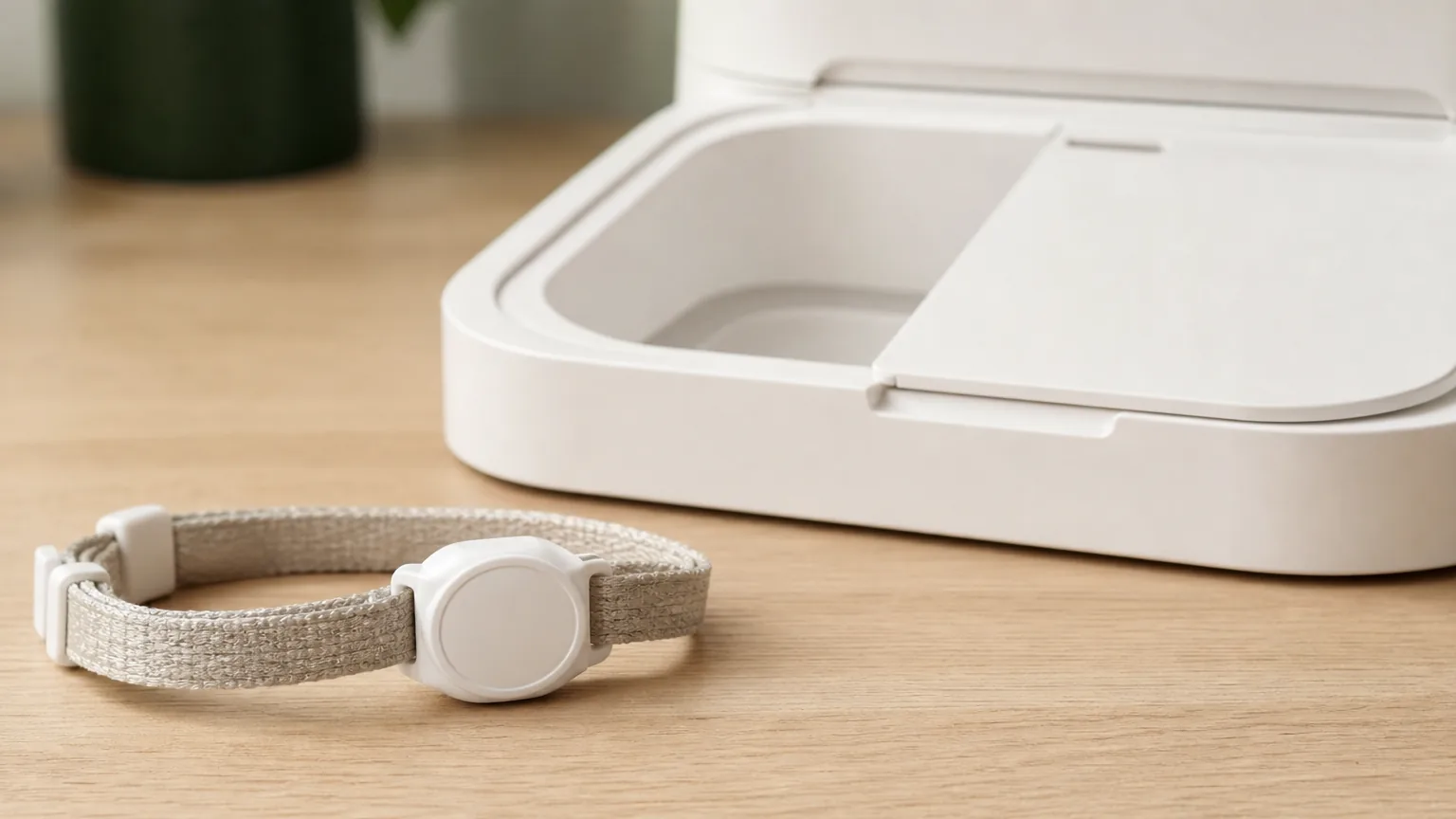
The tested feeder did two distinct things: it opened only for a collar-tagged cat, and it portioned food precisely. The study never isolated which of the two produced the benefit. Their words are that the results may not transfer to systems that only separate cats, or only portion food.
That matters commercially, because those are sold as different products at different prices. A timer-and-hopper feeder portions but does not separate. An RFID feeder does both and costs several times more. The trial supports the combination and is silent on either half alone.
There is a second confound the authors flag: the bowl group may simply have been harder to police. If a household could not reliably separate cats at mealtimes, the restricted cat could eat the other cat's food, and no calorie prescription survives that.
Setting the portion
The feeder is only as good as the number you program into it. A meta-analysis of 115 treatment groups put maintenance at roughly 55 kcal per kg of body weight per day — lower than the formula printed on most feeding charts, which means the default guidance tends to overfeed.
Two things that catch people out: heavier cats need fewer calories per kilogram rather than more, and neutering moves the requirement by about 10%.
The full arithmetic, including how to convert kcal into grams and why you must weigh what the machine actually dispenses, is in automatic feeder portion size for cats.
One detail from the 2022 trial belongs here: the feeder tested adjusted only in 1/8 cup increments, about 37 kcal on that diet. For a cat needing 220 kcal a day, one increment is 17% of the daily ration. Fine-grained portion control is a specification worth checking before buying.
The number nobody advertises: how often cats actually eat
Left to themselves, cats do not eat two meals a day. A cat hunting for a living takes something in the order of 8 to 12 small kills across a day — the figure the 2022 authors cite as the species baseline.
That fact is usually deployed as an argument for high-frequency feeders. It is worth noticing that the same paper which cites it also found six meals performed no better than two. The evolutionary story and the measured outcome point in different directions, and the measured outcome is the one with a control group.
Where the natural pattern does bite is grazing. Free access to a full bowl all day is associated with overeating, and most owners feed only one or two meals. A feeder does not resolve that tension by adding meals; it resolves it by making each meal a fixed size.
Wet food is a different problem
Most automatic feeders are built for dry food. Wet food introduces a spoilage limit that has nothing to do with portions, and the commonly cited two-hour rule holds in some conditions and breaks in others.
We worked through where that line actually falls in how long wet food can sit in an automatic feeder.
Multi-cat homes: the case where feeders earn their price
Every cat in the 2022 trial lived with at least one other cat. That is the hard case — one cat needs restriction, another grazes, and separating them at every meal is a chore that owners abandon.
The feeder tested used an RFID collar tag to open a shield over the bowl for one specific cat. Two of the three cats that failed to complete the study were in the bowl group, and one of those dropped out specifically because the owner could not separate the cats during feeding.
An honest caveat from the authors: the study could not separate whether the benefit came from separation or from accurate portioning, because the tested feeder did both. Their words — the results may not transfer to feeders that only do one of the two.
What to check before buying
Ordered by how well the evidence supports it:
- Portion granularity. Ask what the smallest increment is. 37 kcal steps are coarse for a 4 kg cat.
- Individual access control, if you have more than one cat. This is the mechanism with a measured outcome behind it.
- Whether it holds dry food only. Almost all do.
- Meal frequency last. Two meals performed the same as six on every measure taken.
And one behavioural note: of 23 cats, one refused to use the feeder entirely and had to be moved to the bowl group. That is roughly 4%, from a small sample, but it is not zero.
Where this evidence stops
The sample is tiny. Seven, ten and six cats per group. The headline 83.2% represents five cats out of six.
The groups were not balanced at baseline. The bowl group started heavier (P = 0.035), with an estimated 50.0% body fat against 42.7% and 40.5%, and 86% male against 50% in the other groups. The authors flag this themselves — a fatter starting point means longer to reach ideal condition, which inflates the apparent gap.
Total weight lost was not significant. 9.7% for bowls, 15.2% and 17.1% for feeders — but the analysis says a much larger sample would be needed to call that a real difference. Only the proportion reaching ideal condition was significant.
The owner questionnaire was not validated. The paper says so directly.
Nobody has tested a feeder in a single-cat home. Every cat here lived in a multi-cat household on a therapeutic weight-loss diet. If your cat is a healthy weight and lives alone, this trial does not describe your situation.
A note on who funded what
This work was supported by Vet Innovations. The feeder tested was the PortionPro Rx — a Vet Innovations product. The weight-loss diet was provided by Hill's Pet Nutrition.
The study of an automatic feeder was paid for by the company that makes that automatic feeder. The lead author also declares research grants from Hill's, Royal Canin, Radio Systems and Vet Innovations, and a seat on a retailer's advisory council. Two co-authors declare comparable ties.
None of that makes the numbers wrong. The randomisation, the blinded initial scoring and the published null result on meal frequency all point to a study run properly — a manufacturer-funded trial that reports its sponsor's headline feature doing nothing is not the behaviour of a marketing exercise. But you are entitled to weigh the funding alongside the finding.
This is the same shape of problem we hit with scratching products, where the two trials showing a product worked were both tied to its maker and the independent one came back null. That is set out in why does my cat ignore the scratching post.
What we sell, and what we do not
We make a programmable automatic feeder. It dispenses dry food on a schedule. It does not have RFID access control, which is the feature with the strongest evidence behind it in the trial above — so for a multi-cat home where one cat needs restriction and another does not, ours is not the right tool.
We have run no feeding trials of our own. Nothing above was tested on our product.
---
Sources
- Witzel-Rollins A, Murphy M, Albright J, et al (2022). Evaluation of a pet-separating automatic feeder and high-frequency meal feeding for weight loss in multi-cat households. J Feline Med Surg 24(8):e281-e288. Full text read. 23 cats, up to 26 weeks, three randomised groups. Funded by Vet Innovations, maker of the feeder tested; diet provided by Hill's Pet Nutrition.
- Bermingham EN, Thomas DG, Morris PJ, Hawthorne AJ (2010). Energy requirements of adult cats. British Journal of Nutrition 103(8):1083-93. Meta-analysis, full text read. Covered in full in the linked portion-size article.
- Background figures on obesity prevalence (25–67%) and prior weight-loss success rates are quoted as reported within Witzel-Rollins et al 2022, not read separately.
What we do not claim: we hold no feeding data of our own. The trial above is 23 cats in multi-cat homes on a therapeutic diet, funded by a feeder manufacturer, with unbalanced baseline groups. It is the best available evidence on this question, which is a statement about how thin the evidence is. A cat losing or gaining weight unexpectedly needs a vet, not a firmware setting.
Related reading
- Automatic Feeder Portion Size for Cats: The Standard Formula Overfeeds, and a Meta-Analysis Says So
- Free Feeding vs Scheduled Feeding Cats: What the Controlled Trial Actually Measured
- How Long Can Wet Food Sit in an Automatic Feeder? The Two-Hour Rule and Where It Breaks