Editorial — Published 2026-08-06 — By Wangzian, Pet Lifestyle Curator
How Long Can Wet Food Sit in an Automatic Feeder? The Two-Hour Rule and Where It Breaks
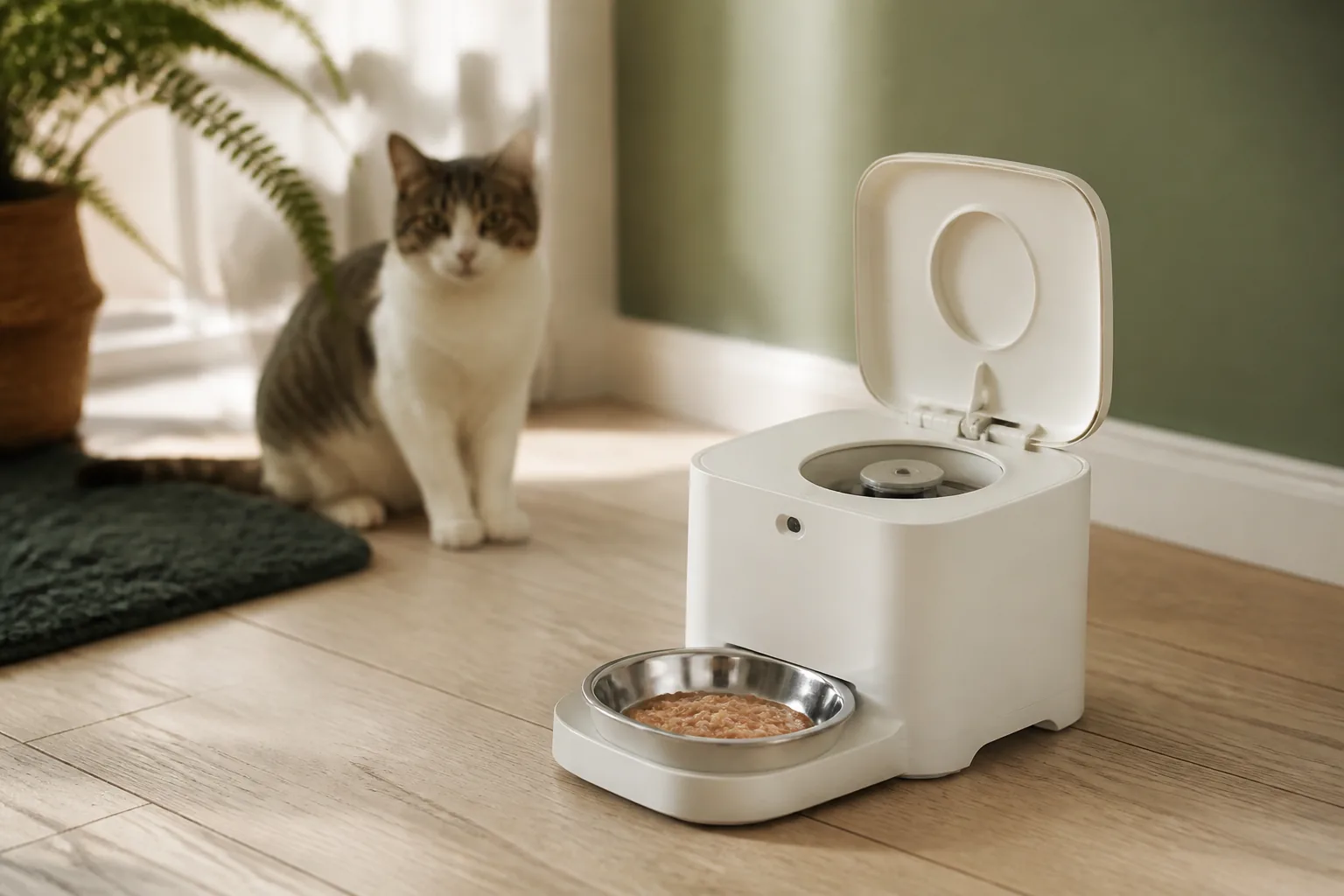
Two hours at room temperature. One hour if the room is above 90°F. That is the USDA limit for any perishable food, and an automatic feeder does not change the chemistry — it only changes who is watching. If your feeder holds wet food longer than that without a cooling element, the timer is the wrong tool for the job.
The growth rate is the part people find hardest to believe. The USDA calls 40–140°F the Danger Zone. In that range, bacteria can double in as little as 20 minutes.
So six hours is not twice as bad as three. It is roughly nine more doubling cycles.
What the FDA actually says about pet food specifically
The guidance is short and unambiguous: promptly refrigerate or throw out unused or leftover canned and pouched pet food. Not "check whether it smells." Not "your cat will avoid it if it is bad."
Two more instructions from the same page that almost nobody follows:
- Wash pet food bowls after each use.
- Wash water bowls daily.
Hold that thought, because there is survey data on how well that lands.
Only 21.5% of cat owners clean the bowl after each meal
A 2023 study in BMC Veterinary Research surveyed 351 dog owners and 186 cat owners in Italy, then went further and swabbed 96 actual dog food bowls for bacterial counts. The self-reported habits alone are worth reading:
| Cat bowl cleaning frequency | Share of owners |
|---|---|
| After each meal | 21.5% |
| Once a day | 22.7% |
| 2–3 times a week | 19.3% |
| Once a week | 16.6% |
| Less than weekly | 19.9% |
So roughly one in five cat owners does what the FDA recommends, and roughly one in five cleans the bowl less than once a week. The same survey found 43% of cats are fed ad libitum — food permanently available, which for wet food means permanently in the Danger Zone.
The finding that contradicts the standard advice
Here is where the swab data gets interesting, and where a lot of confident internet advice falls over.
Metal bowls were significantly more contaminated than plastic ones. Total mesophilic aerobic bacteria came in at 2.18 Log₁₀ CFU/cm² for metal against 1.23 for plastic, with p < 0.001 — one of the strongest results in the study.
That is the reverse of what most people are told. "Stainless steel is the most hygienic" gets repeated everywhere, and about the material it is true. Steel is non-porous. It does not develop the scratch network that plastic does.
But these were not laboratory surfaces. They were bowls from real homes. The authors suggest the metal ones simply got cleaned less carefully, because owners trusted the material to do the work for them.
The second unexpected result: hand washing produced higher Enterobacteriaceae counts than a dishwasher (p = 0.0515). And here is the part worth sitting with — hand washing was no better than dry wiping at all.
A sponge that has wiped a wet-food bowl becomes a way to move bacteria around the kitchen. The dishwasher wins on water temperature. Nothing else in a domestic kitchen gets that hot.
Wet food bowls also tested dirtier than dry food bowls (1.99 vs 1.42 Log₁₀ CFU/cm², p = 0.0397), which is the expected result and the one directly relevant to feeder timers.
Reassuringly, the study found no Salmonella, Campylobacter or VTEC E. coli in any of the 96 bowls. This is about general bacterial load, not an outbreak.
What this means for your feeder settings
If the feeder has no cooling element, treat it as a bowl on a timer. Schedule wet portions for times you are home to clear leftovers within two hours. A feeder that dispenses wet food at 11am while you work until 6pm is not a feeding solution. It is a seven-hour incubation.
If it has ice packs, you get an extension, not an exemption. Gel packs in a sealed compartment usually hold up for four to six hours in a cool room, and far less in a warm one.
Measure yours once instead of trusting the box. Put a portion in, leave it as long as your actual workday, then check the temperature when you get home. Ours held below 45°F for about five hours in a 22°C room. During a heatwave it failed well before that.
Above 90°F, halve everything. This is the same reason we treat summer as a different operating season for every piece of pet equipment in the house.
Split the difference with dry. Dry food in the feeder for daytime, wet food served by hand morning and evening, sidesteps the problem entirely. The FDA's warning is specifically about canned and pouched food.
This is worth weighing against what feeders demonstrably do well. In a controlled weight-loss trial they beat hand-feeding by a wide margin, but that trial ran on dry prescription food — the evidence and its limits are in our automatic pet feeder guide.
The maintenance that actually matters
Based on the swab data rather than intuition:
- Run removable bowls through the dishwasher where the design allows. This was the only cleaning method that measurably outperformed the others.
- Do not trust a metal bowl to stay clean because it is metal. That assumption is exactly what the contamination numbers punish.
- Keep a dedicated sponge if you must hand-wash, and do not let it near human dishes.
- Clean the dispensing chute, not just the bowl. Residue in a chute never gets wiped and never dries out. It is the same failure mode as the pump housing in a water fountain, which we covered in the fountain cleaning schedule.
- Wash your hands after refilling. The FDA lists this first. It is aimed at protecting you, not the cat.
Water needs the same discipline. A cat that avoids a fouled station drinks less, and we went through what follows from that in why cats under-drink.
Our own feeding and water range is built around parts that come out and go in a dishwasher. The study above is really an argument about whether cleaning is convenient enough to actually happen.
What this article cannot tell you
The bowl swabs were from dogs only — 96 of them, in Italy. Cat habits were surveyed, but no cat bowls were sampled. Applying the metal-versus-plastic result to cats is an inference, not a finding.
The dishwasher comparison rested on just five dishwasher users. That is why the p-value sits at 0.0515 rather than comfortably under 0.05. Treat it as a strong hint, not a settled fact.
The USDA two-hour rule is written for human food. No regulator has published a feeder-specific limit for pet food. That gap is exactly why the human standard is the most defensible thing to use.
---
Sources. USDA Food Safety and Inspection Service, "Danger Zone (40°F–140°F)", updated June 2023 — doubling time, two-hour and one-hour limits. US Food and Drug Administration, "Proper Storage of Pet Food & Treats", updated May 2024 — refrigerate or discard leftover canned food, wash bowls after each use, wash water bowls daily. Raspa F, Schiavone A, Pattono D et al. (2023), BMC Veterinary Research 19:261, doi:10.1186/s12917-023-03823-w — survey of 351 dog and 186 cat caregivers plus microbiological analysis of 96 dog food bowls; bowl material, feed type and cleaning method comparisons.
How this was made. Written by Wangzian, drawing on the regulatory guidance and the published study cited above, plus our own ice-pack timing measurements at home. Drafting assistance from an AI writing tool; every figure quoted traces to a named source, and the limits of each are stated above rather than smoothed over.
Related reading
- How Often Should You Clean a Cat Water Fountain? A Maintenance Schedule That Actually Works
- Why Is My Cat Not Drinking Water? Causes and Fixes
- How to Keep Pets Cool in Summer: The Complete Playbook We Run Every Year
- XueQiu Pets water and feeding range