Editorial — Published 2026-08-07 — By Wangzian, Pet Lifestyle Curator
Why Does My Cat Paw at the Water Before Drinking?
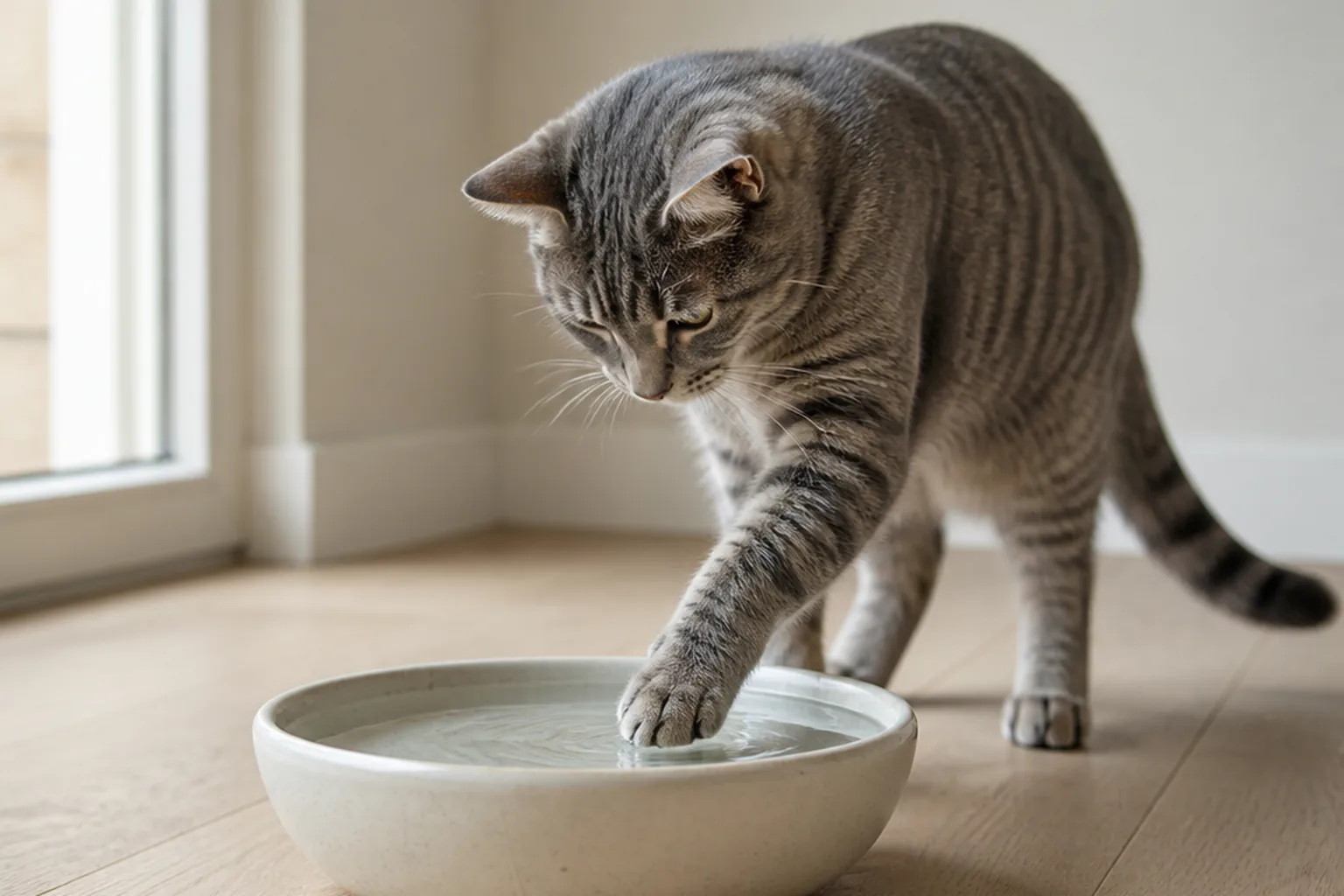
Your cat stands over the water bowl, dips a paw in, taps the surface, sometimes licks the paw instead of drinking from the bowl at all. Occasionally they scratch at the floor beside it first.
Search this and you will find four confident explanations, each stated as fact. One of them was put to a controlled test and did not hold up. One is genuinely well supported. One is plausible but untested. And one is a medical sign that is worth taking seriously.
This article separates them.
The explanation that failed a controlled test
The most repeated answer online is whisker fatigue — the idea that a cat's whiskers are overstimulated by the sides of a deep bowl, making the experience unpleasant, so the cat uses a paw instead.
It is worth knowing where this came from. The term entered popular circulation through a New York Times piece in June 2017. It does not appear in standard veterinary textbooks, and it has not been widely reported at veterinary conferences or in the journals.
In 2021, the Journal of Feline Medicine and Surgery published "Evaluation of whisker stress in cats", which tested it directly. The study compared cats fed from a commercially sold "whisker-friendly" dish against their normal bowl, measuring three things: time spent at the dish, food dropped, and amount eaten.
The bowl type made no difference to any of them.
There is one caveat that matters, and the study reported it: given a free choice between the two, more cats chose the whisker-friendly bowl. So a preference does appear to exist. What the data does not support is the stronger claim — that a normal bowl causes a cat distress significant enough to change how much they eat.
The honest position: a wide shallow bowl may suit your cat better, and there is no harm in trying one. But if a retailer tells you your cat's bowl is causing a recognised medical condition, that is a marketing claim, not a diagnosis.
The explanation with the strongest support
Cats see poorly at close range. Feline vision is optimised for detecting movement at a distance rather than resolving detail nearby, and objects very close to the face are not sharply focused. Their whiskers, not their eyes, do most of the near-field sensing — which is why a cat will sniff and feel at something held right in front of it rather than simply look.
A bowl of still, clear water sits inside that near zone. The surface of perfectly still water is close to invisible: no ripple, no movement cue, nothing for an eye tuned to motion to lock onto.
Tapping it solves the problem. The moment the surface moves, the cat has a definite reading on where the water is and how far down.
This explanation fits the observed behaviour better than the others. It predicts that the pawing happens more with full still bowls than with moving water, and that the cat often paws once and then drinks — which is exactly the pattern most owners describe.
The explanation that is plausible but untested
Cats in the wild avoid standing water near their food, and the usual reasoning offered is contamination: stagnant water is where bacteria accumulate, and an animal that avoids it survives longer.
There is a real basis for the underlying premise. Around 95% of the bacteria in a water system sit on the surfaces rather than in the water itself, and biofilm establishes in a bowl within days — we covered the measurements on that here. So the instinct would not be misplaced.
What is missing is any study connecting that instinct to this specific behaviour in domestic cats. It is a reasonable hypothesis. Treat it as one.
There is a related and much more mundane version of the same idea that often gets overlooked: the cat may simply be removing something. A hair, a speck of kibble, a piece of dust on the surface. Watch what the paw does — if it sweeps across the surface rather than tapping down into it, that is what you are seeing.
The explanation worth ruling out with a vet
Some pawing is normal and lifelong. A change in the behaviour is different.
If your cat has recently started pawing at water, hovering at the bowl without drinking, or drinking noticeably more or less than usual, those are among the observable signs of several conditions that are common in cats: chronic kidney disease, hyperthyroidism, diabetes.
Increased thirst is one of the earliest visible signs of all three, and all three are more treatable when caught early.
This is the part of the article that matters most. Nothing about bowl shape is worth attention if the underlying cause is a change in thirst. If the behaviour is new, the bowl is not the first thing to investigate.
What is worth trying, in order
- Note whether it is new. Lifelong habit or recent change decides everything else. A recent change goes to a vet first.
- Count the water. Fill to a marked level and check it at the same time each day. A rough number told to a vet is far more useful than "she seems to be drinking more".
- Try a wider, shallower bowl. The controlled study found no effect on eating, but it did find a preference. It costs little to test on your own cat.
- Try filling the bowl higher. If the visibility explanation is right, a bowl filled closer to the rim brings the surface up to where the cat can actually judge it. This is free.
- Try moving water. A fountain gives a constantly moving surface, which removes the visibility problem entirely. Worth knowing before you spend: three controlled studies found fountains do not increase average water intake — but about one cat in five does show a genuine preference, and the pawing may be a signal that yours is one of them.
- Keep it clean either way. Whatever the cat is detecting, a bowl with biofilm on the walls is not helping.
What we would not tell you
We sell bowls and water fountains. The temptation in an article like this is to land on "your cat is telling you it needs a different bowl", because that sells one.
The evidence does not support that conclusion. One controlled study on bowl shape found no effect on eating behaviour, and three controlled studies on fountains found no effect on water intake. What the evidence does support is that some individual cats have preferences worth accommodating, and that a change in drinking behaviour is a medical signal before it is a shopping signal.
If your cat has pawed at water for years and is otherwise well, this is very likely just how your cat drinks.
If the pawing did start alongside a change in how much your cat drinks, the equipment question and the medical question are worth separating. Both are laid out in the cat water fountain guide, including the one-in-five figure and how to spot that cat before buying anything.
---
Sources
- Slovak JE, Foster TE. Evaluation of whisker stress in cats. Journal of Feline Medicine and Surgery 2021; 23(4): 389–392. doi:10.1177/1098612X20930190
- Wedderburn P, MRCVS. Whisker Fatigue: Does It Really Happen? Cats.com veterinary review — on the absence of whisker fatigue from veterinary textbooks and its 2017 origin in popular media.
- Flemming HC, Percival SL, Walker JT. Contamination potential of biofilms in water distribution systems (2002) — on the roughly 95% of bacteria residing on surfaces rather than in the water phase.
A note on the vision section: it describes the general character of feline near vision rather than a specific published threshold. An earlier draft of this article gave a numeric minimum focal distance; on checking, the figure that circulates for that is the human near point, not a feline measurement, so it has been removed rather than repeated.
We sell pet bowls and water fountains. Both the whisker-bowl study and the fountain studies cited here work against those products, and are reproduced as published.
Related reading
- The Slimy Film in Your Pet's Water Bowl: What It Is and What Actually Removes It
- Cat Water Fountain vs Bowl: What Happened When Researchers Actually Measured
- Why Is My Cat Not Drinking Water? Causes and Fixes
- XueQiu Pets water and feeding range