Editorial — Published 2026-08-07 — By Wangzian, Pet Lifestyle Curator
The Slimy Film in Your Pet's Water Bowl: What It Is and What Actually Removes It
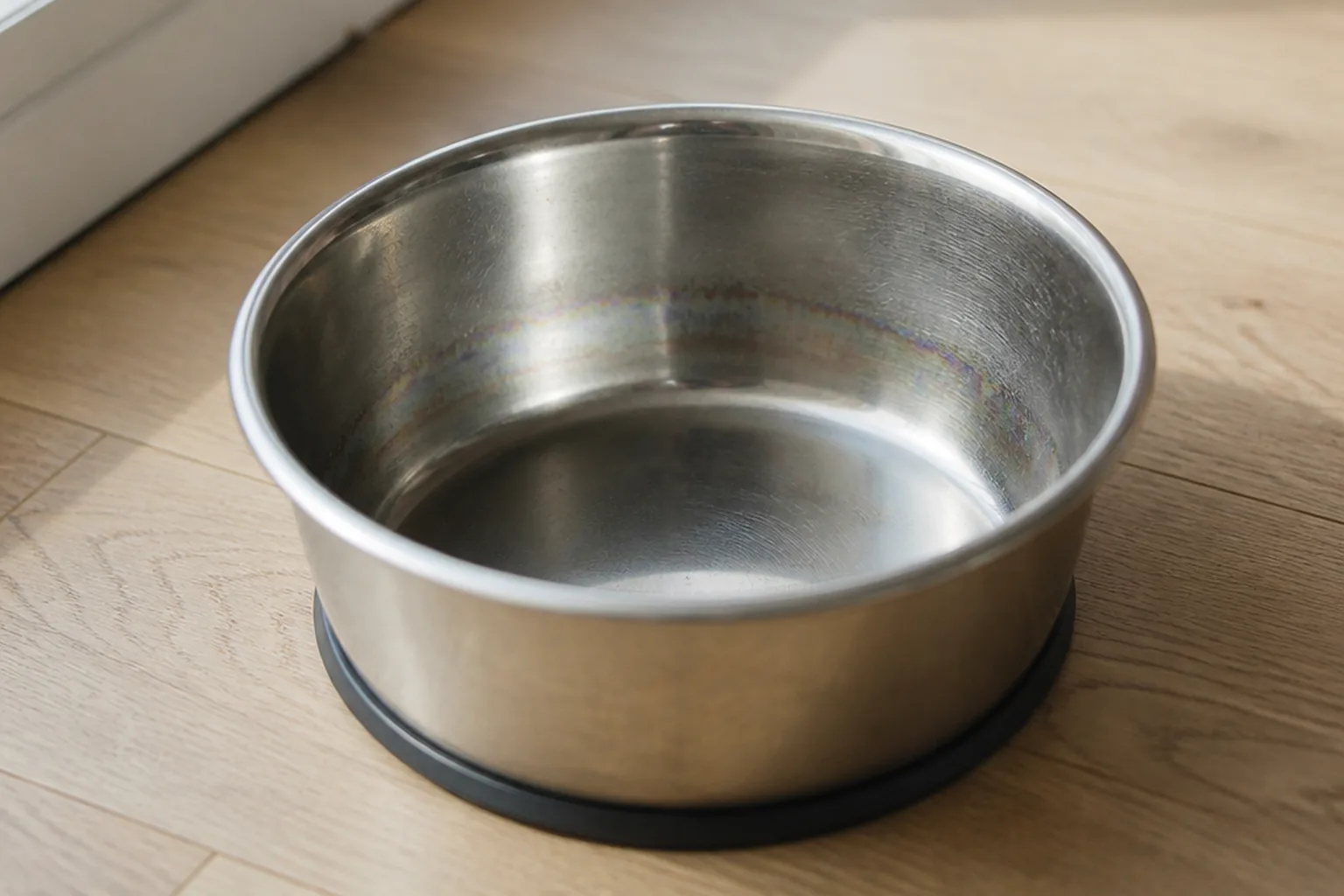
Run a finger around the inside of your cat's water bowl a day after filling it. If it feels slippery rather than simply wet, that is biofilm — a structured community of bacteria held together by a matrix the bacteria secrete themselves.
It is not algae. Algae needs light and is green. Biofilm forms in a bowl under your kitchen table, in the dark, and is usually clear or faintly pink.
Most of what is written about this online is either a forum thread guessing at the answer or a retailer explaining why their bowl is the solution. Two peer-reviewed studies have actually measured it. One of them produced a result that works against the products we sell, and we are going to lead with that one.
Metal bowls grew more bacteria than plastic, not less
Raspa and colleagues published in BMC Veterinary Research in December 2023. They sampled 96 dog food bowls from Italian households and counted total mesophilic aerobic bacteria per square centimetre, using standard ISO methods.
The finding on material:
| Bowl material | Result |
|---|---|
| Metal (stainless steel or similar), 48 bowls | Significantly higher bacterial counts |
| Plastic, 48 bowls | Lower counts |
p < 0.001. That is a strong result, and it points the opposite way to the usual retail advice that stainless steel is the hygienic choice.
We sell a stainless steel bowl. This study does not flatter it, and pretending otherwise would be the easiest thing in the world — the paper is behind an academic search, not a shopping search, and almost nobody selling bowls has mentioned it.
Two things stop this from being the last word, and both are in the paper's own discussion. The authors note that steel grade, surface smoothness and the age of the steel all affect how cleanable a metal surface is, and they did not control for any of them. A scratched, older, low-grade steel bowl is a different surface from a new, smooth one. They also point out that an earlier study, Luisana et al. in PLOS ONE (2022), found no significant effect of material at all.
So the honest summary is: material matters less than most marketing claims, and where it does matter, metal did not win.
What did have a clear effect: how you wash it
The same study compared cleaning methods on those 96 bowls.
- Dishwasher beat hand washing. Enterobacteriaceae counts were higher in hand-washed bowls (p = 0.0515).
- Hand washing was no better than dry wiping. No significant difference between the two.
That second point is the uncomfortable one. Wiping a bowl out with a cloth performed about as well as washing it by hand — which says less about wiping than it does about how most people hand wash.
The authors give a specific mechanism. Kitchen sponges harbour bacteria themselves, and Marotta et al. (2018) found sponges are frequently used for pet bowls and kitchen surfaces interchangeably. Luisana's group found bowls washed at 71.1 °C had lower counts than those washed in cold or lukewarm water. A cold rinse with a shared sponge can move bacteria around rather than remove them.
If you take one practical thing from this article: the dishwasher, on a hot cycle, is measurably better than what most of us do at the sink.
Why the film comes back within a day
A second study, from Hartpury, tracked three brand-new bowls — plastic, ceramic and stainless steel — across 14 days with six healthy dogs, swabbing at day 0, day 7 and day 14. Every material showed a significant rise in bacterial count between day 0 and day 7.
Two mechanisms explain the speed. Bacteria in a biofilm are substantially more resistant to antimicrobials and environmental stress than the same bacteria floating free. And roughly 95% of the bacteria in a water system sit on the surfaces, not in the water — so tipping out the water and refilling removes almost nothing.
That is why the film returns a day after you rinse. You changed the 5%.
What was actually found living in there
The Hartpury study identified MRSA and Salmonella among the species cultured, with the widest range of species coming from the ceramic bowl. Donofrio et al. (2012) ranked the pet water dish among the most contaminated items in the household.
Two things worth keeping in proportion. The Hartpury sample was six dogs — small, and the authors say so. And the larger Raspa study found no Salmonella, Campylobacter or verotoxigenic E. coli in any of its 96 bowls.
So: a neglected bowl can harbour organisms that matter, particularly in a house with a baby, an elderly resident or anyone immunocompromised. It is not a reason to panic about a bowl you wash regularly.
What actually removes biofilm
Biofilm is physically attached. Rinsing does not remove it — the matrix is the point of the structure.
- Mechanical scrubbing. Something has to physically break the matrix. This is the non-negotiable step.
- A dedicated brush, not the kitchen sponge. The sponge is a reservoir; the study data on hand washing is partly a story about sponges.
- Hot water. 71.1 °C in the Luisana protocol. A dishwasher reaches this; a tap usually does not.
- Dry it. Biofilm needs persistent moisture to re-establish. A bowl left wet in a cupboard is a head start.
- Get into the corners. Raspa's team excluded slow-feeder bowls from their study specifically because internal ridges make cleaning harder. Fountains have pumps, seals and narrow channels for the same reason — the parts you cannot reach are the parts that hold biofilm.
What we would actually tell a buyer
Choose the bowl you will genuinely clean daily, in the way that works. A plain bowl scrubbed every day beats a fountain that gets a full strip-down once a month.
If you use a fountain, the pump housing and tubing matter more than the visible reservoir, and the manufacturer's cleaning interval is a floor rather than a target. The part-by-part schedule we run on six units is in how often to clean a cat water fountain, and whether a fountain is worth owning at all — the three trials say it raises intake for about one cat in five — is in the cat water fountain guide.
If you use stainless steel, buy smooth and replace it when it scratches. The Raspa authors flagged surface roughness and age as the variables they could not control, which is a hint about where the risk sits.
And if a retailer tells you their material prevents biofilm, ask which study. Every material in both of these studies grew bacteria. The variable that moved the numbers was washing, not material.
---
Sources
- Raspa F, Schiavone A, Pattono D, et al. Pet feeding habits and the microbiological contamination of dog food bowls: effect of feed type, cleaning method and bowl material. BMC Veterinary Research 19, 261 (2023). doi.org/10.1186/s12917-023-03823-w
- Luisana E, Saker K, Jaykus LA, Getty C. Survey evaluation of dog owners' feeding practices and dog bowls' hygiene assessment in domestic settings. PLOS ONE 17: e0259478 (2022).
- Wright C, Carroll A. Microbiological assessment of canine drinking water: the impact of construction material on the quantity and species of bacteria present in water bowls. Hartpury Student Research Journal (2018). Student journal, not indexed; no stable link located.
- Donofrio RS, Bechanko R, Hitt N, et al. Are we aware of microbial hotspots in our household? Journal of Environmental Health 75: 12–19 (2012). ResearchGate record
- Marotta SM, Giarratana F, Calvagna A, et al. Study on microbial communities in domestic kitchen sponges. Italian Journal of Food Safety 7: 193–198 (2018). doi:10.4081/ijfs.2018.7672
We sell pet bowls and water fountains. The material finding in the Raspa study does not support the product we sell, and it is reproduced here as published.
Related reading
- How Often Should You Clean a Cat Water Fountain? A Maintenance Schedule That Actually Works
- Cat Water Fountain vs Bowl: What Happened When Researchers Actually Measured
- Why Is My Cat Not Drinking Water? Causes and Fixes
- XueQiu Pets water and feeding range