Editorial — Published 2026-08-06 — By Wangzian, Pet Lifestyle Curator
Cat Water Fountain vs Bowl: What Happened When Researchers Actually Measured
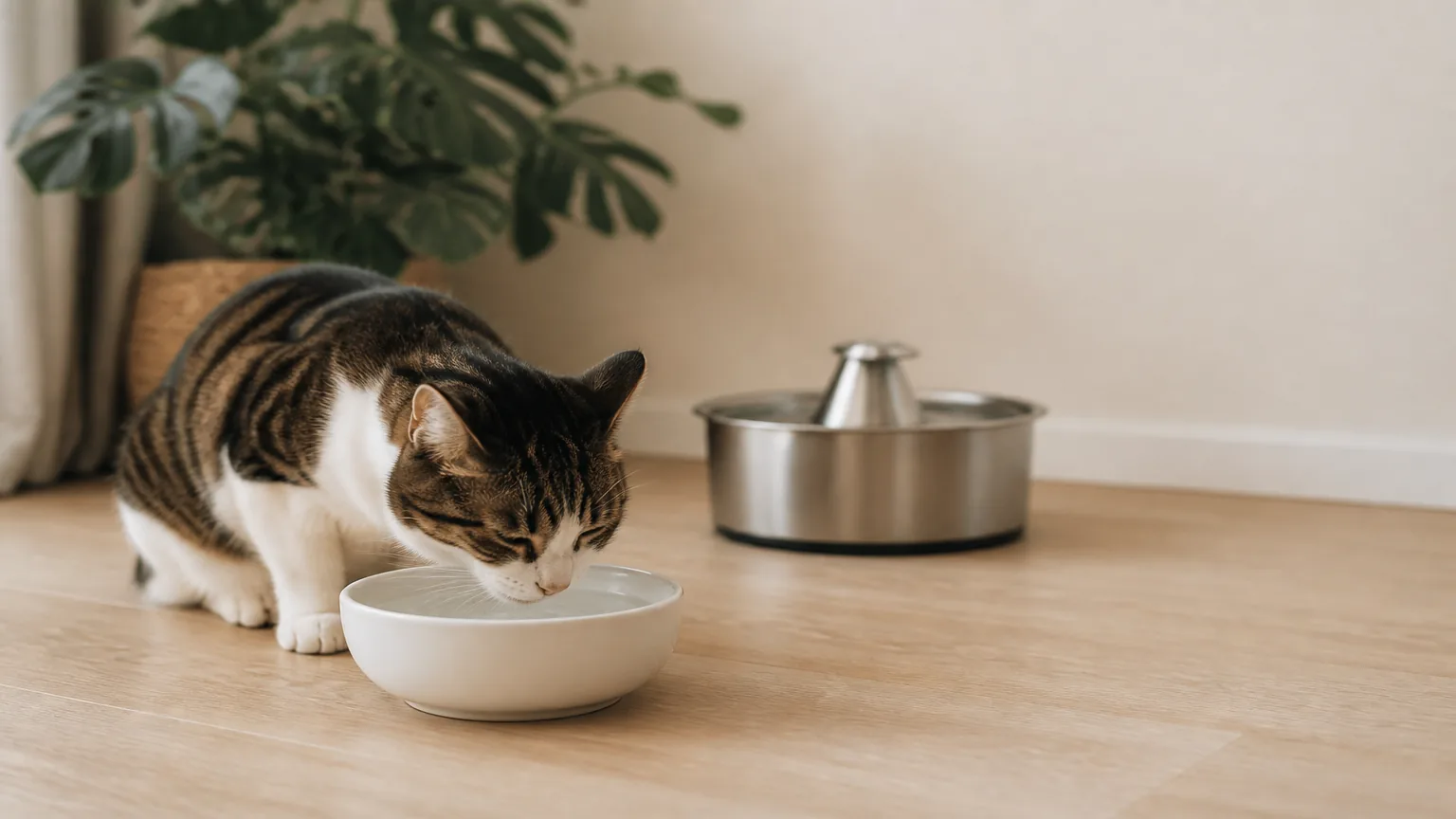
A cat water fountain does not make the average cat drink more than a plain bowl. Three controlled studies measured it. None found a significant difference. About one cat in five does have a genuine preference — and for that cat the choice matters a great deal.
We sell fountains. We also run six of them. So this is an awkward article to write, and it is the one we would want to read before spending the money.
What the three studies found
The most rigorous comparison to date came out of the University of Tennessee. Sixteen cats were enrolled and fourteen finished. Each cat rotated through all three bowl types in a randomised crossover — still, circulating, free-falling. Every rotation allowed a week to acclimatise, then a fortnight of measurement.
Crucially, every cat acted as its own control. That removes the biggest confounder in this kind of test: cats differ wildly from one another.
| Bowl type | Daily water intake (ml/kg/day) |
|---|---|
| Still | 27.48 ± 5.85 |
| Circulating | 26.33 ± 7.34 |
| Free-falling | 26.14 ± 6.49 |
P = 0.942. That is about as close to "no effect" as this kind of measurement gets. The still bowl came out numerically highest, though the gap is meaningless at that p-value.
Urine volume, urine specific gravity, and relative supersaturation for both struvite and calcium oxalate showed no significant difference either. Those are the parameters that actually matter for urinary tract disease, and they did not move.
Two earlier studies pointed the same way. A 2010 trial with thirteen cats compared still against free-falling and found no statistical difference. A separate 2010 pilot used nine shelter cats. It measured 115.44 mL from the flowing source against 109.83 mL from the still one — a gap far too small, in a group that size, to mean anything.
The detail that should make you trust this result
The Tennessee study was funded by Radio Systems Corporation, which sells pet water fountains.
An industry-funded study that fails to find a benefit for the sponsor's product category is the strongest kind of negative result available. Nobody had an incentive to bury the fountain. The authors' own conclusion is blunt: alternative methods to increase water intake should be implemented beyond providing unique water bowls.
But 21% of cats did have a preference
This is where "fountains don't work" becomes too simple.
Three of the fourteen cats showed a statistically significant preference — and the results ran in different directions:
- One cat drank more from the circulating bowl (p = 0.039)
- One drank markedly more from the free-falling bowl, 38.2 against 26.9 ml/kg/day (p = 0.005)
- One drank more from the still bowl (p = 0.037)
So preference is real, it is individual, and it is not reliably in the fountain's favour. Averaged across a population it cancels out. Applied to your specific cat it may be the difference between adequate hydration and chronic under-drinking.
That is a different claim from the one on most product pages, and it is the honest one.
One result that cuts against the fountain
Urine osmolality — how concentrated the urine is — came back higher on the circulating bowl (2584.7 mOsm/kg) than on still (2175.7) or free-falling (2108.6), p = 0.009. More concentrated urine is the opposite of the goal.
The authors are careful here, and so are we. Water intake did not differ between bowls, so the clinical meaning is unclear. They also raise a plausible artefact. Samples were frozen before analysis, storage duration varied by randomisation order, and longer storage is known to lower measured osmolality.
We report it because leaving it out would be selective — not because we think it condemns circulating fountains.
What actually moves water intake
The same body of research is much less ambiguous about the lever that does work: moisture in the food.
Dry kibble runs under 10% moisture. Most canned food sits around 80%. Cats eating dry diets do drink more from the bowl to compensate — but not enough to close the gap. Total daily water intake still comes out higher on wet food, and the urinary parameters improve with it.
If your actual goal is a better-hydrated cat, changing what is in the bowl beats changing the bowl.
Wet food brings its own rules, though. Timing and hygiene start to matter once it enters the routine. We covered the two-hour limit and the bowl contamination data in how long wet food can safely sit in an automatic feeder.
So should you buy one?
A fountain is worth it if: your cat has already shown interest in moving water — drinking from taps, pawing at glasses, sitting in the sink. That behaviour is the individual preference the data says exists in roughly one cat in five, and it is observable before you spend anything.
It is also reasonable if: your cat has a diagnosed urinary condition and your vet wants intake up by any means available. Offering several water sources at once is cheap insurance when preference is unknown.
Skip it if: you are buying it because a listing implied fountains raise intake as a general rule. On the current evidence they do not. Add a second bowl somewhere your cat already rests and switch some of the diet to wet food instead — both are cheaper and better supported.
One thing matters more than the still-versus-flowing question. A fountain your cat avoids because it smells stale is worse than no fountain at all. It creates false confidence that water is being consumed. Ours run on a fixed maintenance schedule for exactly this reason — the routine is in how often to clean a cat water fountain.
And if the real worry is that your cat barely drinks at all, separate that from the equipment question entirely. We went through the normal ranges and the warning signs in why cats under-drink.
This article answers one question: does a fountain raise water intake. The wider decision — how much water a cat actually needs, how to spot the cat that genuinely prefers moving water, and what to look for if you do buy one — is in the cat water fountain guide.
Our own water and feeding range includes both fountains and plain ceramic bowls. After reading this, some buyers should be choosing the bowl.
What these studies cannot tell you
All three used individually housed laboratory or shelter cats, not cats in homes. A cat in a quiet cage has one water source and no competition. That is not the same decision a cat makes in a household with a dog, three humans, and a tap that occasionally runs.
Sample sizes were small — fourteen, thirteen, and nine. Small studies detect large effects reliably and miss small ones. It remains possible that fountains produce a modest benefit these trials were underpowered to see.
Every cat in the Tennessee study was healthy. Cats with kidney disease, cystitis, or urolithiasis may respond differently, and they are precisely the population most owners are buying fountains for.
None of that overturns the finding. It does mean the honest summary is "no measured benefit in healthy cats under controlled conditions," not "fountains are useless."
---
Sources. Robbins MT, Cline MG, Bartges JW et al. (2019), Journal of Feline Medicine and Surgery 21(8):682–690, doi:10.1177/1098612X18803753 — 3×3 crossover in 16 laboratory cats (14 completed) comparing still, circulating and free-falling bowls; water intake, urine volume, USG, osmolality and relative supersaturation; funded by Radio Systems Corporation. Grant DC (2010), J Feline Med Surg 12:431–434, doi:10.1016/j.jfms.2009.10.008 — 13 cats, still versus free-falling. Pachel C, Neilson J (2010), J Vet Behav 5:130–133, publisher page — 9 shelter cats, 115.44 mL flowing versus 109.83 mL still. Dietary moisture figures and the wet-versus-dry intake comparison are drawn from the discussion and cited literature in Robbins et al.
How this was made. Written by Wangzian. Every figure above is quoted from the published papers named, which we read directly rather than summarised from secondary coverage. Where a result is ambiguous, the authors' own caveat is reproduced alongside it. We maintain six fountains and sell both fountains and bowls — a commercial interest this article argues against. Drafting assistance from an AI writing tool; source selection, figures and conclusions are our own.
Related reading
- How Often Should You Clean a Cat Water Fountain? A Maintenance Schedule That Actually Works
- Why Is My Cat Not Drinking Water? Causes and Fixes
- How Long Can Wet Food Sit in an Automatic Feeder? The Two-Hour Rule and Where It Breaks
- XueQiu Pets water and feeding range