Editorial — Published 2026-08-08 — By Wangzian, Pet Lifestyle Curator
The Cat Water Fountain Guide: Everything We Got Right, and the Parts We Got Wrong
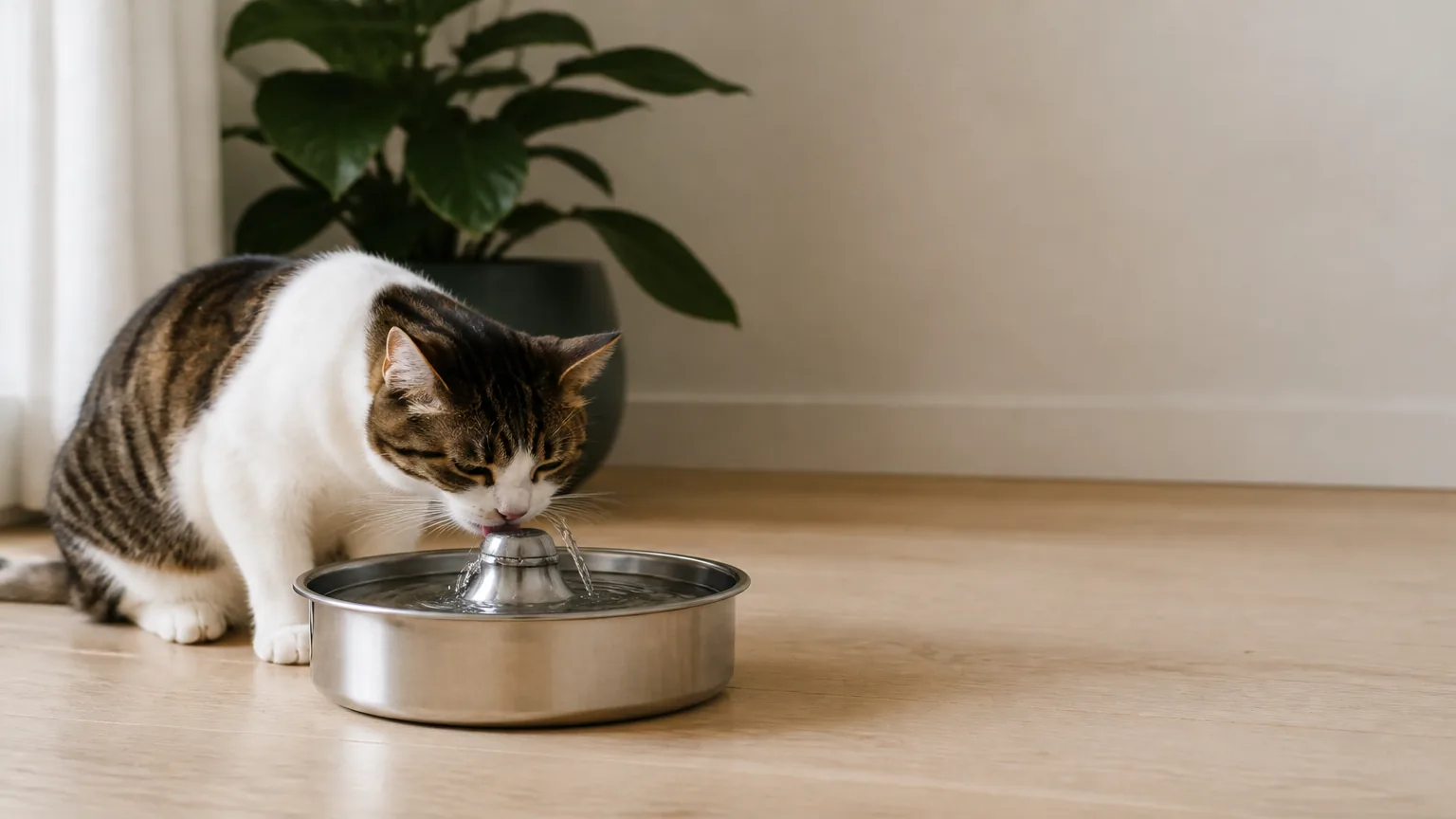
Most cats do not drink more from a fountain than from a bowl. Controlled studies keep finding no significant difference. About one cat in five has a real preference — and if yours is that cat, a fountain matters enormously. This guide covers how to tell which one you have before spending anything.
We sell fountains. We also run six of them and have spent nine days publishing what the research says about them, including the parts that argue against buying one. This is the summary of all of it.
Start with the number that actually matters
Cornell Feline Health Center puts the requirement at 4 ounces of water per five pounds of lean body weight per day. For a 10-pound cat that is about one cup — from all sources combined.
That last clause is where most worry dissolves. Wet food runs up to 80% water. A cat eating mostly canned food takes in a large share of its daily requirement before touching the bowl, and will visibly drink less. A cat on dry food does the opposite. Both can be perfectly hydrated.
So before you diagnose a drinking problem, work out what the diet is already providing. We went through the normal ranges, the skin-turgor test and where it misleads, in why cats under-drink.
Does a fountain increase water intake? Mostly, no
Three controlled studies have tested this. None found a significant increase.
The most rigorous is a randomised crossover from the University of Tennessee. Sixteen cats enrolled and fourteen finished, each rotating through still, circulating and free-falling bowls. Every cat served as its own control.
| Bowl type | Daily intake (ml/kg/day) |
|---|---|
| Still | 27.48 ± 5.85 |
| Circulating | 26.33 ± 7.34 |
| Free-falling | 26.14 ± 6.49 |
P = 0.942. Urine volume, specific gravity and relative supersaturation for both stone types showed no difference either — those are the measures that matter clinically, and they did not move.
The study was funded by a company that sells pet fountains. They published the null result anyway. That is the strongest kind of negative finding available, and it is why we treat it as settled rather than arguable. The full breakdown, including the one result that runs against circulating fountains, is in cat water fountain vs bowl.
The 21% who do care
Averages hide the useful part. Three of those 14 cats showed a statistically significant preference — and they ran in three different directions:
- one drank more from the circulating bowl (p = 0.039)
- one drank markedly more from free-falling, 38.2 against 26.9 ml/kg/day (p = 0.005)
- one drank more from the still bowl (p = 0.037)
Preference is real, individual, and not reliably in the fountain's favour. Across a population it cancels out. In your kitchen it may be decisive.
Cornell's own wording matches this: some cats increase intake with fountains, but individual preferences vary. Notably cautious phrasing from an institution with nothing to sell.
How to tell which cat you have, for free
Your cat has probably already told you. Watch for:
- drinking from a running tap, or waiting by the sink
- pawing at the water surface before drinking
- pushing a glass toward the edge of a table
- preferring one specific bowl in the house over an identical one elsewhere
That first group points toward a fountain being worth trying. The pawing behaviour is more interesting than it looks, and the popular explanation for it — whisker fatigue — failed a controlled test. We covered what the evidence actually supports in why cats paw at water before drinking.
A cheaper test than buying a fountain: put a second plain bowl somewhere your cat already rests. Multi-bowl access is one of the few interventions Cornell lists without hedging, and it costs nothing.
The part almost everyone underestimates: maintenance
This is where fountains genuinely differ from bowls, and not in their favour.
A fountain is a warm, aerated, continuously circulating reservoir. It is a better environment for biofilm than a still bowl — that slick film you feel on the inside wall. Roughly 95% of bacteria in a water system live on surfaces rather than in the water itself, so what you can feel matters more than what you can see.
Two findings from the bowl-hygiene literature reset our own routine:
Stainless steel tested dirtier than plastic. In a study swabbing 96 dog bowls from real homes, metal carried 2.18 Log₁₀ CFU/cm² against plastic's 1.23 (p < 0.001). Not because steel is worse — it is non-porous and should win — but because owners trust it and clean it less.
Hand washing showed no significant advantage over dry wiping. Only dishwasher use produced a real reduction. This makes dishwasher-safe parts a hygiene feature rather than a convenience one, and most product listings bury it.
What that means in practice: rinse the bowl daily, run the removable parts through the dishwasher weekly, replace filters on schedule rather than when they look dirty. The full schedule, part by part, is in how often to clean a cat water fountain, and what the film actually is — plus what removes it — is in the slimy film in your pet's water bowl.
The same logic governs anything else in the house holding food or water. We applied it to feeders — where the risk is bacterial growth in warm wet food rather than biofilm — in how long wet food can safely sit in an automatic feeder.
A fountain your cat avoids because it smells stale is worse than no fountain. It manufactures false confidence that water is being consumed.
Choosing one, if you have decided to
Ranked by what the evidence supports:
- Dishwasher-safe removable parts. The only cleaning method with a demonstrated effect. Non-negotiable.
- Few internal crevices. Every seam is biofilm habitat and a place your weekly clean will miss.
- Quiet pump. A fountain that startles a cat gets avoided, which defeats the purpose entirely.
- Filter cost and availability. Recurring, and the reason many fountains end up running unfiltered.
- Flow style — last. Circulating versus free-falling is the specification most listings lead with, and the one the data says matters least on average.
Material is not on this list. Given that steel bowls tested dirtier in real homes, material choice is dominated by your cleaning habit, not by the substrate.
Our own water and feeding range includes fountains and plain ceramic bowls. After reading this, some buyers should be choosing the bowl — and if the cat drinks well from a bowl, that is a better outcome than an unused fountain.
Where a fountain is genuinely worth it
- Your cat already seeks moving water. Observable in advance, at no cost.
- Diagnosed urinary or kidney disease, with a vet asking you to raise intake by any available means. Offering several sources at once is cheap insurance when preference is unknown.
- A dry-food diet you cannot change, where every increment of drinking counts.
- Multi-cat households where one animal is blocked from a single water station. Cornell lists territorial conflict as a real cause of reduced intake, and a second source in another room fixes it.
Where it is not
- You read that fountains increase water intake as a general rule. On current evidence, they do not.
- You want it to compensate for a dry diet. Adding water to food, or shifting part of the diet to wet, has better support than any bowl design.
- You will not commit to weekly cleaning. An unmaintained fountain is a worse water source than a bowl you rinse daily.
What this guide cannot tell you
Every study cited used individually housed laboratory or shelter cats. A cat in a quiet cage with one water source is not making the decisions your cat makes in a house with a dog and a tap.
Sample sizes were small — 14, 13 and 9. Small studies reliably detect large effects and miss modest ones. A real but small fountain benefit could exist below the resolution of these trials.
Every cat in the Tennessee study was healthy. Cats with kidney disease, cystitis or urolithiasis may respond differently — and they are exactly the population most fountains are bought for.
The bowl-hygiene work was done on dog bowls. We apply it to cats because biofilm physics does not care about the species, but that is an inference, not a finding.
The honest summary is "no measured benefit in healthy cats under controlled conditions," not "fountains are useless." Those are different claims. The gap between them is where your individual cat lives.
---
Sources. Robbins MT, Cline MG, Bartges JW, et al. Quantified water intake in laboratory cats from still, free-falling and circulating water bowls, and its effects on selected urinary parameters. Journal of Feline Medicine and Surgery 2019; 21(8): 682–690, doi:10.1177/1098612X18803753 — funded by Radio Systems Corporation. Grant DC. Effect of water source on intake and urine concentration in healthy cats. J Feline Med Surg 2010; 12: 431–434, doi:10.1016/j.jfms.2009.10.008. Pachel C, Neilson J. Comparison of feline water consumption between still and flowing water sources: a pilot study. J Vet Behav 2010; 5: 130–133, publisher page. Raspa F, Schiavone A, Pattono D, et al. Pet feeding habits and the microbiological contamination of dog food bowls. BMC Veterinary Research 2023; 19: 261, doi:10.1186/s12917-023-03823-w. Flemming HC, Percival SL, Walker JT. Contamination potential of biofilms in water distribution systems (2002) — on the ~95% of bacteria residing on surfaces. Cornell University College of Veterinary Medicine, Feline Health Center, Hydration (last updated 2021) — daily requirement and the fountain caveat.
How this was made. Written by Wangzian. Every figure is quoted from the paper named, read directly rather than summarised from secondary coverage; where the authors hedge, their hedge is reproduced. We run six fountains on a fixed cleaning schedule and sell both fountains and bowls, which is a commercial interest that several conclusions here argue against. This guide consolidates five earlier articles and adds no new claims beyond the Cornell intake figure. Drafting assistance from an AI writing tool; source selection, figures and conclusions are our own.
Related reading
- How Often Should You Clean a Cat Water Fountain? A Maintenance Schedule That Actually Works
- Cat Water Fountain vs Bowl: What Happened When Researchers Actually Measured
- Why Is My Cat Not Drinking Water? What Six Fountains and One Vet Bill Taught Us
- The Slimy Film in Your Pet's Water Bowl: What It Is and What Actually Removes It
- Why Does My Cat Paw at the Water Before Drinking?
- How Long Can Wet Food Sit in an Automatic Feeder? The Two-Hour Rule and Where It Breaks
- XueQiu Pets water and feeding range