Editorial — Published 2026-08-04 — By Wangzian, Pet Lifestyle Curator
How to Keep Pets Cool in Summer: The Complete Playbook We Run Every Year
Short answer: keep pets cool in summer by fixing the environment before buying anything — close curtains on the sunny side, move walks to before 8 am and after 7 pm, keep clean water in reach, and add cooling gear only where those three fall short. Free changes deliver most of the benefit; equipment covers the gap.
We learned the order the hard way. Our office beagle Mango had a heatstroke scare after a routine midday walk, and in the weeks afterward we bought cooling mats, a cooling vest, and an elevated cot. The gear helped. But when we measured what actually moved his resting respiratory rate, the biggest single change was free: closing the west-facing curtains at 11 am, which dropped the room 2–3°C.
This is the playbook we've run every summer since, in the order we'd rebuild it from scratch.
Layer 1: Fix the room (free, biggest effect)
Before spending anything, take the heat out of the space your pet actually occupies.
Block the sun before it gets in. Radiant heat through glass is the main driver of afternoon room temperature. Curtains or blinds on the sunny side, closed before the sun hits rather than after, gave us the 2–3°C drop mentioned above. Closing them at 2 pm after the room has already absorbed heat does far less.
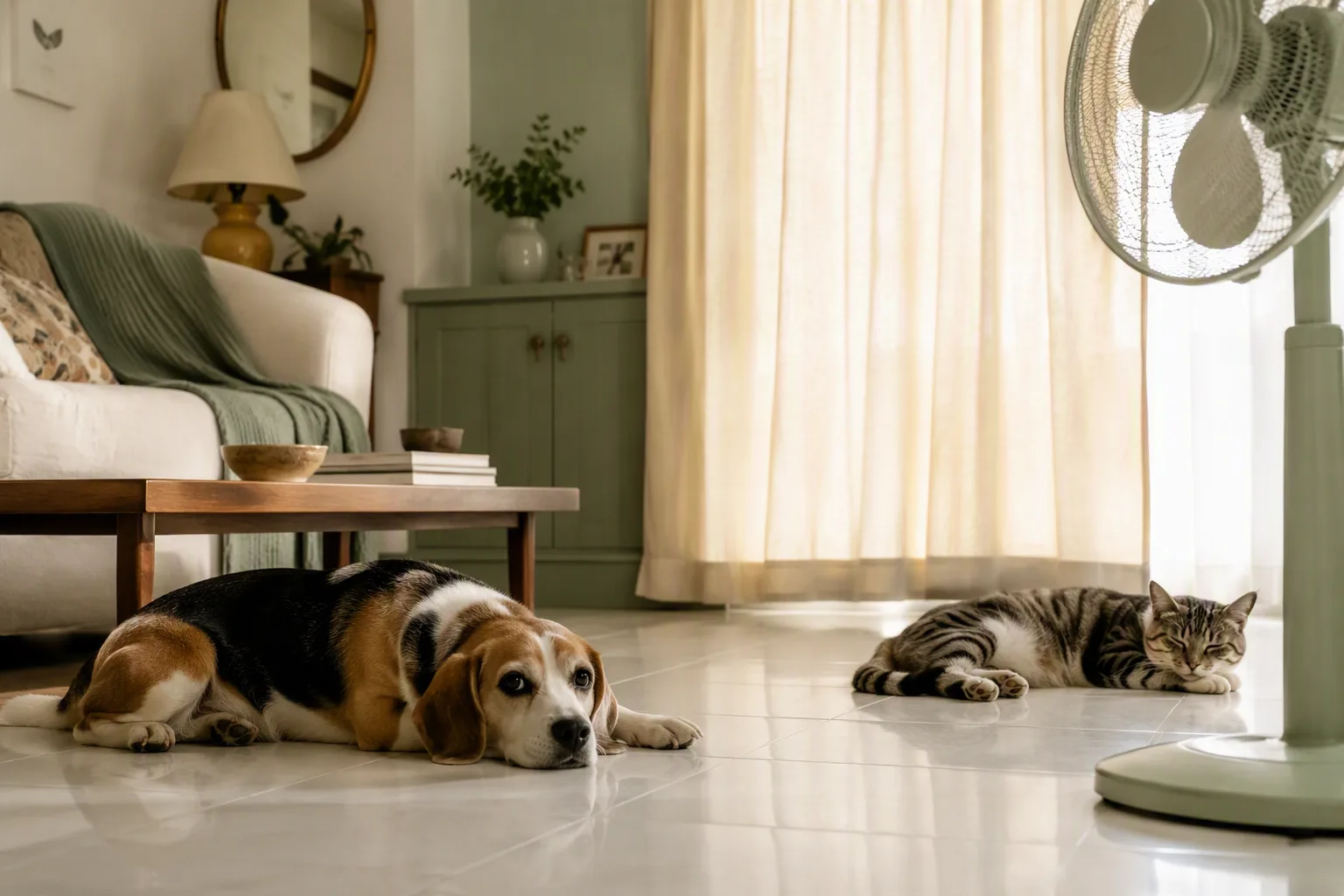
Create airflow, not just cold air. A fan pointed across a room does more for a panting dog than an air conditioner running with the door shut, because moving air accelerates evaporation off the tongue and airway. We keep one floor fan on low, angled to sweep the area rather than blast one spot — pets should be able to move into and out of the airflow.
Leave hard floors accessible. Tile and stone are the most-used cooling surfaces in our test room, beating every product we've bought. Our cats choose bathroom tile over gel mats routinely, and dogs will belly-flop onto it given the option. Don't carpet over the coolest surface in the house.
Know your humidity, not just your temperature. This is the variable most owners ignore. Panting cools by evaporation, so it fails precisely when the air is already saturated. A humid 32°C day is more dangerous than a dry 38°C one. We keep a cheap hygrometer in the test room; above 70% humidity, we treat the day as one risk level higher regardless of what the thermometer says.
Layer 2: Shift the schedule (free, second biggest effect)
Move walks to the edges of the day. Before 8 am and after 7 pm. A short midday walk in humidity is worse than a long dawn walk — the total heat load matters more than the duration. This single change did more for Mango than any product we own.
Use the seven-second asphalt test. Press the back of your hand flat on the pavement and hold. If you can't make seven seconds, it's too hot for paw pads. Remember that radiant heat off that surface hits a dog's belly far harder than it hits your face at standing height.
Skip the walk entirely on bad days. Dogs need mental stimulation, not necessarily distance. On our worst days we do scent games indoors — hiding treats around the room — and Mango is as tired afterward as from a walk, with none of the heat exposure.
Never leave a pet in a parked car. Not for five minutes, not with windows cracked. Interior temperature climbs far faster than most people estimate, and this remains one of the most common causes of preventable heatstroke deaths.
Layer 3: Add the right gear (paid, fills specific gaps)
Only after the first two layers are in place does equipment earn its price. Here's what each type actually does, and the honest match:
| Gear | How it cools | Best for | Fails when |
|---|---|---|---|
| Gel cooling mat | Conduction from belly and chest | Indoor resting dogs, crates, car seats | Dog won't lie on it |
| Water-filled mat | Conduction, longer hold | Large breeds, long nappers | Heavy, valve can leak |
| Elevated mesh cot | Airflow underneath | Outdoor, balconies, humid climates | Needs space |
| PCM mat | Fixed-temperature contact | Seniors, post-surgery, "too cold" worries | Highest cost per area |
| Cooling vest | Evaporation off wet fabric | Moving dogs in dry heat | Humidity above ~70%, no airflow |
Two findings from our own testing worth carrying into a purchase decision:
Mats and vests are not interchangeable. A mat cools a still dog by contact; a vest cools a moving dog by evaporation. Putting a vest on a dog lying in a warm still room does nothing, and in humid air a wet vest becomes an insulating layer that makes things worse. We broke this comparison down in detail in dog cooling mat vs cooling vest — the humidity threshold is the part most buyers miss.
Cats need convincing, dogs don't. Dogs flop onto whatever is coolest. Cats evaluate texture with their paw pads before committing, and a cat's comfort zone runs 30–38°C — well above ours. In our five-cat test room, three adopted the mat, one used it only in the hottest week, one never did. The trick that converted our holdout was covering half the mat with a thin cotton towel as a texture bridge; full details in do cooling mats work for cats.
If you're buying your first piece of gear, a pressure-activated gel mat is the safest starting point for most households — no soaking, no timing, no monitoring. Sizing and safety rules are in the dog cooling mat guide.
Layer 4: Hydration (quietly the most underrated)
A dehydrated animal cools less efficiently, because panting and evaporative cooling both spend water. This makes water quality a cooling issue, not just a health one.
Cats are the harder case — they're chronically poor drinkers with a weak thirst drive. In our test room the cats who drank least showed the most heat-related restlessness. That's why we're strict about fountain upkeep: a fountain that smells stale gets avoided, and an avoided fountain is worse than no fountain at all because it creates false confidence. The maintenance schedule we actually run is in how often to clean a cat water fountain.
Practical rules for summer:
- Put water where the animal already rests, not only in the kitchen
- Add a second water station in hot months — proximity increases intake measurably
- Refresh more often in heat; warm stale water gets refused
- Watch intake as a warning signal, not just a supply issue
We keep cooling gear, filters and water stations on one seasonal supply list so the whole checklist takes thirty seconds to run.
Cats and dogs need different watching
The species difference matters most in how trouble announces itself.
Dogs pant as their primary cooling mechanism. Panting is normal; panting that doesn't ease after five minutes of rest is not. The escalation runs: frantic panting → thick ropey drool → brick-red gums → wobbling → collapse. Two or more of those together is an emergency. Full escalation order and the vet-taught cooling protocol are in signs of heatstroke in dogs.
Cats almost never pant. Open-mouth breathing in a cat is not cooling behavior — it's a distress signal that can indicate heat stress, respiratory disease, or cardiac trouble, and it warrants a call to a vet the same day. Earlier and subtler signs are worth learning: sprawling flat on tile is normal; increased grooming is early self-cooling; restlessness and repeatedly seeking new cool spots means it's time to intervene.
The mistake that undoes everything else
Ice water. It feels like the obvious emergency response and it's the most common serious error. Ice-cold water constricts surface blood vessels, which traps core heat inside exactly when you need it released. Room-temperature water on the belly, armpits, groin and paws, combined with moving air, cools faster and more safely. The full sequence, and why UK emergency vets now say cool first and drive second, is in how to cool down a dog in hot weather.
Two smaller errors worth avoiding:
- Trapping the animal on a cooling surface. Lining an entire bed or crate with mat material removes the animal's ability to self-regulate. We tried it with cats and got complete avoidance. Cooling should always be one option among several.
- Assuming gear substitutes for supervision. A mat lowers skin temperature at contact points. It does not reverse a rising core temperature, and it does not watch your pet for you.
Our weekly summer checklist
What we actually do, in about ten minutes a week:
- Check hygrometer readings; adjust the day's plan if humidity is high
- Inspect cooling mats for punctures — any sticky spot means gel is escaping
- Refresh water stations and clean the fountain per schedule
- Confirm walk times still match sunrise and sunset as the season shifts
- Look at gums once, so the healthy baseline color is familiar before an emergency
That last one is worth doing today rather than in a crisis. The whole office learned to lift a lip and check gum color after Mango's scare, and knowing what normal looks like is what let us catch it early enough.
Start here if you only do three things
- Close the curtains on the sunny side before noon
- Move walks to before 8 am and after 7 pm
- Put a second bowl of clean water where your pet already sleeps
All three are free, all three work today, and together they outperform any product on this page. Buy gear afterward, for the specific gap your house still has.
---
How this was made: written by Wangzian based on multiple summers of hands-on testing in our office and test room — six water fountains on a fixed maintenance schedule, cooling gear logged with an infrared thermometer, and observations from one beagle and five cats. Drafting assistance from an AI writing tool; measurements, incidents and conclusions are our own. Sources referenced: American Kennel Club Canine Health Foundation (akcchf.org) heat-safety guidance; Cornell Feline Health Center (vet.cornell.edu) guidance on feline respiratory distress and hydration.
Related reading
- Dog Cooling Mat Guide: How to Keep Your Dog Cool in Summer
- Dog Cooling Mat vs Cooling Vest: Which One Your Dog Actually Needs
- Do Cooling Mats Work for Cats? What Five Cats Taught Us in One Summer
- Signs of Heatstroke in Dogs: What I Watch For After One Close Call