Editorial — Published 2026-08-04 — By Wangzian, Pet Lifestyle Curator
How to Cool Down a Dog in Hot Weather (And the Two Mistakes That Waste the First Ten Minutes)
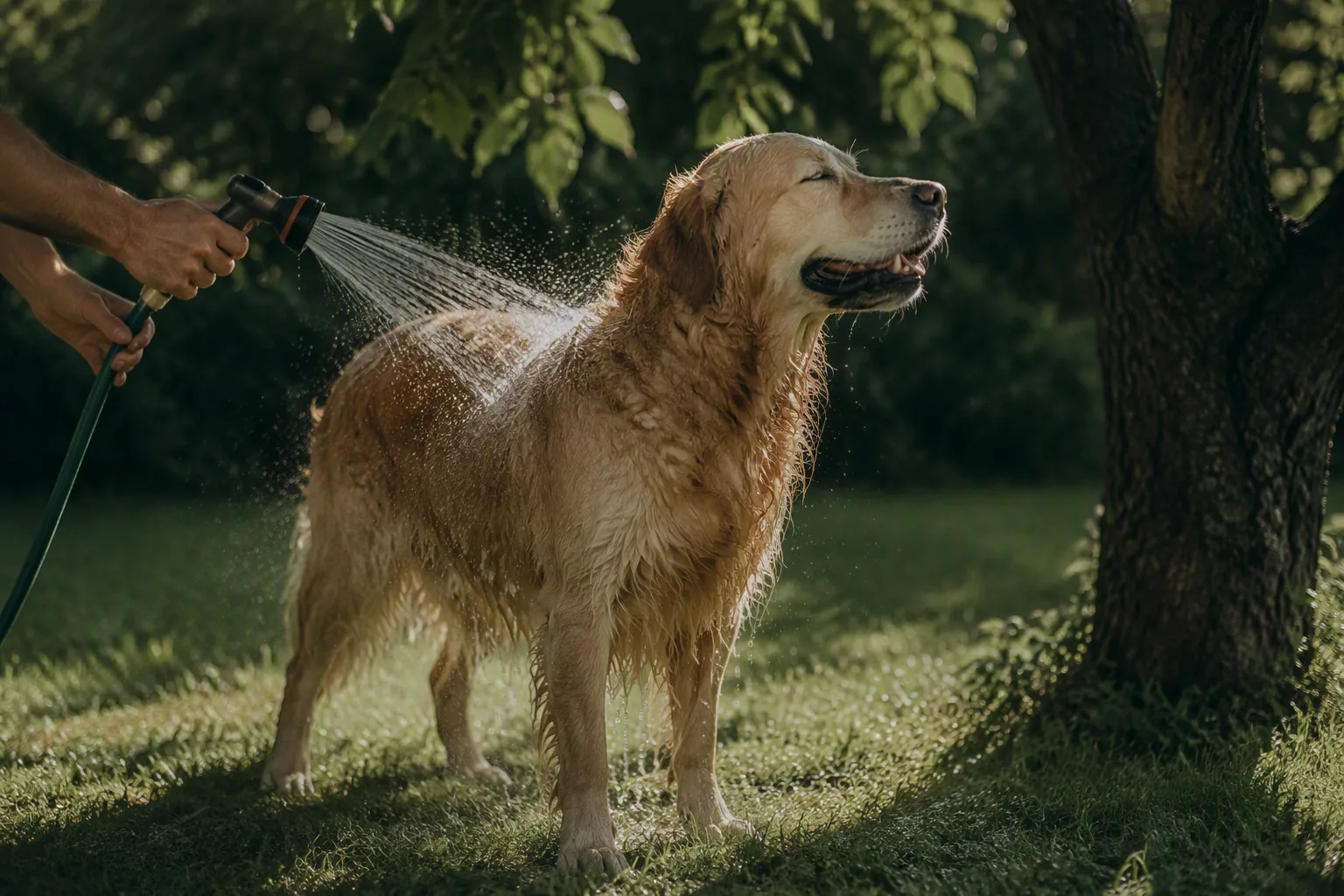
Move the dog into shade, pour cool water over the entire body, and get air moving across the wet coat. Do those three things before anything else. If your dog is showing heatstroke signs, cool first and drive to the vet second — the order matters more than the speed.
That last instruction contradicts most people's instinct, and it is the single most important thing in this article. But before the how, one number that changed how our office treats summer walks.
The average heatstroke walk was not on a hot day
When UK researchers logged the environmental conditions for exertional heat-related illness in pet dogs, the average wet bulb globe temperature was 16.5°C. Not 35°C. Not a heatwave. A mild, pleasant afternoon.
Wet bulb globe temperature folds air temperature, humidity, radiant heat and wind speed into one figure, so it is a better description of what a body actually experiences than a thermometer reading. Sixteen and a half degrees is jumper weather for you. For a labrador doing a normal walk at a normal pace, it was enough.
The same body of work found that 74.2% of heat-related illness cases presenting to UK primary care vets in 2016 were triggered by exertion, not by hot cars or hot rooms. A more recent 2024 analysis put exertion at 51.46% of cases with a recorded trigger — a lower share, but still the largest single one.
We learned this the slow way. Our office beagle Mango had his scare after a routine midday walk in June, on a day nobody thought twice about. Nobody left him in a car. He just walked, at 1pm, in the sun, at a pace he had managed a hundred times in April.
If you want the full list of what to watch for, we wrote that up separately in the signs of heatstroke we now check for after one close call. This piece is about what to do once you see them.
The three-step protocol
1. Shade and stop, immediately
Stop the activity. Get the dog out of direct sun and off hot ground. Radiant heat from asphalt keeps loading the dog even after it stops moving, and a surface that has been in the sun all afternoon can stay hot long after the air cools.
2. Wet the whole dog
Pour, hose or immerse — whole body, not spot treatment. The most common mistake here is the wet towel. In a survey of UK veterinary practices, wet towels were the most frequently recorded cooling method at 51.31%, and they are among the least effective. A towel laid over a dog quickly reaches the dog's own temperature and then insulates. If you use towels, they need to be continuously re-soaked, not applied once.
3. Move air across the wet coat
This is the step people skip, and it is where most of the cooling actually happens. Water on the coat cools by evaporating; evaporation needs air movement. A fan, a car's air conditioning on full, an open window in a moving car, even someone waving a folder — all beat still air by a wide margin.
The order is deliberate. Water without airflow is slow. Airflow without water is slower.
Cool first, transport second
Here is the instruction that feels wrong and is right.
Every current UK guideline — the Royal Veterinary College among them — tells owners to begin cooling before getting in the car. Not while driving. Not at the clinic. Before.
The reason is uncomfortable: a dog put straight into a vehicle often gets hotter. In a 2024 study of canicross dogs, 24.4% of dogs managed with passive cooling or immediate vehicle confinement experienced a rise in core temperature after exercise. Nearly one in four went the wrong direction, during exactly the window the owner believed they were helping.
Cars are small, poorly ventilated boxes containing a panting animal. Time spent driving is time spent not cooling, and the clock on organ damage is running the whole way.
So: cool for the first few minutes, phone the vet while you do it, then travel — continuing to cool in the car if you have a second person.
The ice water question, honestly
We have written before that ice water is a mistake. That advice needs a correction, because the evidence has split into two cases and the distinction matters.
For healthy dogs with exertional heat illness — the fit dog that overheated on a run or a walk — recent field data is clear. A 2024 study covering 115 cooling profiles used water between 0.1°C and 15°C and recorded no adverse effects, no hypothermia and no shock. A 2023 randomised cross-over trial found partial immersion, standing the dog chest-deep in water, cooled faster than both passive cooling and isopropyl alcohol on the paw pads. Cold water is not the enemy for this group. If you are beside a stream, use the stream.
For classic heat illness — the elderly dog in a hot conservatory, the overweight dog, the dog with heart or airway disease — the older caution still stands. Guidance leans toward evaporative cooling with cool rather than icy water, because the cardiovascular stress of a cold shock is a real risk in a compromised animal. This is also what the RVC advises for general owners, who cannot always tell which case they are looking at.
If you are unsure which describes your dog, use cool water and a fan. It is the option that is never wrong.
One more figure worth carrying: stop active cooling at around 39.5°C. Past that point you risk overshooting into hypothermia. If you have no thermometer, stop when the dog is visibly comfortable and breathing normally, and let the vet take it from there.
Two things that do not work as well as you think
Isopropyl alcohol on the paw pads. It does cool, but the same trial that measured it also recorded significantly higher heart rates than water immersion or passive cooling — a sign of stress or discomfort — and there is an absorption risk. Water is better and kinder.
Cooling only the paws or the head. A dog's surface area is where heat leaves. Four paws are a small fraction of it. Wet the body.
Who is most at risk
Brachycephalic breeds — English and French bulldogs, pugs — carry roughly 4.2 times the odds of heat-related illness compared with mesocephalic breeds. Overweight dogs, thick-coated breeds, very young and very old dogs, and dogs with airway, lung or heart conditions all sit above baseline too.
If you own one of these, the threshold for calling a walk off should be far lower than the weather suggests. Remember the 16.5°C figure.
What we changed after Mango
Three things, none of them purchases:
- Walks moved to before 8am and after 7pm. Not "when it looks hot" — always, from June to September.
- The seven-second asphalt test. Back of the hand on the pavement. If you cannot hold it for seven seconds, it is too hot for paws, and the radiant load is too high for the dog.
- A hose and a box fan live by the back door all summer. The point of the protocol is that it happens in the first minute. Equipment you have to go and find does not get used.
Gear has a place after those, not instead of them — a mat cools a resting dog by conduction, a vest cools a moving dog by evaporation, and we compared the two in cooling mat versus cooling vest. The full seasonal system, in priority order, is in our summer cooling playbook.
Hydration sits underneath all of it. A dehydrated dog cools less efficiently, which is why we treat water station maintenance as a summer safety job rather than a chore. Our own water, cooling and feeding range exists because we kept rebuying the same four things every June.
What this article cannot tell you
Every figure above comes from studies of dogs in the UK, and most of the cooling trials used healthy working or sporting animals. Whether cold immersion is equally safe for geriatric or comorbid dogs is explicitly listed as an open question by the researchers themselves. Retrospective record studies also rarely capture cooling duration or water temperature, so the real-world picture is coarser than the numbers suggest.
None of this replaces a vet. Cooling buys time; it is not treatment. Call the clinic while the water is running.
---
Sources. Hall EJ, Carter AJ, O'Neill DG (2020), Animals 10(8):1324, doi:10.3390/ani10081324 — exertional trigger share and UK incidence. Hall EJ et al (2022), Veterinary Sciences 9(5):231, doi:10.3390/vetsci9050231 — wet bulb globe temperature and risk factors. Carter AJ, Hall EJ, Bradbury J et al (2024), Journal of Thermal Biology 121:103827, doi:10.1016/j.jtherbio.2024.103827 — post-exercise cooling, 115 profiles, 0.1–15°C immersion. Parnes SC et al (2023), Animals 13(23):3673, doi:10.3390/ani13233673 — randomised cross-over comparing immersion, passive cooling and isopropyl alcohol. Hall EJ, Carter AJ, Bradbury J et al (2023), Veterinary Sciences 10(7), PMC10385239 — UK practice cooling methods survey. Beard S, Hall EJ, Bradbury J et al (2024), Veterinary Record 194(11):e4153, doi:10.1002/vetr.4153 — epidemiology and trigger distribution. Royal Veterinary College, heatstroke fact file — first aid guidance.
How this was made. Written by Wangzian from our own summer routine and the veterinary literature cited above, with AI assistance for drafting and structure. Every figure is traceable to a named study. Observations about Mango and our office routine are our own.
Related reading
- Signs of Heatstroke in Dogs: What I Watch For After One Close Call
- How to Keep Pets Cool in Summer: The Complete Playbook
- XueQiu Pets water, cooling and feeding range