Editorial — Published 2026-09-12 — By Wangzian, Pet Lifestyle Curator
How to Groom a Long-Haired Cat at Home
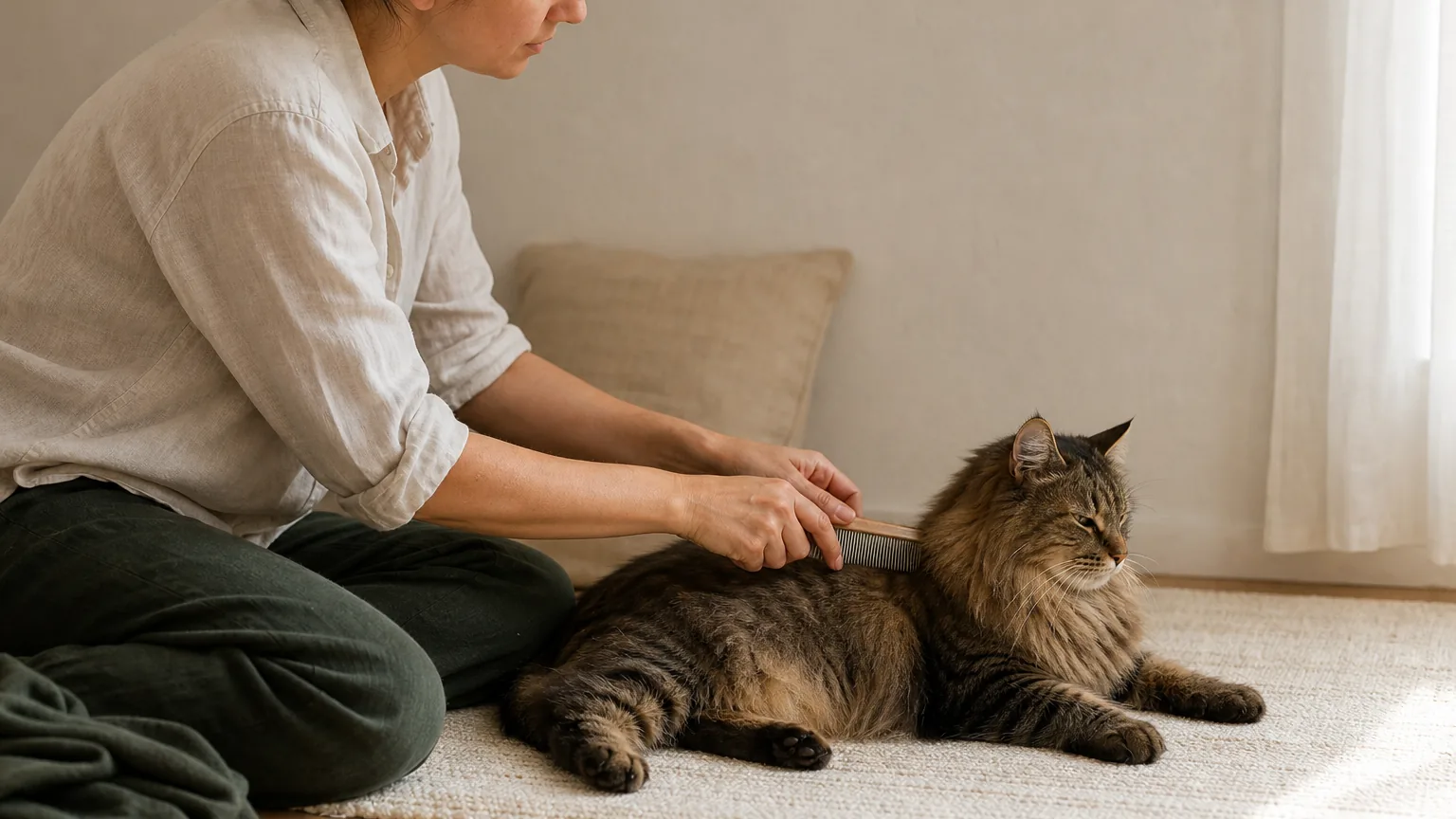
To groom a long-haired cat at home, inspect the coat daily, gently comb small sections of loose hair, and stop when a tangle pulls or the cat becomes uncomfortable. Tight mats, sore skin and sudden grooming changes need professional assessment; never cut a mat out with scissors.
The difficult part is often deciding what needs doing before picking up a brush. A glossy back can hide tangled hair behind a leg. A comb that catches might have found loose undercoat, a knot, or a tender patch of skin. Repeating the same stroke harder will not tell you which.
This guide is for routine coat care in a comfortable cat, with clear stopping points. It does not cover medical treatment, nail trimming or dental care. Those jobs need their own instructions and should not be added to an already difficult grooming session.
Start by deciding whether this is a home-grooming job
Watch the cat move before touching its coat. Does it walk normally, choose its usual resting place and accept ordinary petting? A new objection to touch deserves attention, especially if the same cat has stopped jumping or reaching its hindquarters. Do not diagnose arthritis from a coat change, but do not treat possible pain as disobedience either.
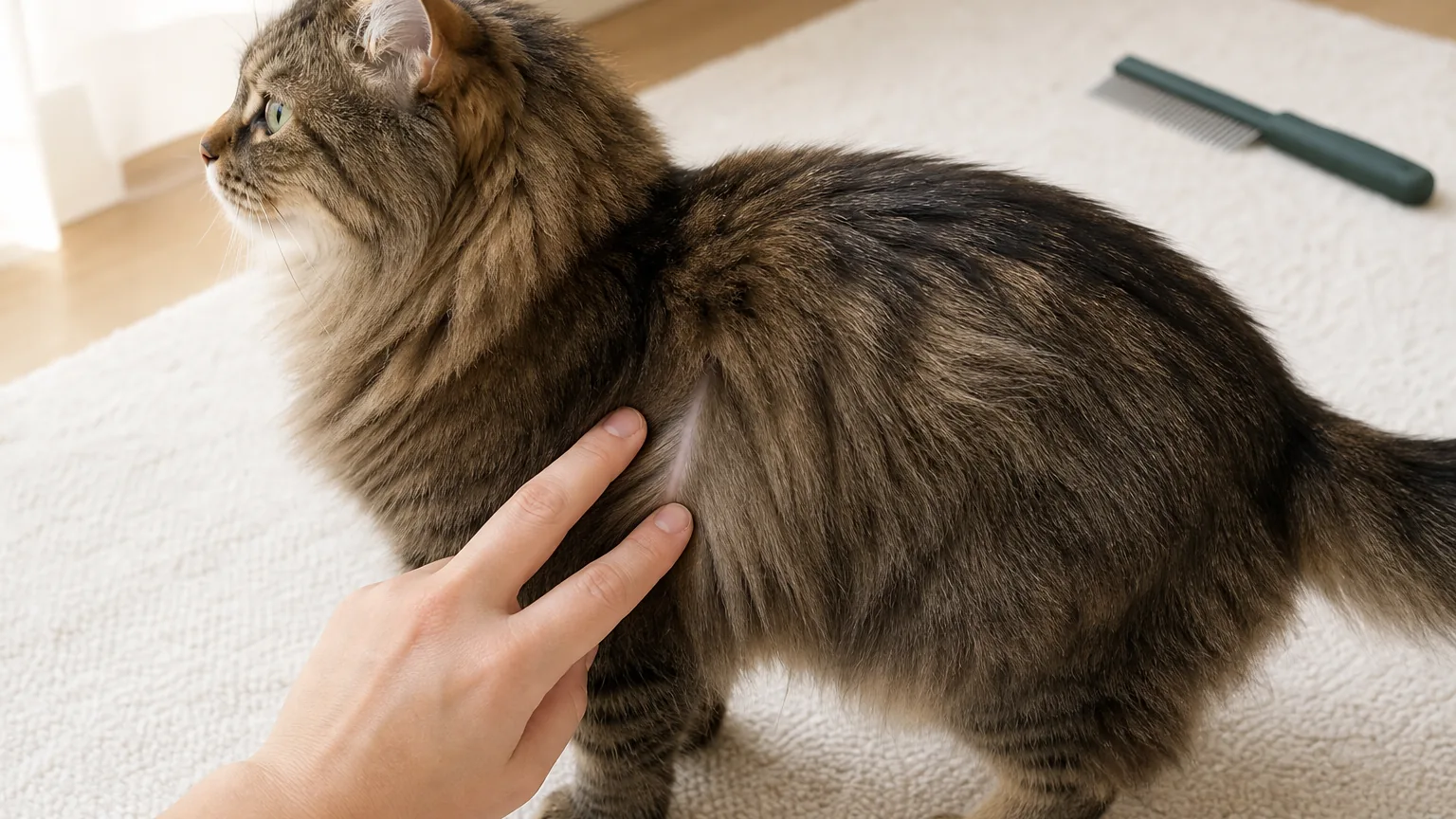
Next, use your fingers to part a little hair in an area the cat accepts. Look for redness, broken skin, debris or a dense patch that moves as one piece. VCA's guidance on long-haired cats identifies painful mouth conditions, obesity and arthritis as possible contributors to poor self-grooming. A brush cannot address those causes.
| What you find | What to do next | What to avoid |
|---|---|---|
| Separate, loose hairs; comfortable skin | Continue with gentle section-by-section combing | Repeated scraping of an already clear area |
| A small, loose tangle that separates easily | Work gently with fingers, then reassess | Pulling until the skin moves |
| A firm mat attached close to the skin | Arrange a cat-experienced groomer or vet assessment | Sliding scissors underneath |
| Redness, moisture, wounds or pain | Contact a veterinarian | Covering the problem with grooming products |
| A sudden loss of grooming ability | Record the change and speak to the vet | Assuming a new brush will solve it |
Size alone is not a safe clearance rule. A small knot can still sit against delicate skin. If you cannot tell what lies beneath it, leave removal to someone trained to assess it.
How to groom a long-haired cat at home, one section at a time
Choose a familiar, stable surface with good light. A non-slip mat on the floor avoids the added problem of a cat trying to jump from a table. Put your tools within reach before the cat settles. Keep other pets away, and leave a clear route for the cat to walk off.
Start on a comfortable shoulder or a section of the back that the cat already accepts being touched. Follow the direction of hair growth with light strokes. Part the coat with your free hand so you can see what you are working through, rather than dragging a comb across a thick blanket of hair.
Use short passes through free hair. If the comb catches, pause, lift it clear and inspect that small section with your fingers. Do not brace the cat and pull through resistance. Return to a free section only if the cat is still relaxed.
Check both sides when the cat changes position voluntarily. Behind the ears, under the front legs and around the hindquarters can need extra attention, but they are not places to force access. A cat lying on its side has not necessarily agreed to belly handling. Leave inaccessible areas for another brief session or get professional help if tangles are developing there.
End before the session becomes a struggle. Turning toward the tool, pulling away, tail lashing, flattened ears, growling or trying to leave all justify stopping. You do not need to wait for a bite to count the message as clear.
For the separate task of rebuilding tolerance, use our guide to helping a cat accept brushing. This page focuses on coat inspection and safe maintenance, rather than promising a training deadline.
Choose tools by what they need to reach
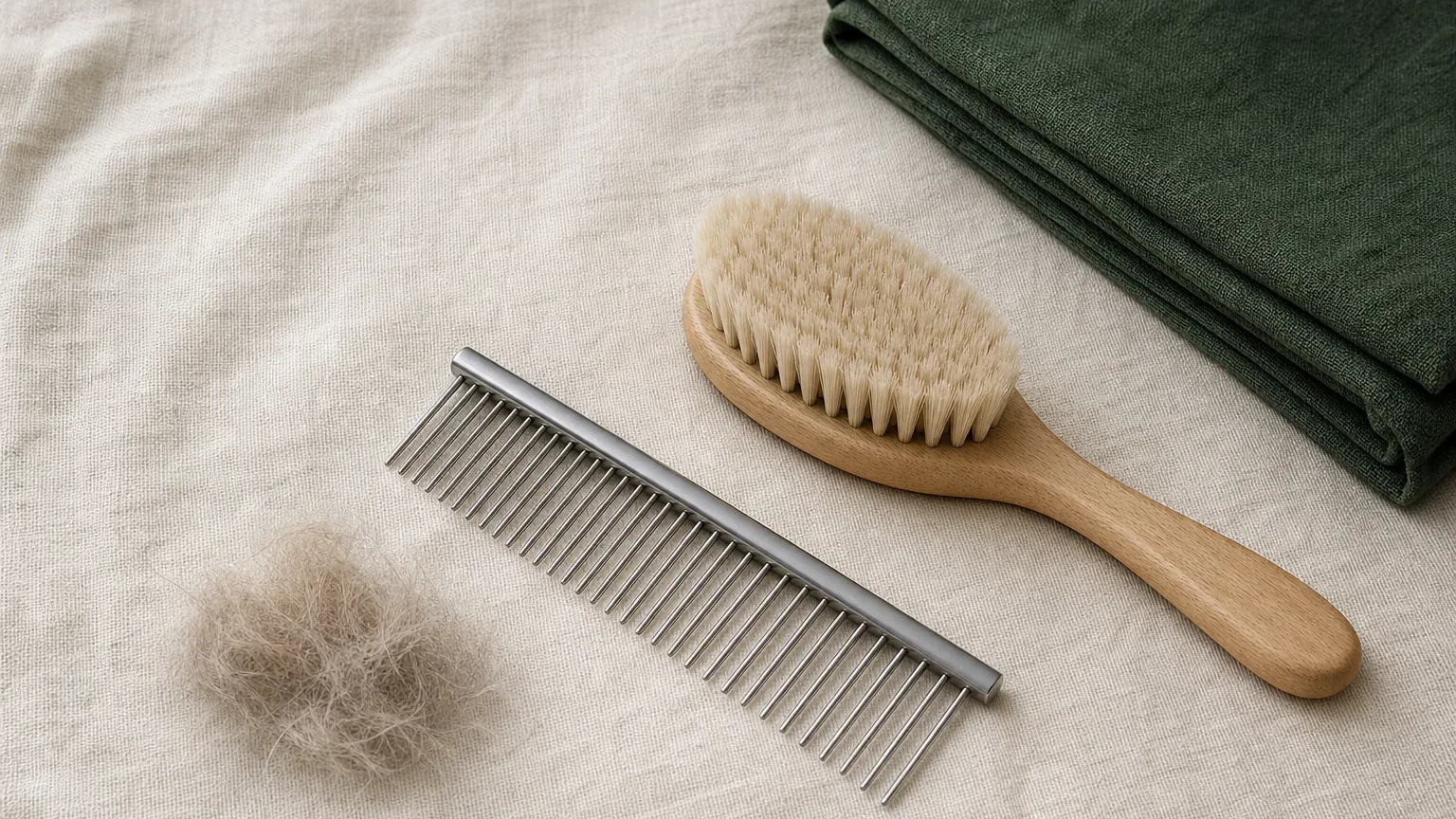
A metal comb with smooth, rounded teeth is useful for checking whether long hair separates. Examine the teeth before use: rough edges, bent teeth and trapped debris are reasons to clean or replace it. A soft brush can finish free hair, but a tidy surface does not prove the deeper coat is clear.
A slicker is another coat-maintenance option, provided its pin length and pressure suit the cat. It should not be used to force apart a dense mat. Ask a groomer to demonstrate the tool on your individual cat if you are unsure how deeply it should work.
| Tool or item | A sensible role | Its limit |
|---|---|---|
| Smooth-toothed metal comb | Check separate sections and collect loose hair | Cannot make a skin-tight mat safe to pull |
| Soft brush | Light finishing on a clear coat | May miss tangles below the surface |
| Cat-appropriate slicker | Remove loose coat with gentle pressure | Repeated passes can become uncomfortable |
| Non-slip mat and good light | Keep the setup stable and visible | Do not replace calm handling |
| Scissors or a bladed splitter | Leave out of a beginner's mat-removal kit | Hidden skin makes cutting hazardous |
The XueQiu Pets product range is a place to compare grooming equipment, not a substitute for individual advice. This guide does not claim that any particular brush prevents disease, removes every mat or reproduces a research prototype's performance.
Check daily without turning every check into a long session
VCA recommends daily combing or brushing for long-haired cats, including the areas prone to matting. ASPCA describes grooming long-haired indoor cats every few days. These are practical care recommendations, not results from a trial identifying one universally optimal interval.
A reasonable conservative starting point is a daily opportunity to inspect and gently comb whatever the cat comfortably permits. A quick look at the shoulders does not mean the entire coat has been checked. Note which areas still need attention, and get help if you repeatedly cannot reach them.
For an illustrative home log, use four fields: area checked, what the fingers found, whether the comb passed freely, and how the cat responded. An entry might read, “Left shoulder: loose hairs; comb passed; cat stayed. Right hind leg: dense patch; stopped before combing.” This is an example record, not a report from a real patient or a timed protocol.
That record makes tomorrow's task specific. You can start by assessing the missed area instead of grooming the easy back again and assuming the difficult parts are fine. If the dense patch remains, arrange help rather than letting the log become a reason to postpone it.
Our shedding-season brushing schedule discusses frequency in more detail. Keep your cat's comfort and coat condition ahead of any timer or calendar target.
Why a cat's tongue does not settle the whole grooming question
The tongue does more than rake across hair. In a 2018 experimental study, Alexis Noel and David Hu examined tongues from six cat species, using high-speed filming, force measurements and CT scans. Their abstract describes hollow tips on the backward-facing papillae that take up saliva and release it onto hair.
The study also describes a tongue-inspired prototype brush with lower grooming forces and easier cleaning than its comparator. That finding belongs to the tested prototype. It is not evidence that an ordinary shop-bought slicker has the same effect, nor does it tell owners how hard to press.
For this guide, we read the PubMed abstract, figure captions and conflict statement. The journal page did not return article text, and the full-text archive presented a verification page. We therefore do not claim to have reviewed the full paper. The authors disclosed a provisional patent relating to the technology.
The useful distinction is between understanding a mechanism and choosing care for an individual cat. Neither the tongue's structure nor the time spent licking proves every part of a long coat is free of tangles. You still need to inspect the areas that are becoming difficult to maintain.
Stop at a mat instead of trying to beat it
Loose hair slides and separates. A mat tends to hold together. If a gentle finger check cannot separate the clump without discomfort, that is enough reason to stop home removal; you do not need to prove how firmly it is attached.
VCA specifically warns against cutting mats with scissors because skin can be caught even when it is not visible. Keep blades away from the hidden underside. Do not introduce a powered clipper for the first time over a tight mat either. A veterinarian or experienced cat groomer can assess safe removal, with veterinary sedation considered only when appropriate for that cat.
Photograph the location if doing so causes no stress, and tell the professional whether the area smells, looks damp or hurts when touched. Skin changes belong with a veterinarian. A groomer can manage coat maintenance but cannot replace diagnosis of a painful lesion.
Keep baths and coat cutting as separate decisions
Long hair alone is not a reason for a bath. Many healthy cats keep themselves clean; bathing becomes a different question when the coat is contaminated, self-care is impaired or a veterinarian prescribes skin treatment.
Do not soak a tangled coat hoping the knot will wash out. Deal with the mat assessment first, since wetting can make tangles harder to remove. If a bath is genuinely needed, ask about a cat-safe product and follow its label. Human shampoo, fragranced household cleaners and improvised essential-oil mixtures do not belong in this routine.
Nor does summer automatically call for shaving. Discuss recurrent matting, coat contamination or an inability to maintain the coat with a professional. A haircut should follow that assessment rather than a calendar reminder or a photo of another cat's style.
Use coat changes as information for the vet
A seasonal increase in loose hair is different from bald spots, broken skin or persistent chewing at one patch. Our explanation of autumn shedding covers the seasonal question; it should not be used to dismiss a sudden change in the cat in front of you.
Bring the grooming log to an appointment. “She objects when I touch the right hip and has stopped using the high shelf” gives the vet more to investigate than “she hates brushing.” Describe what happened without assigning a cause.
If travel itself is difficult, our guide to taking a cat to the vet can help you prepare. Do not postpone assessment of a painful mat until the cat has completed a home brush-training programme.
Questions owners ask during grooming
Can I brush against the coat to reach the undercoat?
For a beginner, gentle work with the hair's direction and small visible sections is the safer starting point. Ask for an individual demonstration before changing technique. Reaching deeper should never mean scraping skin or pulling harder.
Should I finish the whole cat in one sitting?
No. Check what the cat comfortably allows, record missed areas and return later. If essential areas remain inaccessible or matted, get professional help rather than making sessions longer or more forceful.
Is a daily mat a sign that I need a sharper tool?
Not necessarily. Check where it recurs, whether the coat has changed and whether self-grooming has become difficult. A groomer can review technique and equipment; a vet should assess pain or skin abnormalities.
Can a brush guarantee fewer hairballs?
Removing loose hair reduces what is available to swallow, but no brush in this guide has a tested guarantee. Persistent vomiting or other illness signs need veterinary advice, even when the vomit contains hair.
What is the simplest place to begin tonight?
To learn how to groom a long haired cat at home, start with an easy shoulder section in good light. Check it with your fingers, make a gentle comb pass if the hair is free, and stop while the cat is comfortable. Leave any painful or attached clump for assessment.
Sources and editorial notes
- Noel AC and Hu DL, 2018: Cats use hollow papillae to wick saliva into fur. Primary experimental research. Abstract, figure captions and patent disclosure reviewed; full text not obtained. This older mechanism study does not validate our routine or a commercial grooming tool.
- VCA: Removing mats from long-haired cats. Institutional guidance on daily care, possible medical contributors and when home mat removal is unsafe. The page addresses young cats; individual adult or senior care needs veterinary advice.
- VCA: Grooming and Coat Care for Your Cat. General clinical guidance, updated February 13, 2026, on coat care, bathing and mat-removal precautions; not a controlled comparison of brushing schedules.
- ASPCA: Cat Grooming Tips. Institutional guidance used for skin warning signs and the distinction between routine grooming and care requiring help. No publication date was visible. Some tool advice differs across sources; this beginner guide deliberately avoids blades and powders for home mat removal.
Prepared by XueQiu Pets Editorial with AI assistance from sources reviewed on September 11, 2026. The example log is illustrative; no owner trial or clinical case was conducted for this article. Images are AI-generated editorial illustrations, not treatment photographs or product evidence. General information only; it does not replace a veterinary examination.