Editorial — Published 2026-08-18 — By Wangzian, Pet Lifestyle Curator
How to Stop a Cat Scratching the Carpet: The One Substrate That Held Its Own in Testing
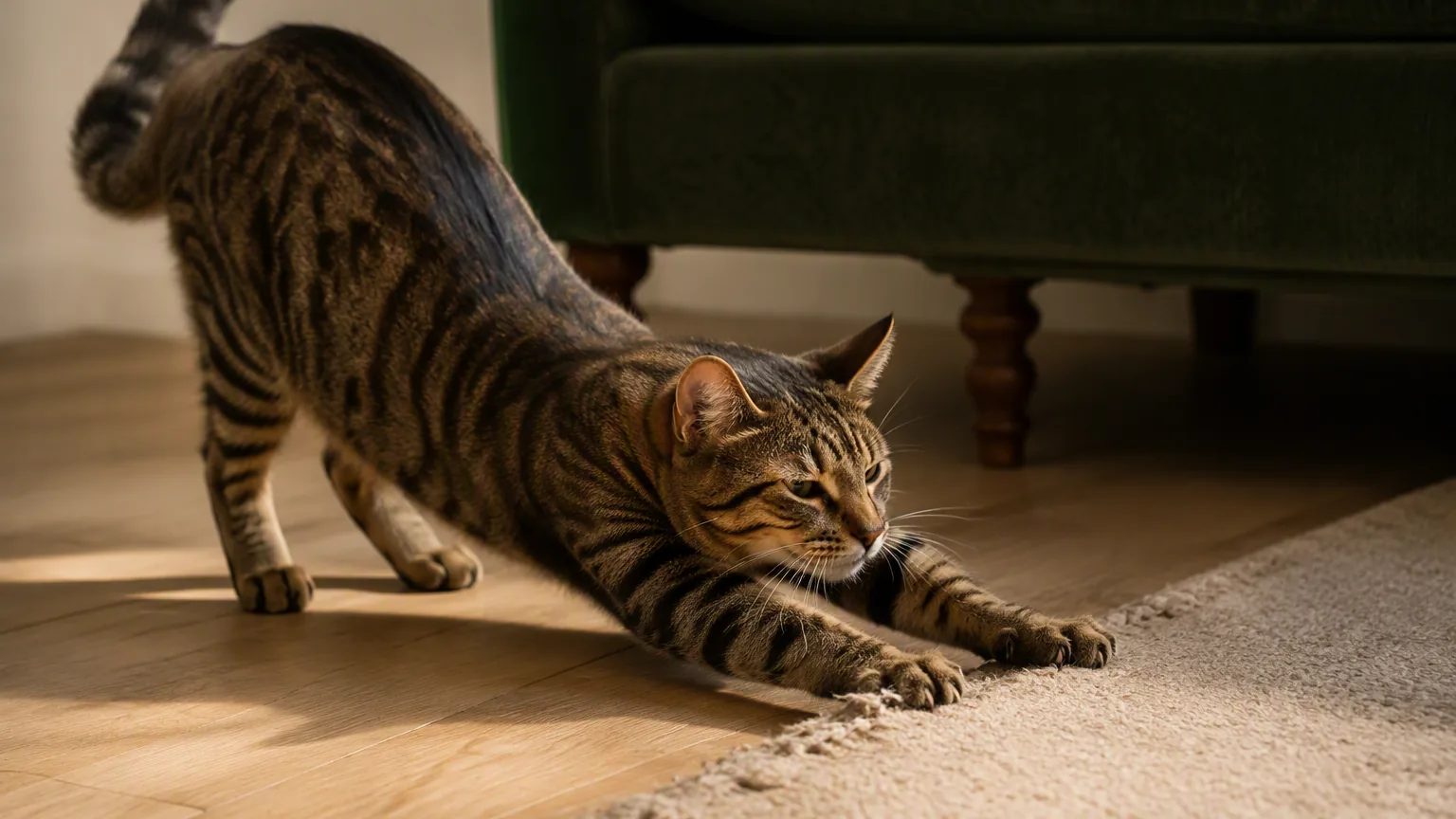
Give the cat something better in the same place and the same orientation. Carpet gets scratched because it lies flat on the floor, and in controlled testing flat is exactly what cats reached for — which is why an upright post three rooms away does not compete with it.
Why carpet specifically
Most advice treats carpet-scratching as the same problem as sofa-scratching. The data says it is not.
In 2018 a team at Texas Tech ran two-choice preference tests on 40 shelter kittens, filming which of two scratchers each one actually used. Across six studies an S-shaped cardboard scratcher beat nearly everything: a hemp post with a toy on top, bubble wrap, window screen, short-pile carpet.
It failed to beat one thing. Long-pile carpet lying flat on the floor — 26.50 seconds against 11.17, with P = 0.125. Not significant.
Read that carefully, because it is easy to over-claim. The direction still favoured cardboard, and with six kittens per comparison the test may simply have been too small to detect a real difference. What you can say is narrower and still useful: of everything tested, deep carpet on the floor was the only surface the winner could not clearly out-compete.
The same study explains part of why. When the researchers took one material — window screen — and tested it standing up against lying flat, the flat version won: 21.67 seconds to 10.50, P = 0.03.
And when they lifted long-pile carpet off the ground onto a raised 12 cm platform, its appeal collapsed. Against the cardboard it managed 5.00 seconds to 37.50.
So carpet's advantage is not really that it is carpet. It is that it is a deep-pile surface already lying flat, in the room the cat lives in. Raise it and it stops working. Your floor is the one place that condition is met permanently.
The two things everyone recommends
Search this question and you will get the same two answers from nearly every result: sprinkle catnip on a scratching post, and put double-sided tape on the carpet.
Catnip was tested. It did nothing. In the sixth study, kittens got the cardboard scratcher alone or the same scratcher treated with one of three additives:
| Additive | Plain scratcher | Treated | P |
|---|---|---|---|
| Dried catnip plant and leaves (5g) | 3.40s | 5.00s | 0.69 |
| Catnip oil mist spray (10s of spraying) | 8.20s | 10.20s | 0.75 |
| Hair from other cats (5g) | 13.40s | 16.00s | 0.63 |
Three attempts, three null results.
There is an important qualifier the paper supplies itself: these were eight-week-old kittens, and cats under three months rarely respond to catnip at all — the opioid system that mediates the response is not fully developed that early. This is evidence that catnip does not work on kittens, not that it fails in adult cats. If your cat is grown and responds to catnip, that response is real. What this study removes is the assumption that catnip is what makes a young cat adopt a scratcher.
Double-sided tape has not been tested at all, as far as we can find. It appears in advice from large welfare organisations and in dozens of blog posts, and none of them cite a trial. That does not make it wrong. It means nobody has measured how well it works, or whether the cat simply moves two feet to the left.
What the evidence does support
Buying another scratcher is probably not the fix. A 2018 survey of 116 indoor cats found 83.9% scratched something they should not, and 76.1% of those households already owned a scratcher. Provision was not the missing variable.
That survey also tested the most intuitive intervention and got the opposite of the expected answer. Owners who picked their cat up and placed it next to the scratcher saw it used less often — mean frequency 3.8 against 4.6, P = 0.0135. The authors suggest scratching follows waking, stretching or social tension, and lifting the cat mid-sequence breaks the chain. One survey, an association rather than a proven cause, but worth knowing before you carry your cat to the mat again.
We covered the same pattern in more detail — including how often a post was already sitting in the same room as the ruined furniture — in why cats scratch furniture.
Carpet is one case of a broader pattern. If the post in your house is being skipped while the damage continues elsewhere, the summary of everything the research does and does not establish sits in why does my cat ignore the scratching post.
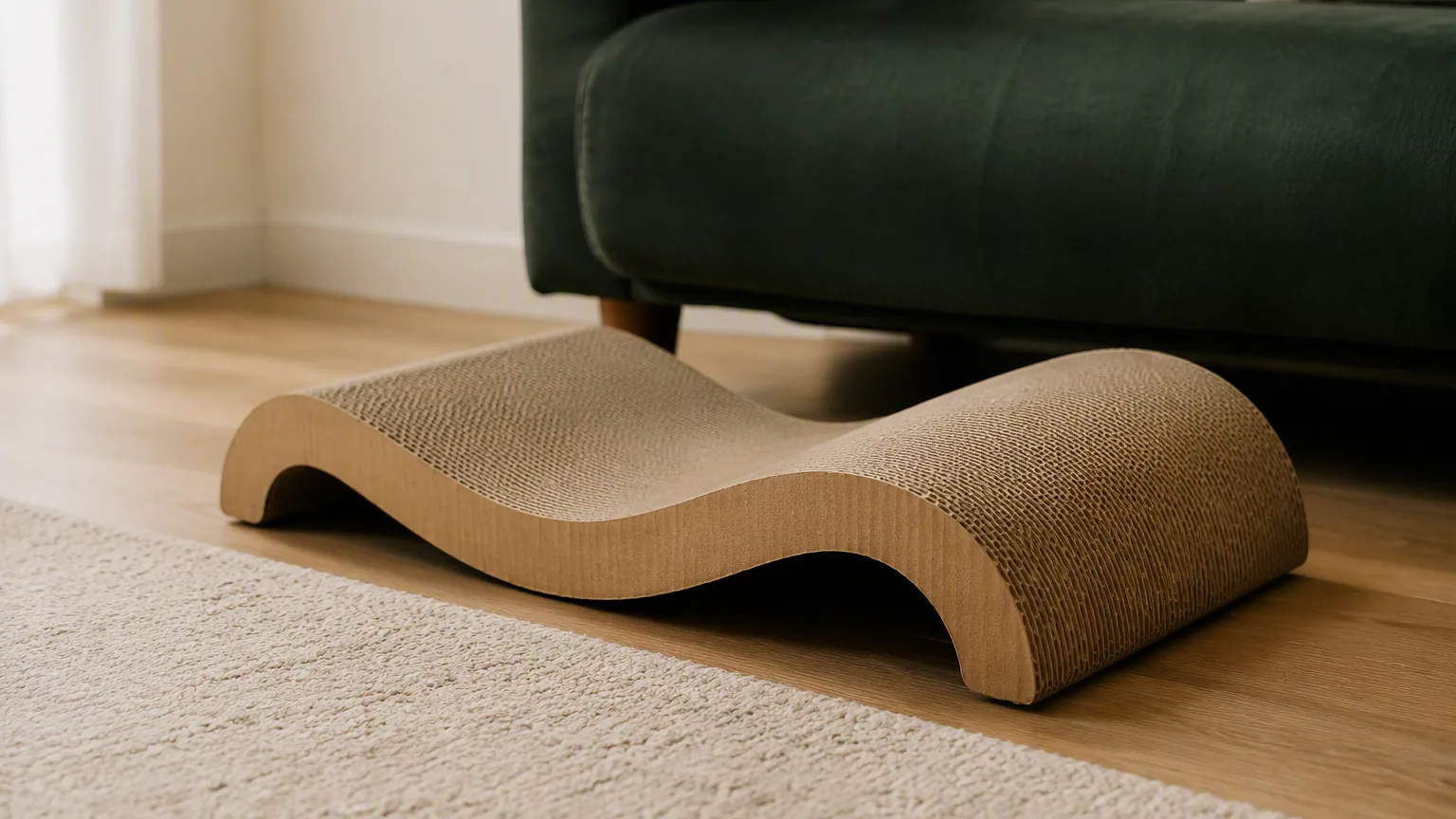
Match the orientation before you match the material. If the cat is working on your floor, a vertical post is answering a question it did not ask. A flat pad or an S-shaped cardboard scratcher lying in the same spot is competing on the same terms.
Do not raise it. This is the finding most likely to save you money. The raised carpet-covered pad, 12 cm off the ground, was the worst performer in the entire set.
Punishment changed nothing. In that survey 69.2% of owners yelled and 37.4% sprayed water. Grouped and tested, none of the techniques significantly affected how often cats scratched the wrong things. Nor is removing the option a fix — scratching is a normal part of stretching, claw maintenance and scent marking, not a fault to correct.
Where this evidence stops
These were kittens. Eight weeks old, from a shelter. The authors are explicit: "Nor can we conclude that kitten and adult cat scratcher interactions are the same." If your cat is six years old, this is a strong hint, not a finding about your cat.
The samples are tiny. Five or six kittens per comparison. That cuts both ways — the significant results survived a harsh test, but every non-significant result could be a real effect the study was too small to see.
It contradicts the biggest survey in this field. Wilson and colleagues' 4,105-cat survey found rope was used most and that upright posts of three feet or more were preferred. This trial found kittens preferring flat cardboard, and its authors say plainly that their findings "do not agree, in general" with that conclusion. Survey of adults versus controlled test of kittens — both can be right about their own subjects.
It was a 20-minute session in a simulated room, and for the first ten minutes the researcher placed each kitten on each scratcher in turn. That is prompting, not free choice, for half the test.
One thing worth noting about the source
Every other study we have used on scratching has had a commercial thread somewhere — a manufacturer paying for it, or an author holding a patent. This one states that the authors received no financial support of any kind and declared no conflicts of interest.
It is a small, limited study on the wrong age group for most readers. It is also the cleanest piece of evidence in the pile.
What we sell, and what we do not
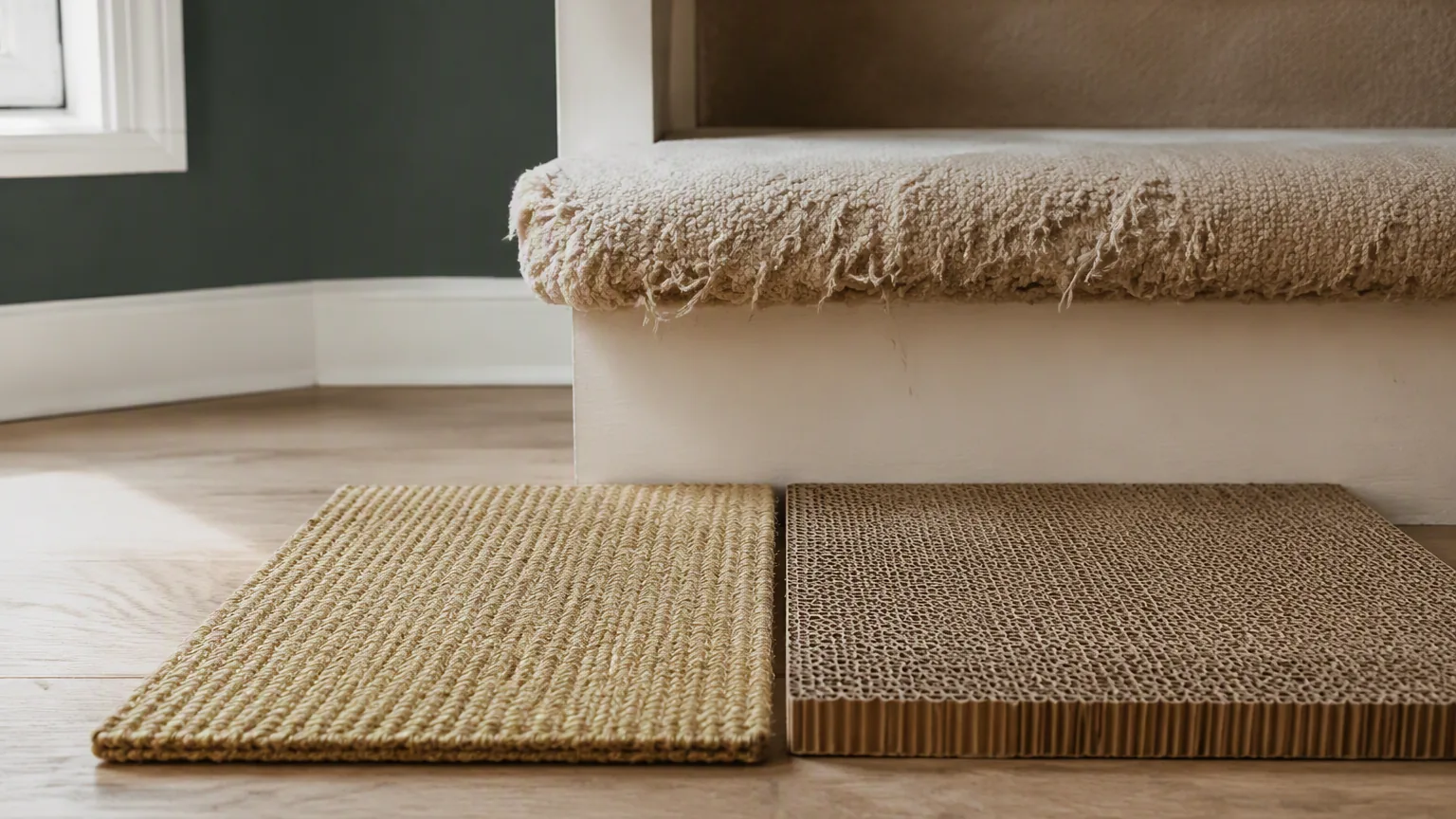
We make scratching products, including a flat sisal mat and a corrugated lounger — both of which sit on the floor, which is the format this study supports. We have run no trials of our own, our mats are not the ones tested here, and nothing above should be read as evidence for our specific products over anyone else's.
If you want the other side of this cluster — a product with three published trials whose results point in awkward directions — see does Feliscratch actually work. And for a case where the popular explanation of a cat's behaviour collapsed the moment someone added a control group, taking your cat to the vet has the clearest example we have written up.
---
Sources
- Zhang L, Plummer R, McGlone J (2019). Preference of kittens for scratchers. Journal of Feline Medicine and Surgery 21(8):691-699. Open access, full text read. 40 kittens, six two-choice studies, 5-6 kittens per comparison. All durations and P values above are from the Results section. The authors received no financial support and declared no conflicts of interest. Note for transparency: the first and last authors also published the 2020 adult-cat scratcher study discussed in our Feliscratch article — same laboratory, different study, different subjects.
- Moesta A, Keys D, Crowell-Davis S (2018). Survey of cat owners on features of, and preventative measures for, feline scratching of inappropriate objects: a pilot study. J Feline Med Surg 20(10):891-899. Open access, full text read. Paper questionnaire handed to 140 clients of one University of Georgia practice, 116 returned (82.9%). The 83.9% and 76.1% figures, the placement result (3.8 vs 4.6, P = 0.0135) and the punishment finding are from the Results section and Tables 2-3. The authors received no financial support and declared no conflicts of interest. Limitations the authors state: a single practice, a sample unlikely to represent cat owners generally, and a broad definition of "inappropriate" that probably inflates the 83.9%.
- Wilson C et al. (2016), n = 4,105, and Salgirli Demirbas Y et al. (2024), n = 1,211, are covered in full in the linked article on scratching and are not restated here.
What we do not claim: we hold no data of our own on scratching substrates, and nothing here tells you how to stop a cat scratching the carpet with certainty — only which alternatives held up when someone measured them. Nothing here is veterinary advice. A sudden increase in carpet scratching, particularly alongside other changes in behaviour, is worth raising with a vet rather than solving with furniture.
Related reading
- Why Do Cats Scratch Furniture (And What Actually Stops It)
- Does Feliscratch Actually Work? Three Studies, and Who Paid for Them
- Taking Your Cat to the Vet: What the Evidence Supports, and Where It Runs Out