Editorial — Published 2026-08-25 — By Wangzian, Pet Lifestyle Curator
Soft vs Hard Cat Carrier: What the Only Crash Test Actually Found
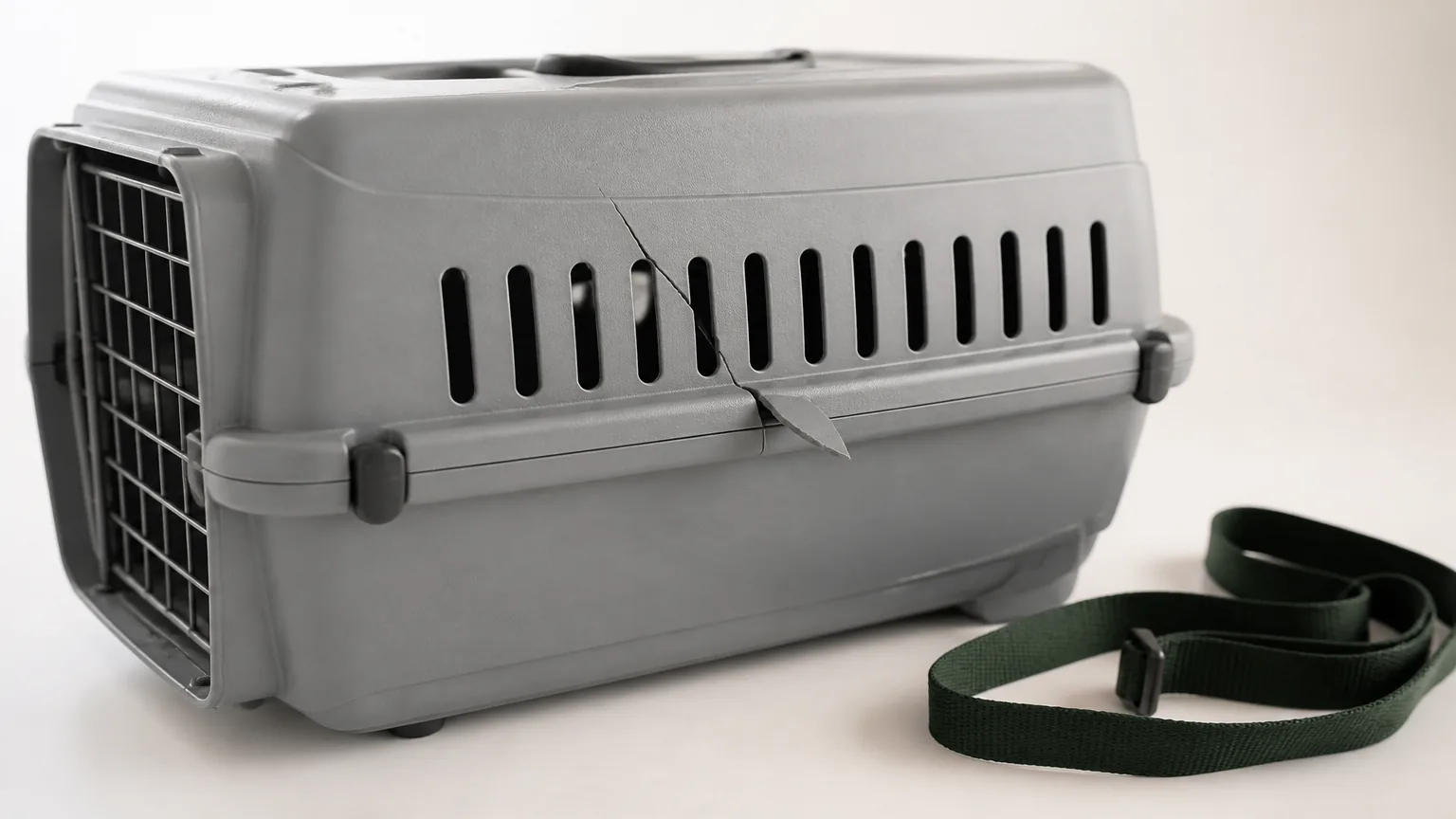
Pick a soft carrier for short vet trips and handling, a hard one for cleaning and stacking — but if the reason you are choosing hard is car safety, the only public crash test points the other way. In it, both rigid plastic carriers cracked apart at 30 mph, and one released the dummy entirely.
That result surprises most people, so it is worth going through what was actually tested before drawing any conclusion from it.
The only test that exists
There is no performance standard for pet carriers. That is not a rhetorical opening — it is a direct quote from the study itself: "At the time of this study, there are currently no performance or dynamic testing standards for pet travel carriers."
The Center for Pet Safety ran the 2015 Carrier Crashworthiness Study, sponsored by Subaru of America. Testing was done at MGA Research Corporation, an NHTSA-contracted facility, with a former IIHS senior research engineer as technical advisor. Ten tests across eight products, using the 30 mph crash pulse from FMVSS 213 — the federal child restraint standard — because carrier manufacturers were already referencing that standard in their own marketing.
Weighted instrumented dummies stood in for animals: 15 lb, 20 lb, 45 lb, 75 lb. No live animals.
The pass criteria were only two, and both had to hold:
- The carrier fully contains the dummy before, during and after impact.
- The carrier and every attachment point stay secured to the test bench throughout.
What happened to the hard shells
Two rigid plastic carriers were tested. Both failed, and both failed the same way.
| Test | Product | Restraint | Outcome |
|---|---|---|---|
| V15585 | PetMate Vari Kennel, 15 lb dummy | Lap/shoulder belt | Plastic fractured; dummy ejected completely |
| V15583 | PetMate Compass, 45 lb dummy | PetBuckle + lap/shoulder belt | Strap held; the plastic shell broke anyway |
The Compass result is the more instructive one. The restraint system did its job — the strap stayed intact. The carrier body is what gave way. Excursion measurements indicated increased injury risk to both the animal and the human occupants.
The Vari Kennel is the case that should retire the intuition outright. A 15 lb dachshund dummy struck the side wall, the plastic broke, and the dummy left the carrier as a projectile. The shell itself stayed on the seat. It contained nothing.
What happened to the soft ones
Six soft or soft-framed carriers were tested. Most failed too — this is not a story about soft carriers being good.
- Sleepypod Mobile Pet Bed: the top Velcro connection released and the carrier fell off the bench. The dummy stayed contained, but the carrier did not stay put.
- Snoozer Roll Around: the front mesh panel tore along its seam and the dummy was thrown out.
- Kurgo Wander: attachment points released. Total failure.
- Pet Ego Pet Tube with a 75 lb dummy: attachment points released. Total failure.
- Pet Ego Jet Set Forma Frame on its original fabric strap: connection failed, product left the bench.
Only two products passed. Both were soft. And here is the part that matters more than the material:
Both of them had failed on their factory connection method first. The Sleepypod passed after adding a PPRS Handilock. The Pet Ego passed after switching to an ISOFIX-Latch connection. Same carrier bodies, different attachment hardware, opposite results.
So the material is not the variable
CPS did not design this as a soft-versus-hard experiment. Their selection criterion was whether a manufacturer advertised the product as crash tested. The material comparison is something you can read out of the results afterwards, which is a weaker kind of finding than a controlled test.
Look at what actually separated pass from fail:
- Two products that failed on original hardware passed with rigid connection systems added.
- A hard shell with a purpose-built restraint strap still failed, because the failure was in the shell rather than the strap.
- Every total failure — dummy ejected or carrier launched — traced to either a connection releasing or a structure tearing, not to a general property of the material.
The defensible conclusion is narrow: what determined the outcome was whether the carrier stayed rigidly connected to the vehicle, and ordinary plastic shells fracture at 30 mph rather than outperforming fabric.
What you cannot conclude is that soft carriers are safer. Sample size is two hard shells, both from one brand.
Why this evidence is weaker than it sounds
We would rather state the limits than let a single study carry more weight than it can.
It is not peer-reviewed. It is a self-published technical report. We searched PubMed and PMC across eight query formulations for peer-reviewed work on pet carrier crash safety and found nothing — verified against control searches to confirm the tool was working. Zero published studies. There is nothing to triangulate against.
Two hard shells is not a sample. Both were PetMate products. A different manufacturer's plastic could behave differently.
Nothing measured injury. The criteria were containment and attachment integrity — binary, structural. No load or acceleration data on the dummy. The study can tell you whether the carrier came apart. It cannot tell you how badly an animal would have been hurt.
Frontal impact only, one speed. No side impact, no rear-end, no rollover.
The data is ten years old. Products have been revised since 2015.
Manufacturer involvement was uneven. Sleepypod and Pet Ego got retests after engaging with CPS. Snoozer never responded and got none.
On funding: Subaru of America sponsored the work. CPS states it is not affiliated with the pet products industry and does not endorse products, and the sponsor is a carmaker with no stake in which carrier wins — but the disclosure belongs here either way. We apply the same standard to studies whose results we like as to those we do not.
One thing people misapply
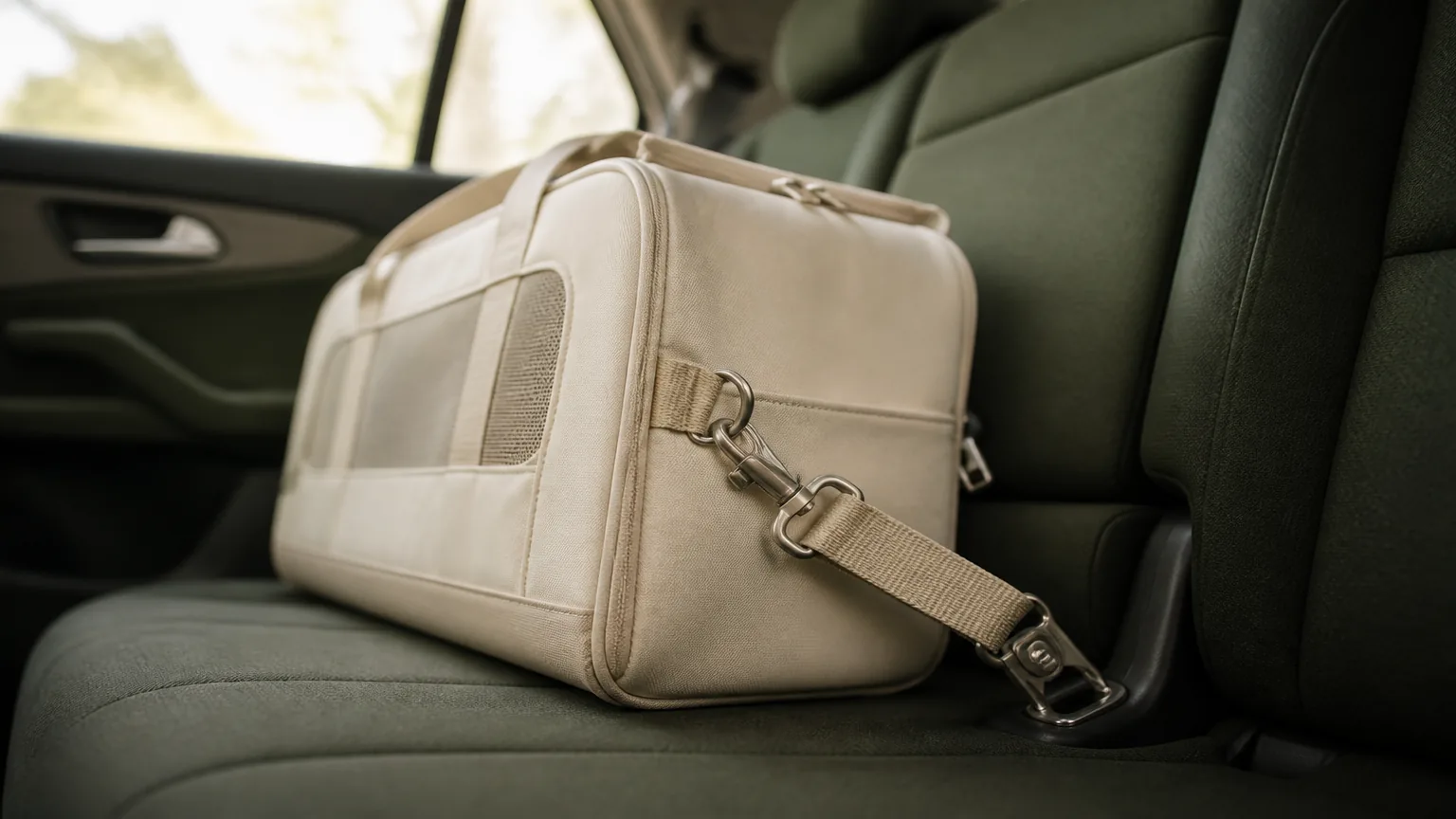
Airline container rules are sometimes cited as proof that hard shells are structurally required. They are not evidence about car crashes. IATA's Live Animals Regulations govern cargo-hold transport — containment, ventilation, escape prevention — and the full text sits behind a paid publication. Using it to argue crash performance in a passenger vehicle is applying a rule to a situation it was never written for.
We could not read IATA's container-material clauses directly, so we are not quoting them.
How to actually choose
Since the crash data does not settle the material question, decide on the things it does not cover.
Choose soft when the trip is short and the handoff matters. A carrier that opens from the top lets a cat be examined in the base. In a 2022 survey, exiting the carrier at the clinic rated a median stress of 5 — worse than the ride home — and 10.6% of owners had their cat examined in the base with the top removed. Our vet visit guide covers where that number comes from and what else moves it.
Choose hard when cleaning matters most, when the carrier doubles as a recovery space, or when a cat has a history of shredding mesh. Snoozer's failure mode — a torn mesh seam — is also the everyday failure mode of soft carriers with determined cats.
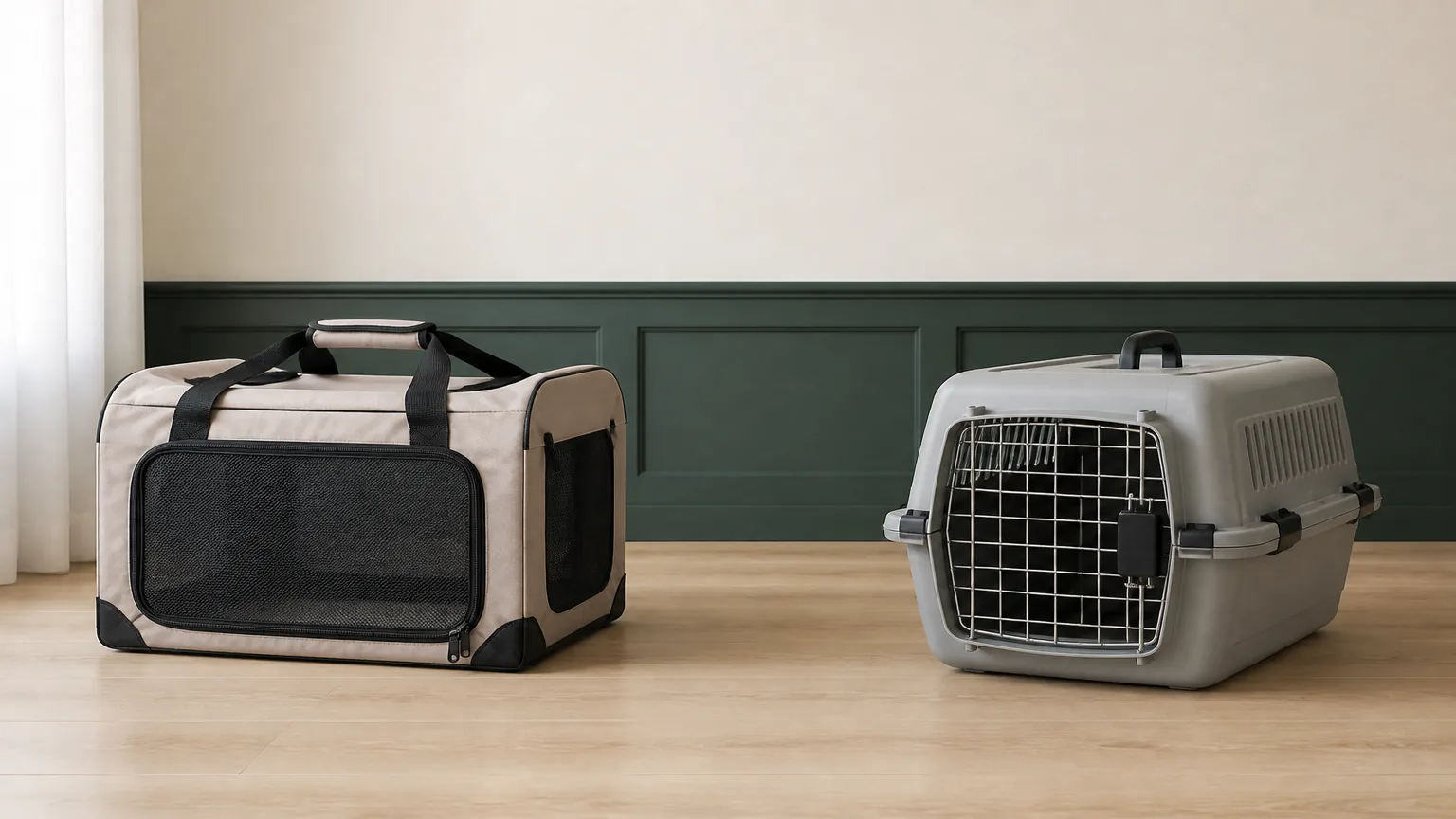
Regardless of which you choose, the attachment is the part with actual test data behind it. A carrier resting loose on a seat is the configuration that failed most often.
Two related questions come up constantly and neither has the answer people assume: how long a cat can stay in a carrier has no sourced number behind the figures in circulation, and the right lead time for carrier training has never been measured. Both are worth reading before a first long trip.
If you are setting up a small apartment more generally, the same evidence-first approach applies to litter box placement.
What we sell, and what we do not
We make a ventilated PP travel carrier — a hard one, for the record. Its listing states a 3–5 kg suitable weight from the source specification. It has not been crash tested, and we do not claim airline compliance for it, because we hold no test data supporting either claim. If crash performance is your deciding factor, buy from the CPS certified list instead of from us — that recommendation costs us a sale and is still the correct one.
So the honest answer to soft vs hard cat carrier is that the question is aimed slightly off target. Decide the material on cleaning, handling and how your cat behaves; decide the safety question on how the carrier attaches to the car, which is the only part anyone has actually tested.
You can see what we do carry on our products page.
Sources
- Wolko LA, Center for Pet Safety 2015 Carrier Crashworthiness Study Summary Report, sponsored by Subaru of America, 22 July 2015. Open access, full report readable. Testing by MGA Research Corporation (NHTSA-contracted), FMVSS 213 30 mph crash condition, 15/20/45/75 lb instrumented dummies, no live animals. All test IDs, failure modes and pass criteria above are quoted from this report. CPS states it does not use live animals, is not affiliated with the pet products industry, and does not endorse products.
- Peer-reviewed literature search: PubMed and PMC, eight query formulations combining pet carrier, crash, restraint, motor vehicle and animal transport terms. Zero results. Control searches returned expected volumes, confirming the absence is real rather than a tool failure.
- The 2022 clinic-stress figures cited in the "how to choose" section come from the survey covered in our vet visit guide, linked above, and are not from the CPS study.
- IATA Live Animals Regulations container requirements were not readable — the container-requirements PDF returned empty on three attempts and the full regulations are a paid publication. No IATA clause is quoted here.